Summary Quick-View
The Era of Data Velocity
The global datasphere has transcended the limits of traditional management. As of late 2022, the datasphere swelled to a staggering 64.2 zettabytes, with enterprise data continuing to expand at an annual clip of nearly 30%. For the modern executive, this is not merely a storage challenge; it is a survival crisis. For years, organizations have been drowning in the “Data Swamp”—a stagnant state where 67.5% of stored information becomes effectively unusable due to poor performance and the friction of retrieval.

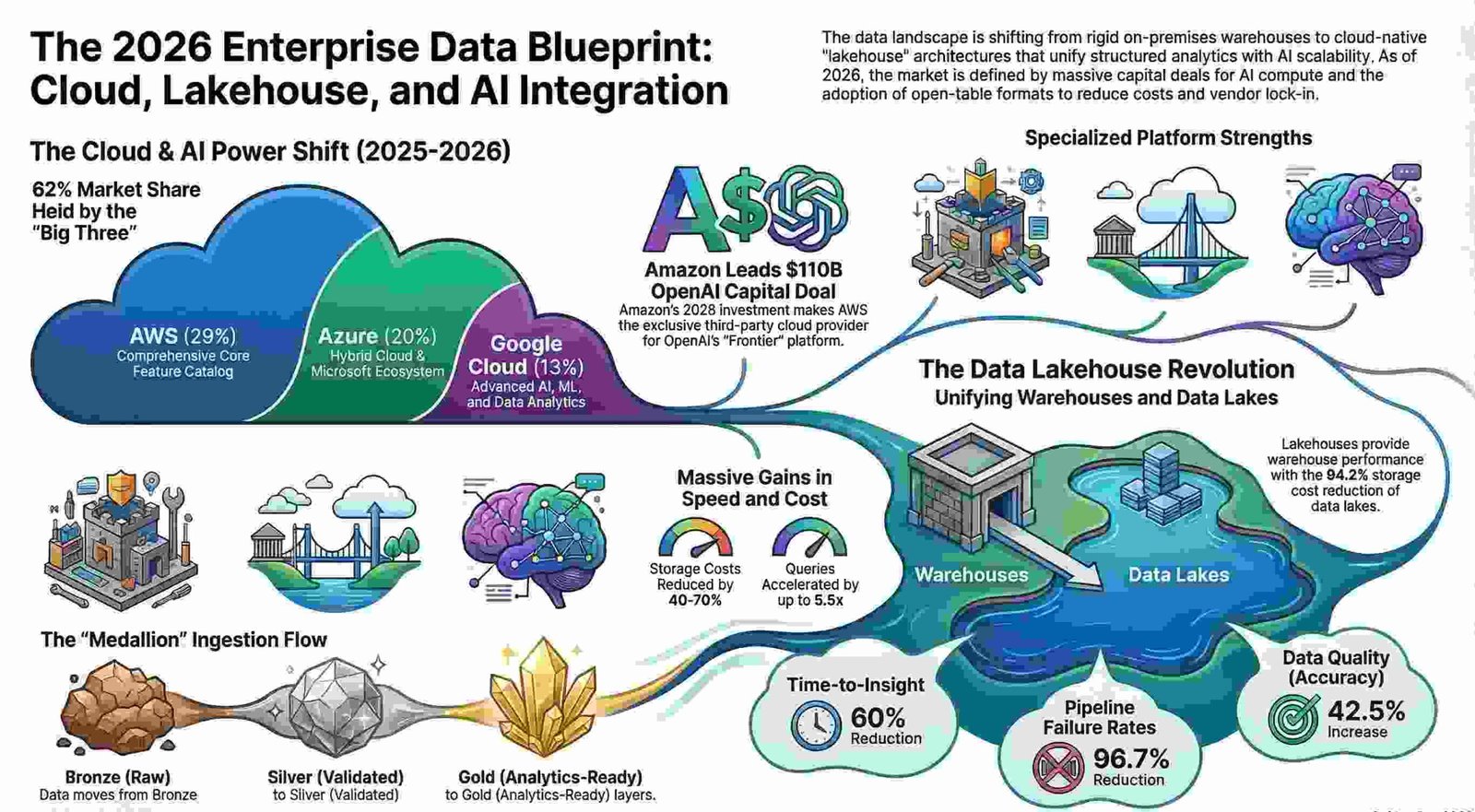
The traditional boundaries between the data warehouse and the data lake have not just blurred; they have been dismantled. We are witnessing a tectonic realignment driven by three converging forces: hyperscale Cloud infrastructure, generative AI, and the “Lakehouse” architecture. This evolution is transforming data from a dormant liability into a high-velocity engine for prediction, fundamentally shifting the cost-value equation for the 2026 landscape.

- The Surprise Partnership: Amazon, OpenAI, and the New Cloud Hierarchy
The most significant signal of this shift is OpenAI’s historic 110 billion capital and compute deal. This round—led by Amazon (50 billion), with $30 billion each from Nvidia and SoftBank—propels OpenAI’s valuation to roughly $840 billion. While OpenAI’s historical ties to Microsoft Azure are deep, the decision to name Amazon Web Services (AWS) as the exclusive third-party cloud provider for “Frontier,” its next-generation enterprise platform, represents a major shift in the “Big Three” hierarchy, where AWS, Azure, and Google Cloud already control 66% of the market.
This pivot is driven by the search for “Compute Sovereignty.” The deal secures two gigawatts of Trainium compute capacity and focuses on the joint development of a “Stateful Runtime Environment” on AWS Bedrock.
“We’re pushing the frontier across infrastructure, research, and products to make AI more capable, reliable, and broadly useful,” said Sam Altman, co-founder and CEO of OpenAI.
The strategic “Why” behind this partnership is the move toward stateful AI. While traditional models are “stateless”—resetting after every interaction—these new environments allow AI agents to retain memory and context across complex tasks. This is the technological catalyst that makes the $110 billion investment viable; without the ability to process data with such continuity, scaling to the next frontier of intelligence would be economically impossible.
- The Economic Miracle of the “Lakehouse”
To bypass the Data Swamp, enterprises are adopting the “Lakehouse” paradigm. This architecture is the economic engine of the AI era, merging the governance of a warehouse with the flexibility of a data lake. It utilizes a “staged ingestion” model to ensure that the 67.5% of data that previously went to waste is now refined into a strategic asset:
- Bronze Layer: The raw capture zone, preserving data provenance.
- Silver Layer: The validation zone, where standardized quality checks occur.
- Gold Layer: The refined, business-ready zone where high-fidelity models are deployed.
The financial impact is transformative. Organizations transitioning to this model report a 40–70% reduction in storage costs and query acceleration of 2.7x to 8.5x. Perhaps most critical for 2026 is the 96.7% reduction in data processing failures. By structured refinement, the Lakehouse ensures that the massive investments in AI are actually fueled by usable, high-integrity data.
- The Death of the Search Bar: How Metadata Became a Strategic Asset
For decades, the search bar has been a gravestone for enterprise intelligence. Data discovery has been a persistent bottleneck, with analysts traditionally spending more time finding data than analyzing it. The transition to automated metadata management has fundamentally inverted this reality.
The “Before vs. After” of data discovery illustrates this shift:
- Legacy Discovery: A manual ordeal averaging 7.3 days to locate and verify relevant datasets.
- Modern Discovery: Automated tagging and integrated business glossaries that reduce discovery time to 4.2 hours.
Metadata is no longer “data about data”; it is the map of the enterprise’s collective intelligence. By unifying metadata, 83.7% of surveyed companies achieved a positive ROI within just 15 months. This transition allows non-technical users to bypass IT queues, transforming metadata into the primary lubricant of organizational velocity.
- From Hindsight to Foresight: Predictive BI on the Dashboard
Business Intelligence is shedding its reactive skin. The goal has shifted from reporting on the past to predicting the future in real-time. This is made possible by integrating advanced algorithms like XGBoost directly into tools like Power BI and Tableau.
XGBoost has emerged as a powerhouse for big data, demonstrating “linear scale-up” efficiency even on 10TB datasets. By running these models directly on the Gold Layer of the Lakehouse, organizations eliminate the need for separate ML silos, allowing high-fidelity predictions to live directly on the executive dashboard.
The integration of predictive analytics into BI dashboards “transforms traditional reporting into an intelligent decision-making ecosystem,” allowing organizations to act on foresight rather than hindsight.
When paired with AWS Bedrock’s stateful environments, these dashboards don’t just show a forecast; they maintain the context of the business’s unique environment, enabling a proactive posture that was previously the domain of pure research labs.
- The “Lambda” Complexity Trap
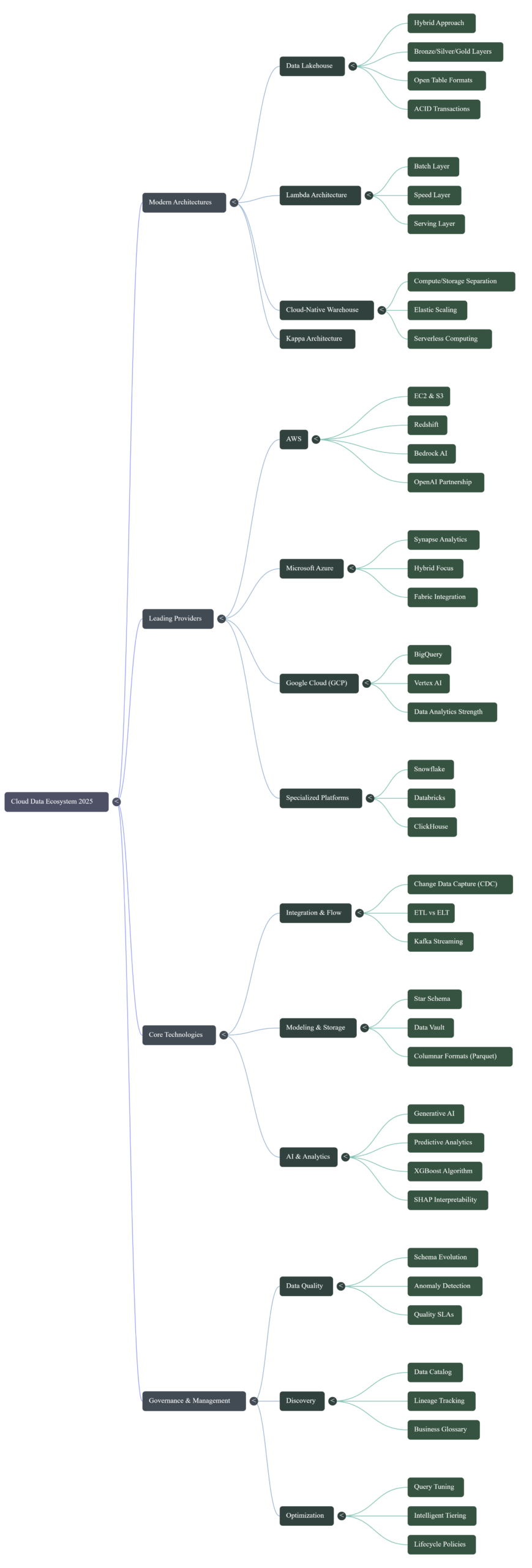
While the pursuit of speed is universal, the path is often blocked by the “Lambda Complexity Trap.” The Lambda architecture—splitting data into separate Batch and Speed layers—was once the standard for handling volume. However, in 2026, this is viewed as a hidden tax on innovation.
Maintaining two separate code bases that must be perfectly synchronized creates immense architectural friction and operational cost. Strategists are now streamlining toward the Kappa Architecture, a pure streaming approach that handles both historical and real-time data in a single path. In this high-stakes landscape, architectural simplicity has become a decisive competitive advantage.
- Conclusion: The Question of 2026
By 2026, the cloud has moved beyond its origins as a storage repository to become a massive, integrated compute-and-prediction engine. With 900 million weekly ChatGPT users and a cloud market projected to exceed $2.2 trillion, data is no longer “the new oil”—it is the new electricity. The OpenAI/Amazon deal is the construction of the grid itself.
As the Data Swamp recedes, the strategic mandate for leadership is clear. In an era where your competitors are predicting the future in real-time on their dashboards, can your organization afford to keep looking in the rearview mirror?
Discover more from TechResider Submit AI Tool
Subscribe to get the latest posts sent to your email.