The Hook: A Relatable Reality Check
For twenty years, the “Nigerian Prince” was the industry’s favorite punchline—a clumsily written ghost in the machine. In 2026, the joke is dead. The ghost has been replaced by an industrialized AI assembly line.

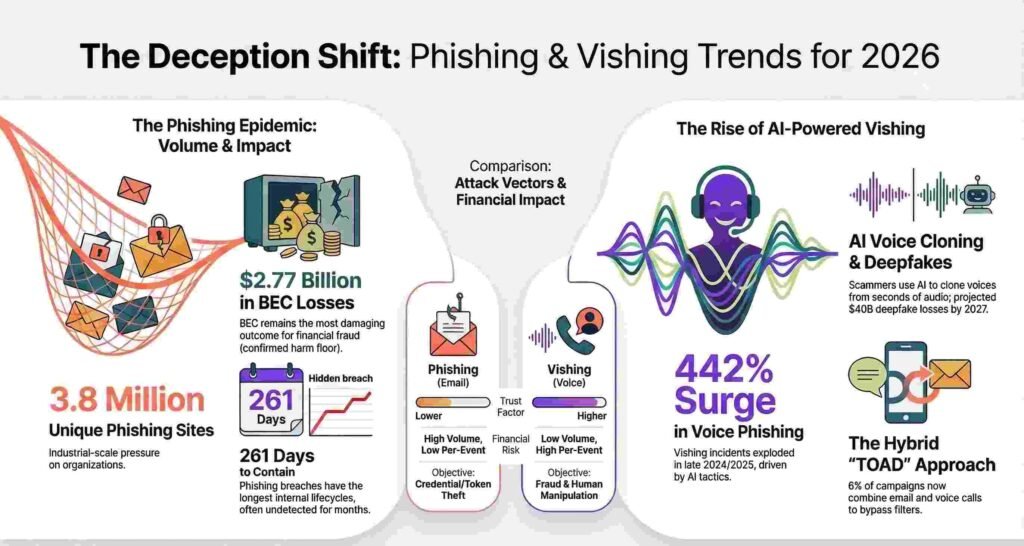
We are living in a high-stakes “trust economy” where your digital identity is the ultimate currency. Phishing is no longer a nuisance of misspelled emails; it is a professional enterprise operating at a scale that traditional defenses cannot touch. In 2025 alone, the Anti-Phishing Working Group (APWG) recorded 3.8 million unique phishing sites. This list distills the most volatile shifts in the threat landscape based on 2025-2026 data, revealing a reality where the “human firewall” is being bypassed by silicon-speed social engineering.
——————————————————————————–
MFA is No Longer Your Silver Bullet
For years, Multi-Factor Authentication (MFA) was the industry’s “silver bullet.” In 2026, that bullet has shattered. Attackers have industrialized Adversary-in-the-Middle (AiTM) Phishing-as-a-Service, turning a sophisticated hack into a subscription model for low-level criminals.
Operations like Tycoon 2FA act as a transparent proxy between the victim and the legitimate service. When you log in, the attacker’s server passes the traffic through to Microsoft or Google in real-time, effectively “proxying” the session. They don’t just steal your password; they capture the authenticated session token and cookie immediately after you provide your MFA code.
Technical Insight: The ClickFix Tactic Adversaries like Storm-1865 (impersonating brands like Booking.com) have introduced novel social-engineering tricks like “ClickFix.” Instead of a link, they present a fake browser error and trick the user into copying and pasting a malicious command into their terminal—effectively forcing the victim to hand-deliver the “backdoor” to their own machine.
In mid-2025, Tycoon 2FA alone accounted for 62% of all Microsoft-blocked phishing, generating over 30 million fraudulent emails in a single month. For traditional perimeter defense, this is “game over”: the attacker isn’t breaking in; they are walking through the front door using your already-verified identity.
——————————————————————————–
Your Boss’s Voice is the New Malware
The most visceral shift in the digital theater is the weaponization of the human voice. Driven by generative AI that can clone a specific “voice melody” from just seconds of audio, vishing (voice phishing) saw a staggering 442% surge between H1 and H2 2024. This trend has reached a fever pitch in 2026.
By 2027, deepfake-enabled fraud is projected to hit $40 billion in global losses. Attackers no longer need to exploit code when they can exploit the biological impulse to trust a familiar voice.
Real-World Impact: The Deepfake CEO Scam As documented by The Wall Street Journal, the CEO of a British energy company transferred $243,000 to an assailant after a call from his “boss.” The AI-cloned voice was so perfect it mimicked the boss’s specific accent and conversational rhythm, creating an overwhelming sense of urgency and authority that bypassed all standard verification procedures.
——————————————————————————–
Telephone-Oriented Attack Delivery (TOAD) is the Ultimate Trust Trap
The most successful modern attacks aren’t solo acts; they are hybrid “TOAD” campaigns. Attackers combine a bogus email (like a fake invoice) with a follow-up phone call to establish ultimate credibility.
This isn’t amateur hour. Syndicates like Scripted Sparrow operate at a terrifying industrial volume, sending approximately 6 million targeted emails per month that use spoofed reply-chains to inject fake invoices into real business conversations. By late 2023, 6.1% of all phishing campaigns utilized this multi-channel approach. Talking human-to-human remains the most effective way to bypass technical filters because it moves the attack into a medium where “security software” doesn’t exist: the phone conversation.
——————————————————————————–
Gen Z and Millennials are the New High-Risk Targets
There is a persistent myth that only seniors fall for digital scams. The data for 2026 tells a different story. Younger, tech-native men (ages 18-44) are frequently falling for vishing and mobile scams, often due to their high volume of digital payment transactions and comfort with messaging apps.
While the 60+ demographic remains the primary target for government impersonation, the “industrialized rotation” of scams ensures that every demographic has a specific vulnerability.
| Target Demographic | Primary Scam Type | High-Risk Platform |
| Seniors (60+) | Government Impersonation & Tech Support | Landline/Traditional VoIP |
| Gen Z / Millennials (18-44) | Digital Payment Scams & Mobile Fraud | WhatsApp / Telegram / SMS |
| Finance Executives | Deepfake Voice Clones & BEC Wire Transfers | Business Mobile / Teams |
| IT Administrators | OAuth Consent Phishing & Token Theft | Cloud Identity Portals |
——————————————————————————–
The Real Cost Isn’t the Click; It’s the 261-Day Cleanup
We must distinguish between “pressure” (attack volume) and “harm” (losses). A 4% drop in quarterly phishing attacks doesn’t mean safety; it means attackers are rotating their campaigns for higher ROI.
The true burden of phishing is the “silent aftermath.” According to IBM/Ponemon data, phishing-related breaches take an average of 261 days to identify and contain—the longest lifecycle of any attack vector. This dwell time exists because a successful phish is rarely a “smash-and-grab.” Instead, it is the “seed” for lateral movement, where attackers spend months moving through your network to plant ransomware or exfiltrate IP. Even if you halt a fraudulent $50,000 wire transfer, the forensics and containment costs can easily reach into the millions.
——————————————————————————–
The Forward-Looking Summary: Identity as the Perimeter
In 2026, we are shifting from “blocking links” to “verifying workflows.” When an email looks perfect and a voice sounds identical to your boss, technical filters have reached their limit.
“Zero Trust” can no longer be just a network policy enforced by a firewall; it must move from a software setting to a human habit. This means verifying every high-stakes request through secondary, out-of-band channels—every time, without exception.
A Final Thought: If you received a call from your CEO right now asking for an urgent $200,000 transfer to close a deal, would your first instinct be to obey—or to hang up and call them back on their verified office line?
Discover more from TechResider Submit AI Tool
Subscribe to get the latest posts sent to your email.