Summary Quick-View
Organizations today are drowning in data but starving for insight. We spend millions on collection and analysis, yet most teams fail to act on the right levers. The “data-driven” label has become a shield for mediocrity—a way to hide behind industry “best practices” while ignoring the messy reality of human psychology.

We’ve been taught to value brevity, chase “quick wins,” and trust playbooks that haven’t been updated in years. The data reveals a different story: many of these standards are actually holding us back from meaningful growth. To move people, you must understand the underlying mechanism of behavior, not just the surface-level metric.

Here are five surprising truths that challenge the traditional data-driven narrative.
——————————————————————————–
1. Why “Short and Sweet” is Killing Your Conversions
Conventional wisdom dictates that landing pages should be short to reduce friction. The assumption is that users won’t read. However, evidence from high-performing campaigns suggests the opposite: in one instance, a significantly longer landing page generated a 638% increase in leads.
The success of this shift relied on moving from a “Brand Value” proposition (focusing on the company) to a “Process-level Value” proposition (focusing on the experience of the interaction). Friction is a cost; anxiety is a barrier. You can increase the cost—page length—if you successfully lower the barrier. By using longer copy to frame a TeleAgent as a trusted advisor rather than a salesperson, the page reduced the user’s anxiety. The value of the information provided outweighed the friction of the scroll.
“Your marketing creative should not be based on ‘I’—the marketer. It should be based on ‘they’—the customer.”
2. The “What” is a Lie Without the “Why”
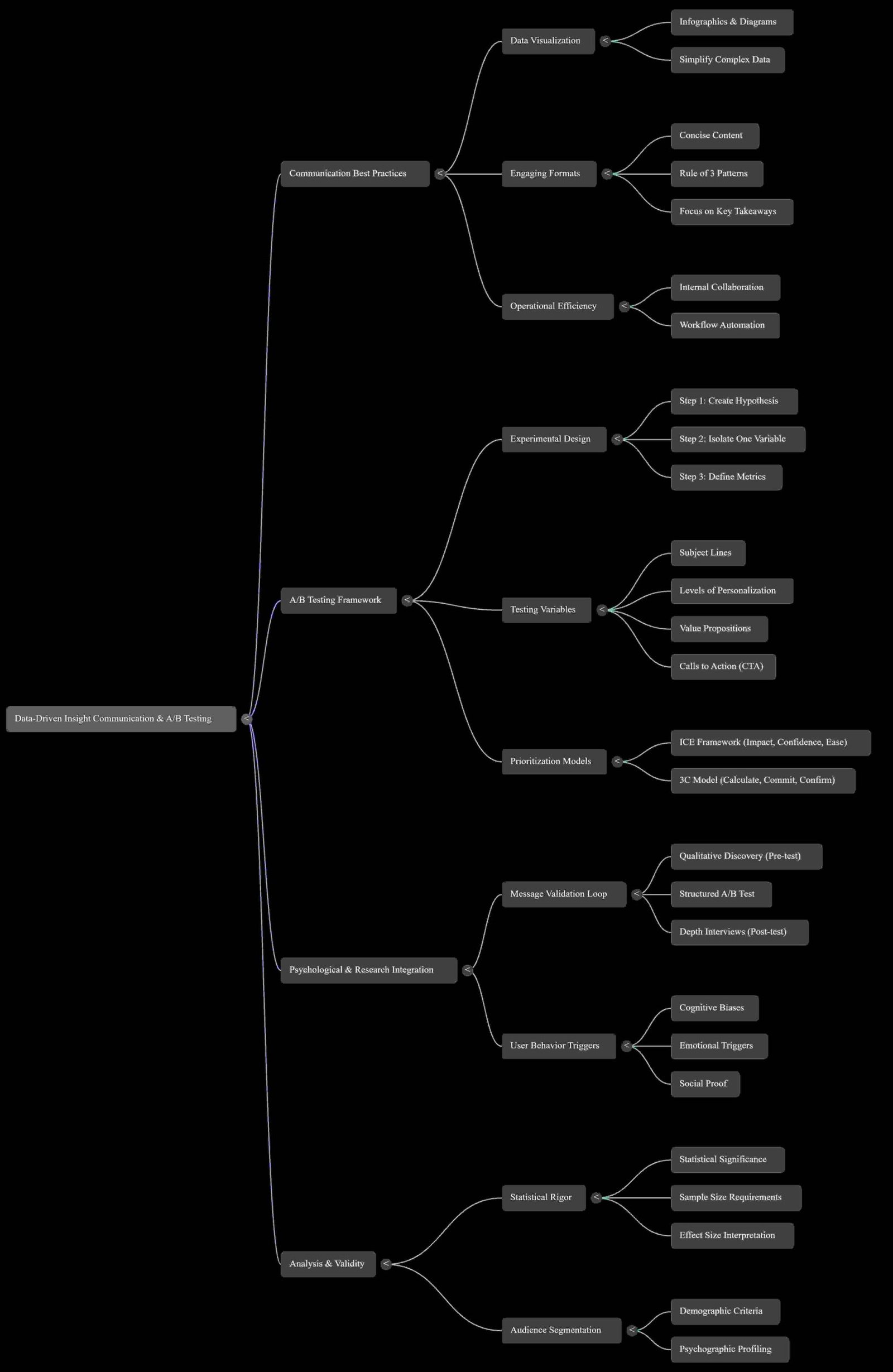
Standard A/B testing measures what happened, but it is notoriously poor at explaining why. Picking a winner based solely on behavioral proxies leads to “local optimization”—you might see a lift, but you haven’t built a repeatable knowledge base because you don’t understand the mechanism of success.
The antidote is the Message Validation Loop, a three-phase framework that integrates qualitative depth with quantitative scale:
- Qualitative Discovery (Pre-Test): Use AI-moderated interviews and 5-7 level laddering to uncover the motivational layers behind customer language.
- Structured A/B Testing: Run tests using variants grounded in the actual vocabulary inventory discovered in phase one.
- Post-Test Depth Interviews: Re-interview participants to identify the cognitive steps that connected the winning message to the action.
Without the “why,” every test is an isolated event rather than a strategic building block.
3. The Rule of 3: Our Brains Are Hardwired for Patterns
Internal data communication often fails because it is overwhelming. Flooding a team with spreadsheets results in data frustration rather than action. To ensure insights stick, lean into the Rule of 3.
Three is the smallest number required to form a pattern. Patterns are easier to digest and more memorable for a busy workforce. This rule is a staple of human narrative, visible in:
- Navigation and environment: Airport terminals.
- Digital product highlights: WaveApps benefit sections.
- Brand identity: Slogans and core presentation takeaways.
“Using the rule of 3 to communicate insights is effective because employees are given essential information in bite-sized, easy-to-understand pieces.”
4. Kill Your “Personal Playbook”
Many leaders rely on “personal playbooks”—the tactics that earned them a promotion six months ago. But in high-velocity markets, “best practices” are rarely universal and expire quickly once they become saturated.
Several common tactics have already passed their prime:
- Using “Quick question” as a cold email subject line.
- Referencing ROI in initial outbound reaches.
- Using slides during a discovery call.
Stop relying on static tips and adopt the Problem-Change-Expectation framework. For example: Problem: Low reply rates on evergreen sequences. Change: Testing Template A (asking for a meeting) against Template B (asking if they are interested in learning more). Expectation: Higher reply rates for Template B. The only truth is the data your own team generates by isolating a single variable.
5. Stop Prioritizing the “Easy” Wins
When faced with a backlog of ideas, most teams default to “Ease.” They run the tests that are simplest to launch, resulting in a roadmap of “quick wins” that feel like progress but rarely move the needle.
To break this cycle, use the ICE Framework (Impact, Confidence, Ease). Score each factor from 1 to 10 and calculate the average. To make this truly strategic, adjust the weighting based on your context:
- Weight “Ease” higher for new programs to build momentum.
- Weight “Impact” higher when under intense executive scrutiny.
This scoring model creates objective accountability and prevents the “HIPPO” (Highest Paid Person’s Opinion) from overriding the data.
——————————————————————————–
Conclusion: From Data-Heavy to Insight-Led
Data is only as valuable as the psychological understanding behind it. High-performing teams recognize that reducing anxiety is often more important than reducing friction, and that a “winner” in an A/B test is meaningless if you cannot explain the human mechanism that caused the lift.
As you audit your current roadmap, ask yourself: Are your “winners” based on lucky guesses in a vacuum of “ease,” or a repeatable understanding of your audience’s psychology?
Discover more from TechResider Submit AI Tool
Subscribe to get the latest posts sent to your email.