Summary Quick-View
1. Introduction: The Year the Network Became Invisible
In 2026, the telecommunications landscape has shifted from a race for signal bars to a battle for architectural dominance. The “coverage race” of the early 2020s has been decisively replaced by a “capability contest.” For the modern digital state, 5G Standalone (SA), Generative AI, and satellite-to-terrestrial convergence are no longer premium upgrades—they are the minimum requirements for infrastructure sovereignty. We are witnessing the rise of the “AI-Native Telco,” where the network is becoming a self-optimizing, intelligent environment. It is no longer a utility we connect to; it is an invisible, pervasive layer of the global economy.

2. The GCC’s “Fiber-Speed” Wireless Dominance
The Gulf Cooperation Council (GCC) has moved beyond terrestrial parity to establish a global performance ceiling that leaves traditional Western markets in its wake. This is the result of a “Strategic Spectrum Moat”—a deliberate policy of deep mid-band allocation and advanced user-plane engineering.
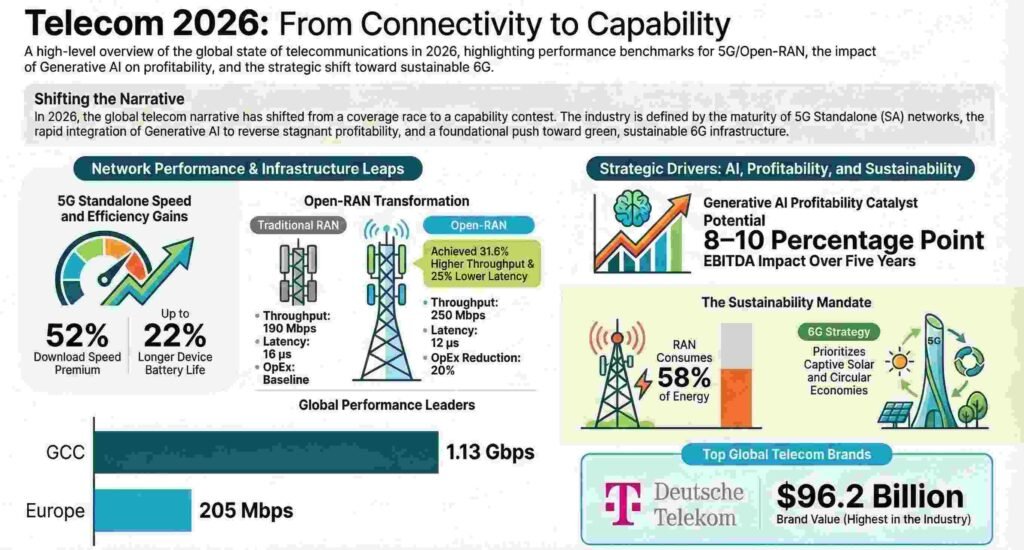
The United Arab Emirates (UAE) currently sets the gold standard with median 5G SA download speeds of 1.24 Gbps. By leveraging “four-carrier aggregation,” the GCC has effectively created a wireless experience that rivals full-fiber broadband. While the U.S. (404 Mbps) and Europe (205 Mbps) grapple with fragmented spectrum, the GCC has pivoted toward 5G Advanced to fuel its “Sovereign AI” ambitions.
The global 5G SA narrative in 2026 has shifted from a coverage race to a capability contest.
The gap is no longer about the number of towers, but about spectrum depth and the ability to support the high-compute demands of localized AI clusters.
3. The 5G SA “Battery Dividend”
A counter-intuitive reality has emerged in 2026: the network is now the primary driver of device longevity. The transition to 5G SA has eliminated the “dual-connectivity” overhead required by Non-Standalone (NSA) networks, which forced devices to maintain simultaneous 4G and 5G signals.
Data from the United Kingdom illustrates this shift: devices on EE’s 5G SA network show median battery discharge times 22% longer than those on NSA. Strategically, this is more than a consumer perk; it is a powerful churn reduction tool. By improving the Quality of Experience (QoE) through Voice over New Radio (VoNR) and lowering cloud latency (reaching 41ms in France), operators are securing user loyalty. However, a technical hurdle remains: while cloud latency has plummeted, gaming latency still struggles to match terrestrial fiber, creating a specialized niche for further network optimization.
4. Gen AI: The $100 Billion Profitability Engine
Generative AI is the catalyst reversing a decade of telco stagnation, projected to unlock nearly $100 billion in incremental value. However, a widening “Agility Gap” separates the leaders from the laggards. Strategic success now depends on which path an operator chooses in the McKinsey “Taker, Shaper, Maker” framework:
- Takers: Buy off-the-shelf SaaS solutions to automate summaries, reducing client interaction costs by 80%.
- Shapers: Fine-tune existing models with proprietary data to increase marketing conversion rates by 40%.
- Makers: Build foundational, telco-specific models to manage core network logic.
The strategic imperative is clear: telcos with dedicated in-house AI teams are deploying solutions in two weeks, while “Takers” remain bogged down in vendor requirements. The AI-Native Telco is not just automating tasks; it is redefining its margin structure.
5. Open-RAN’s Performance Paradox
Open Radio Access Networks (Open-RAN) have introduced a striking paradox into the infrastructure debate. While the promise of vendor diversity is being realized, it has introduced a hidden “interoperability tax.”
- The Technical Wins: Recent deployments show 31.6% higher throughput and 25% lower latency (sub-12 microseconds) compared to proprietary RAN.
- The Performance Secret: Gaps in multi-vendor protocol standardization can lead to 15–20% performance degradation if not meticulously engineered.
- The Security Reality: 68% of industry experts cite decentralized components as a critical vulnerability.
To counter these risks, the industry has shifted toward “Zero-Trust” security frameworks as the baseline for RAN Intelligent Controllers (RICs) and xApps, moving beyond simple encryption toward continuous, decentralized authentication.
6. India’s Leap toward “Green 6G” Sovereignty
India is bypasssing the traditional adoption curve, positioning the Bharat 6G Alliance as a pioneer in sustainable, indigenous infrastructure. Targeting 1 Tbps by 2030, India is framing its network expansion through the lens of a “Circular Economy.”
With the global sector facing a 62-million-tonne e-waste crisis, India’s strategy focuses on the remanufacturing of hardware to mitigate Scope 3 emissions. By deploying “Green Towers” powered by captive solar and wind energy in rural areas, India is ensuring that digital sovereignty does not come at an environmental premium. This is a move from catch-up to leadership, treating 6G as a matter of national economic resilience and environmental stewardship.
7. The Death of the “Dead Zone”: Satellite Convergence
In 2026, the distinction between cellular and satellite networks is finally “softening” into a single, unified fabric. The Direct-to-Device (D2D) paradigm has moved from emergency messaging to a standard feature for global operations.
This “Always On” reality is managed by AI in space. Modern constellations now utilize AI for autonomous mission planning and anomaly detection, allowing the network to adapt to terrestrial outages in real-time. As standard smartphones connect directly to Low Earth Orbit (LEO) satellites, the “dead zone” is becoming a historical relic. For enterprise and maritime industries, this ensures a resilient, autonomous supply chain that functions independently of terrestrial infrastructure collapses.
8. Conclusion: The Sovereign AI Infrastructure
The shift we are navigating is the transformation of the telecom provider into a guardian of “Infrastructure Sovereignty.” 5G SA and 6G are no longer mere speed upgrades; they are the foundational soil in which national AI ambitions are planted.
As the terrestrial and non-terrestrial divides collapse into a singular, intelligent environment, we must confront a final strategic question: How will we value “connectivity” when the distinction between a satellite, a cell tower, and a fiber line finally disappears? In 2030, the “carrier” may no longer be a provider of pipes, but the orchestrator of a global, invisible intelligence.
Discover more from TechResider Submit AI Tool
Subscribe to get the latest posts sent to your email.