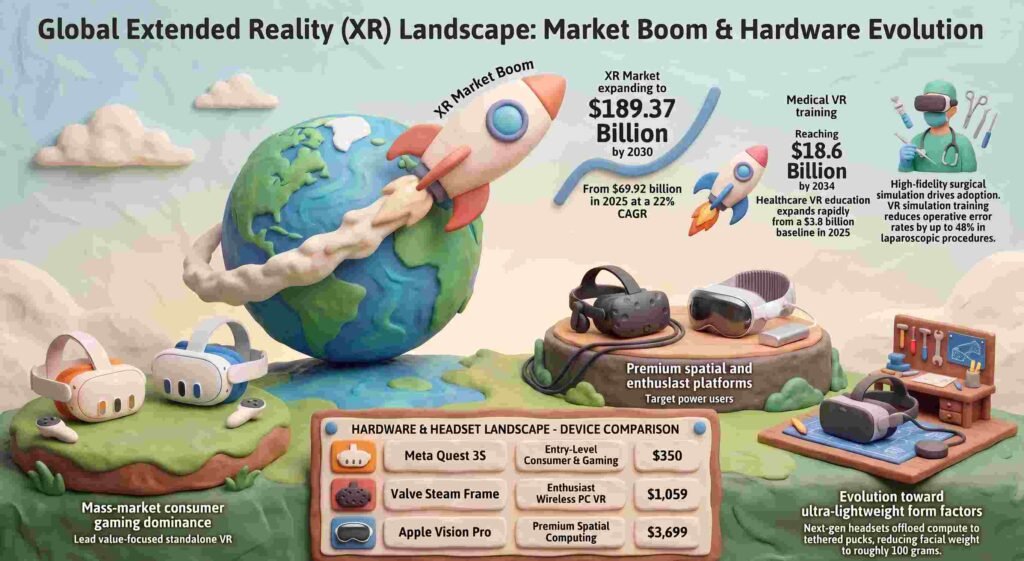
While the mainstream media’s obsession with speculative “metaverse” hype has visibly cooled off, extended reality (XR) and spatial computing have quietly transitioned into a massive commercial boom phase. Far from fading away, the market is demonstrating remarkable institutional momentum: the global AR and VR market is projected to expand from $69.92 billion in 2025 to $189.37 billion by 2030, representing a compound annual growth rate (CAGR) of 22.0%.
This expansion is no longer driven purely by novelty. Instead, it is being propelled by rapid enterprise digital transformation, cloud-based XR platforms, advanced optical waveguides, and targeted institutional implementations—including a virtual reality medical education sector that is alone forecasted to reach $18.6 billion by 2034.
Beyond the macro forecasts, the practical landscape of 2026 has yielded surprising competitive shifts, architectural redesigns, and societal pushback. Below are six of the most counter-intuitive, impactful realities shaping spatial computing today.
1. Paying 10x More Doesn’t Get You Better Gaming: The Apple Vision Pro vs. Quest 3S Paradox
In consumer hardware pricing, higher cost typically correlates with broader capability. However, the 2026 VR gaming market presents a radical paradox: spending ten times more on a headset can actually yield a significantly inferior gaming experience.
The M5-powered Apple Vision Pro, priced at $3,699, remains an absolute marvel of display engineering. Featuring micro-OLED panels delivering 3660×3200 resolution per eye alongside seamless eye and hand tracking, it reigns supreme as a luxury spatial computer for productivity and high-fidelity spatial media. Yet, because Apple designed the system without dedicated spatial controllers and maintains a thin catalog of dedicated VR games, it functions poorly as a dedicated gaming rig—even though visionOS 26 added support for PlayStation VR2 Sense controllers.
| Feature / Spec | Apple Vision Pro (M5) | Meta Quest 3 / 3S | PlayStation VR2 |
| Price Point | $3,699 | 350** (3S) / **599.99 (3) | $400 – $550 |
| Display Technology | Micro-OLED | LCD | Dual OLED (HDR) |
| Per-Eye Resolution | 3660×3200 | 2064×2208 (Quest 3) | 2000×2040 |
| Primary Controllers | Hand/Eye Tracking (PSVR2 Sense support) | Touch Plus Controllers | Sense Controllers (Adaptive Triggers) |
| Game Catalog | Thin / Productivity-First | 500+ Native + SteamVR | Exclusive PS5 Library + PC Adapter |
| Primary Function | Spatial Computing & Media | Immersive VR Gaming & Value | High-Fidelity Console Immersion |
Conversely, Meta’s ecosystem—anchored by the budget 350 Quest 3S and the 599.99 Quest 3—remains the undisputed value and gaming king. Supported by a robust native library of over 500 titles and frictionless access to PCVR via SteamVR, Meta’s lower-cost hardware continues to dominate user engagement. Meanwhile, for PlayStation 5 owners, Sony’s PSVR2 retains the immersion crown, offering dual OLED panels, HDR, a 110° field of view, foveated rendering, and haptics built directly into both the controllers and the headset itself.
“For gaming and value, the Quest 3/3S wins for almost everyone; the PSVR2 takes the immersion crown if you already have a PS5; and the Vision Pro is the most advanced of the three, but not the best one to actually play on.” — VR.one Hardware Analysis
2. The 100-Gram Paradigm Shift: Moving Compute Off Your Face and Into Your Pocket
Form-factor fatigue has long been the primary barrier to prolonged spatial computing use. Wearing 500+ grams of silicon, glass, and lithium-ion batteries on one’s face inevitably leads to neck strain and physical discomfort. To solve this, major hardware manufacturers are executing a sweeping architectural shift: decoupling the display from the processing unit.
Meta showcased this direction with the unveiling of Meta VR Glasses (developed under Project Phoenix and scheduled for a Spring 2027 launch at $1,299.99). The system slims the facial component down to approximately 100 grams of micro-OLED optical hardware. The heavy lifting—including the battery, storage, and processing unit—is offloaded to a ~300-gram pocket puck connected via a high-speed optical tether.
- Sleek Weight Distribution: ~100 grams on the face versus ~500 grams in traditional all-in-one headsets.
- Extreme Pixel Density: Micro-OLED optics achieve 37 pixels per degree (PPD) for ultra-sharp text and spatial media.
- Battery & Usage: Provides up to 3 hours of continuous battery life for media playback and sports streaming.
- Trade-Offs: Field of view narrows to 70° x 66° (compared to ~110° on standard headsets). Touch Plus controllers are sold separately, though existing Quest 3/3S controllers pair seamlessly.
Other industry contenders are rapidly embracing this modular approach. Leaks of Pico’s upcoming Space Pro (Project Swan) reveal a modular design featuring a 270-gram facial unit tethered to an external puck housing onboard Wi-Fi radios and secondary components, which recently cleared FCC testing ahead of its formal release.
3. Virtual Surgeons, Real Results: How VR Simulation Reduces Surgical Errors by Nearly 50%
While consumer spatial computing captures media headlines, the medical training sector is undergoing an institutional revolution. Driven by severe systemic workforce pressures, the global virtual reality medical education and training market—valued at 3.8 billion in 2025**—is projected to surge to **18.6 billion by 2034 (a 19.3% CAGR).
This rapid adoption directly addresses a looming global crisis: the World Health Organization estimates a worldwide shortage of 10 million healthcare workers by 2030. Aided by a 28% drop in average VR headset prices between 2022 and 2025, medical institutions are turning to high-fidelity, risk-free simulation to train surgical residents and clinical staff faster and at scale.
- 230% Performance Improvement: VR-trained surgical residents demonstrated up to a 230% improvement in surgical performance scores during laparoscopic procedure evaluations compared to traditionally trained peers.
- 48% Reduction in Surgical Errors: Clinical studies published in leading surgical journals confirm VR simulation training cuts error rates by 48% in laparoscopic cholecystectomies and 37% in total hip arthroplasty.
- 40% Faster Emergency Response: Simulated mass-casualty VR protocols cut emergency reaction times by 40%.
Modern surgical simulation platforms from companies like Osso VR and FundamentalVR are moving beyond pure visual immersion by embedding AI procedural engines. These analytics engines track over 200 real-time metrics per session—evaluating instrument precision, decision latency, and ergonomic posture—allowing residency programs to continuously verify procedural competency without risking patient safety.
4. Spatial Computing at Work: Saving $450k per Flight Review and Practicing Medicine on the High Seas
Enterprise adoption of spatial computing has matured well beyond exploratory pilot programs, delivering proven return-on-investment (ROI) across complex operational and location-based environments.
Aerospace Collaboration via Digital Twins
Global 3D software vendor Dassault Systèmes integrated its 3DLive platform with Apple Vision Pro, allowing engineering teams to interact directly with high-fidelity digital twins. In one documented aerospace case study, international teams across three continents collaborated inside a shared virtual workspace to evaluate an aircraft interior design—cutting project approval time in half while directly saving $450,000 in international travel and administrative expenses.
Scalable Location-Based VR
Scaling shared virtual reality for public cultural institutions has historically been bottlenecked by local network capacity. Excurio’s LBXR Pulse platform solved this by powering location-based VR experiences for up to 130 simultaneous users across concurrent virtual worlds. Deployed across 25 venues in 17 countries, the platform hosts immersive exhibits for major partners such as the Musée d’Orsay and Harvard University’s Giza Project.
Low-Bandwidth Maritime Telehealth
Delivering specialized medical care to more than 2 million seafarers and offshore rig workers has long been constrained by satellite speeds. Veyond Metaverse’s OceanMD platform delivers mixed-reality telehealth over satellite connections operating at speeds as low as 100 kbps. Onshore medical specialists wearing mixed-reality headsets can conduct real-time consultations and guide remote care far at sea. Demonstrating its commercial momentum, global aviation services company Medaire secured a five-year exclusive agreement in May 2026 to expand OceanMD telehealth to global civilian aviation.
| Organization / Platform | Operational Deployment | Quantified Enterprise Impact |
| Dassault Systèmes (3DLive) | Multi-continent aircraft interior engineering | 50% faster approval; $450,000 saved in travel costs |
| Excurio (LBXR Pulse) | Large-scale shared VR at Musée d’Orsay & Harvard | 130 simultaneous users across 25 global venues |
| Veyond Metaverse (OceanMD) | Mixed-reality telehealth for maritime & aviation | Operates over 100 kbps satellite link; serves 2M+ workers |
5. The Hardware Shakeup: Sony Pivots Away as Valve Triggers a Year-Long Backorder Queue
The competitive landscape of XR hardware has fractured into starkly opposing strategies: traditional consumer electronics giants are retreating, while hardcore enthusiast platforms face unprecedented demand bottlenecks.
Sony’s Hardware Pivot
In a major corporate consolidation, Sony sold dozens of its core XR hardware patents to Meta. The transaction signals an apparent strategic pullback from raw AR/VR hardware manufacturing, leaving Meta to consolidate fundamental intellectual property while doubling down on its infrastructure investments.
Valve Discontinues Index and Launches Steam Frame
Valve officially discontinued its iconic Index headset in October 2026, selling remaining standalone inventory at a discount. In its place, Valve launched the Steam Frame (1,059** for 256GB; **1,299 for 1TB). Powered by a Snapdragon 8 Gen 3 processor with 16GB of RAM and dual 2160×2160 displays, the 440-gram standalone headset runs SteamOS natively or streams from a PCVR rig.
Each Steam Frame kit includes Half-Life: Alyx and a dedicated Wi-Fi 6E wireless adapter, though Valve opted to omit an included wall charger (selling a 45W charger separately for $29). Consumer demand completely overwhelmed Valve’s production pipeline following its September release. Facing massive traffic, Valve instituted a randomized reservation waitlist. Queue notifications inform reservation holders that backorders stretch deep into 2027, proving that intense appetite exists for high-end, open-ecosystem PCVR hardware.
6. The Privacy Pushback: Why European Nations Are Re-Evaluating Smart Glasses in Public
As camera-equipped and audio smart glasses transition into stylish, lightweight consumer accessories, societal friction regarding public privacy and surveillance has reached a critical tipping point.
A massive wave of consumer smart glasses has hit retail shelves in late 2026, introducing varied form factors across price tiers:
- Ray-Ban Meta Audio ($349): Camera-free, focus on open-ear spatial audio and AI voice interactions.
- Snap Specs ($2,195 – $2,395): AR developer glasses featuring an optional cellular charging case tier.
- XREAL AURA ($1,279 – $1,499): High-end AR glasses powered by Android XR with a custom compute puck.
- Samsung Intelligent Eyewear: Display-free smart glasses developed with Gentle Monster and Warby Parker, which cleared 11 frame models at the FCC ahead of a November release.
While consumers embrace AI spatial audio and hands-free video capture, European regulatory bodies are taking defensive measures. Citing acute privacy risks regarding covert recording and unannounced facial video capture in public spaces, Norway officially proposed a temporary ban on smart glasses in public locations. This regulatory friction marks the beginning of an intense legal debate over wearable cameras in public life across Europe.
Where Do We Go From Here?
The spatial computing narrative in 2026 is defined by pragmatic utility over speculative metaverse abstraction. The sector has shed its identity as a novelty gaming niche, recasting itself as an indispensable productivity tool across aerospace engineering, high-seas maritime logistics, and high-stakes clinical education.
As hardware vendors split heavy all-in-one headsets into lightweight facial displays and pocket-sized compute pucks, spatial technology is slowly blending into daily professional workflows. The hardware is becoming lighter, the specialized software ecosystems are maturing, and the operational return on investment is undeniable.
As these modular hardware designs take center stage, everyday users face a fundamental trade-off: Would you be willing to give up a wide field of view for a featherweight, 100-gram display on your face in your next personal computing device?
Discover more from TechResider Submit AI Tool
Subscribe to get the latest posts sent to your email.