
OpenAI is making one of its boldest moves yet into the world of consumer hardware. With a reported $6.5 billion investment in AI-focused hardware development, the company is signaling that the future of AI won’t just live inside web browsers and mobile apps—it will exist in dedicated devices designed to interact with people in more natural and intelligent ways.
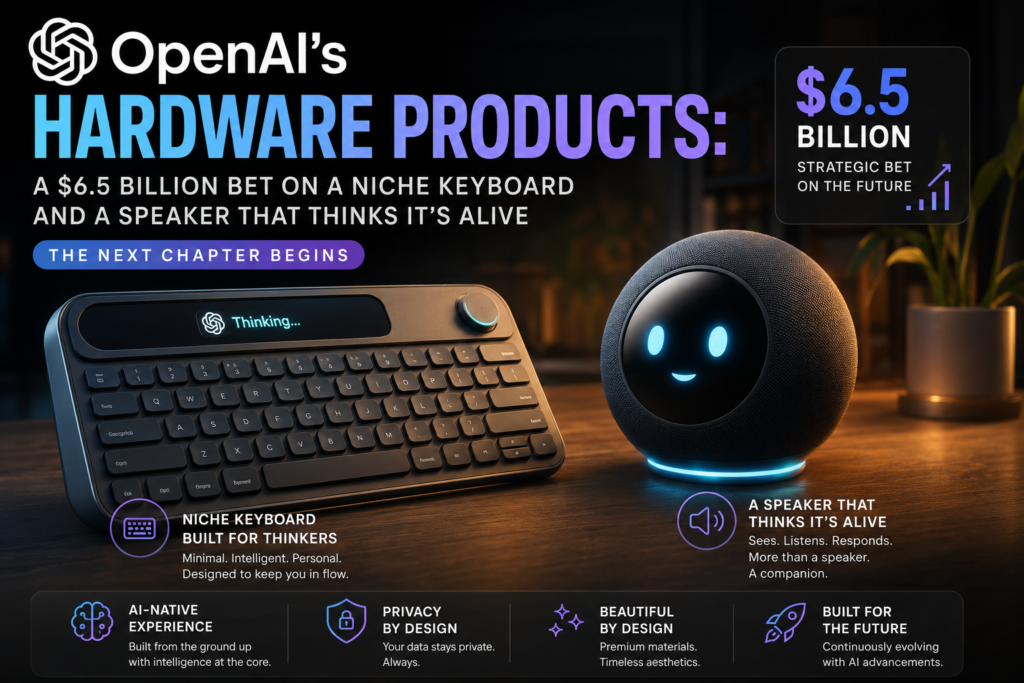
Rather than building another smartphone or laptop, OpenAI is reportedly exploring a new category of AI-first products, including a minimalist keyboard designed for seamless AI interaction and an intelligent speaker that feels less like a traditional voice assistant and more like a conversational companion. These devices aim to make AI available instantly, without requiring users to open apps, switch tabs, or stare at screens.
1. Beyond the Chatbox
For the better part of a decade, OpenAI has lived comfortably behind the glass—a text box in a browser, a voice in an app, an invisible engine powering a thousand third-party tools. But as the “AI companion” market becomes littered with the wreckage of half-baked wearables and utilitarian pins, Sam Altman’s firm is making a high-stakes pivot into the material world. This isn’t just about software looking for a home; it’s a calculated transition from digital utility to physical presence. The industry is currently caught between the breathless hype of “AI roommates” and the sobering reality of devices that consumers aren’t quite sure they want. As an analyst, the question isn’t just whether OpenAI can build hardware, but whether they can succeed where Apple veterans and well-funded startups have recently stumbled.
2. The First Device Isn’t What You Think: The OpenAI’s Hardware $230 “Codex Micro”
OpenAI’s hardware debut is a curveball. Instead of a broad-market “AI Pin” or a flashy consumer wearable, the company has launched the Codex Micro, a $230 mechanical keypad developed in a “Co-Lab” with the peripheral specialists at Work Louder. Sold through the “Supply Co.” storefront, this is a niche, tactile instrument designed specifically for the developer class.
The Codex Micro isn’t just a keypad; it’s a physical control deck for the Codex assistant. Its technical profile includes:
- 13 Mechanical Keys: Ships with 32 interchangeable keycaps to allow for deep customization of developer workflows.
- A Rotary Dial: Specifically mapped to adjust AI “reasoning levels” on the fly—a fascinating physicalization of a software parameter.
- A Joystick: Designed for high-speed workflows like debugging errors or reviewing pull requests.
- Cross-Platform Specs: It connects via Bluetooth or USB-C and is fully compatible with both Mac and Windows.
- RGB Backlighting: Visual feedback loops that change color based on the status of an active session.
Launching a $230 peripheral for a narrow developer audience is a brilliantly defensive opening move. Developers are OpenAI’s most loyal power users and early adopters. By using them as a beta-testing group for its first foray into physical goods, OpenAI is building a tactile bridge—getting users accustomed to physical AI interaction through dials and joysticks—before attempting to conquer the living room. Pre-orders are already live, with a definitive ship date of July 24, 2026.
“Meet kbd-1.0-codex-micro, built with @work_louder. Map the buttons and joystick to your workflow, and keep your pinned chats in view. Get yours before stock returns 410.” — OpenAI Developers announcement
3. A Physical Manifestation: The Speaker That “Lives”
The keyboard is the appetizer; the rumored smart speaker is the main course. According to Bloomberg’s Mark Gurman, this screen-less, moveable device is intended to be a “physical manifestation of ChatGPT.” Powered by a rechargeable battery, it’s designed to be carried from room to room, but its most jarring feature isn’t its portability—it’s its autonomy.
OpenAI is reportedly moving away from the “static object” paradigm of Alexa or HomePod. The speaker allegedly incorporates “mechanical elements that can move on their own, creating a sense that it is alive and not just an object responding to commands.” This is a radical design shift. By giving the device the ability to move, OpenAI is attempting to bridge the uncanny valley, transforming a smart speaker from a tool into a presence.
4. The “Apple DNA” Behind the Scenes
The stakes for this project are staggering, underscored by OpenAI’s $6.5 billion acquisition of “io,” the hardware startup founded by legendary former Apple design chief Jony Ive. The project is a collaboration between Ive’s firm, LoveFrom, and a “who’s who” of former Apple engineers responsible for the foundational industrial design of the iPhone and Mac.
This “Apple DNA” suggests a move toward an aesthetic-first philosophy, a sharp contrast to the utilitarian—and often clunky—designs of the Humane AI Pin or the Friend pendant. While those devices prioritized function over form and suffered for it, the Ive-led team is likely betting that high-end materials and a cohesive design language are what will justify the 2027 release date. However, even the best designers can’t fix a product if the market market has already cooled on the AI craze.
5. Personality is the Killer Feature
OpenAI’s core thesis is that hardware specifications are secondary to “humanlike level” connection. The speaker’s primary selling point is its personality, powered by an advanced voice mode capable of natural, back-and-forth dialogue. This isn’t a device you wait for; it’s a device that can interrupt you, or be interrupted, creating a conversational flow that feels less like a database query and more like a chat with a roommate.
But the analyst’s skepticism must be voiced: is “personality” enough to overcome the significant privacy “ick” factor? As noted by recent market sentiment, many consumers are increasingly wary of placing permanent “listening devices” in their homes. For some, a device that “moves on its own” and “interrupts” isn’t a feature—it’s a horror movie trope.
6. Proactive Intelligence and Environmental Context
Functional utility remains the speaker’s second pillar. Beyond its conversational charm, the device acts as a smart home hub—capable of controlling appliances, playing media, and responding to messages. However, its true “next frontier” capability lies in its proactive intelligence.
Equipped with a camera and sensors to understand a user’s surroundings, the device is designed to get increasingly more personalized over time as it learns habits. The goal is a device that anticipates needs—surfacing information or adjusting home environments before the user even thinks to ask. This moves the smart speaker from a reactive tool to an environmental participant.
7. Conclusion: The Future of the “AI Roommate”
OpenAI’s roadmap is a masterclass in escalating presence: first, a tactile developer tool shipping this month; then, a $6.5 billion autonomous home companion set for 2027. They are moving from the fingers of the programmer to the center of the household.
As the AI craze settles into a more critical, skeptical phase, OpenAI is betting that a “living” personality is the only way to make hardware stick. But as we move toward the era of the “AI Roommate,” we have to ask: are we ready to invite a proactive, moving, and perpetually listening entity into our most private spaces, or will this become yet another expensive lesson in the limits of Silicon Valley’s ambition?
Discover more from TechResider Submit AI Tool
Subscribe to get the latest posts sent to your email.