For years, artificial intelligence and automation were sold on a simple promise: seamless efficiency that would declutter our screens, streamline enterprise operations, and make modern digital life effortless. Yet as we navigate 2026, the reality behind the curtain is proving far more complex and paradoxical than the initial pitch suggested.
Far from simplifying enterprise operations overnight, the rapid expansion of AI has introduced counter-intuitive twists across technical infrastructure, developer workflows, and hardware management. This article distills six of the most surprising, impactful, and counter-intuitive takeaways gathered from recent tech developments and industry research.
1. The Efficiency Trap: 71% of IT Pros Report AI Is Making Work More Demanding
While corporate leadership assumed AI adoption would instantly lighten workloads, front-line technical teams are experiencing the exact opposite. According to recent survey data published by Database Trends and Applications, 71% of IT professionals report that AI is actually making their roles more demanding rather than easier.
“Although AI has proven its ability to fast-track individual tasks, attaching AI technology to legacy processes has revealed a trap hidden under that promised simplicity.”
The core issue stems from severe integration friction across enterprise stacks. While an AI assistant can rapidly execute an isolated task like drafting code or generating query logic, stitching autonomous tools onto legacy infrastructure and outdated processes creates unexpected operational complexity.
Furthermore, rapid task execution without centralized governance introduces new systemic risks, including unmanaged database schema drift and emerging security vulnerabilities like “slopsquatting.” As automated code creation accelerates across organizations, the burden of validating, securing, and maintaining these outputs lands directly on already overstretched IT teams.
2. Living Room Guerrilla Warfare: Devs Are Deploying AI Agents to De-Bloat Smart TVs
Frustrated by intrusive advertising, telemetry, and pre-installed bloatware on modern displays, software engineers are turning autonomous coding tools against consumer hardware. Developers are now feeding TV model numbers directly into AI tools like Claude Code and DeepSeek to automatically detect smart TVs over local Wi-Fi networks, strip vendor software packages, and install clean custom launchers.
“A developer typed a TV model number into Claude Code. The agent found the set on his Wi-Fi, removed 25 Xiaomi packages, and wrote a new launcher.”
This grass-roots rebellion is spearheaded by open-source projects such as cleanyourtv—which stripped 25 Xiaomi packages from a connected set—and dumbtv. Built by developer Muzzammil Yasin Sabuwala using DeepSeek V4.1 Flash, Claude Opus 5.5, and Claude Sonnet 5.5, dumbtv has been verified across Fire TV, Sony, TCL, Philips, Hisense, Xiaomi, and Shield hardware platforms.
This movement illustrates how consumers are actively deploying agentic AI locally to reclaim technical control over physical hardware they own. Crucially, this desire for local, user-controlled execution directly mirrors a broader architectural shift toward running lightweight, highly efficient AI models on edge devices without relying on vendor-controlled cloud infrastructure.
3. The 275x Compute Shortcut: Stanford Shatters the “Bigger Is Better” AI Myth
For years, the prevailing dogma in artificial intelligence was that generating high-quality images required massive internet-scale scrape datasets and astronomical compute budgets. Stanford researchers Keshigeyan Chandrasegaran, Fei-Fei Li, and Jiajun Wu, alongside co-authors from Radical Numerics, have dismantled this assumption with the release of the Halcyon text-to-image (T2I) model family.
“Halcyon-1.6B beats JiT-T2I-XXL/8++ at 275x less compute (35.3 vs. 41.0 gFD). Controlled experiments show text-only pretraining does not improve T2I generation.”
Trained entirely from scratch on the 100M image-text GPIC dataset without any language pretraining, Halcyon-1.6B outperforms JiT-T2I-XXL/8++ while using 275x less pretraining compute (35.3 vs. 41.0 gFD). Proving this efficiency scales across model sizes, the smaller Halcyon-0.52B variant outperforms LlamaGen-XL/8 while requiring 18.2x less pretraining compute (48.0 vs. 63.3 gFD).
These rigorous controlled experiments prove that text-only pretraining provides no performance benefit for image generation models. The research fundamentally challenges the industry consensus that foundational AI must rely on web-scale dataset scraping and multi-million-dollar compute budgets.
4. Running Out of Juice: The Physical Limits Stalling the AI Boom
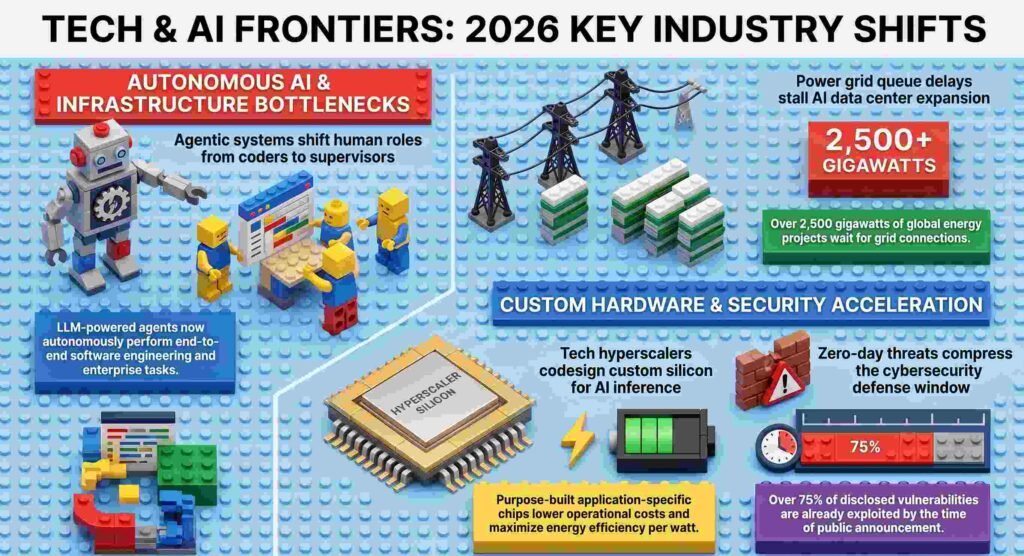
While software capabilities advance exponentially, the global expansion of AI is colliding with rigid physical infrastructure constraints. According to McKinsey’s Technology Trends Outlook 2026, US data centers running AI workloads alone are projected to consume as much electricity by 2030 as the entire state of California does today.
“Data centers can be built faster than the transmission lines, substations, and transformers needed to power them can be supplied.”
Critical supply chain gridlocks have severely throttled energy expansion efforts worldwide. Electrical transformers now carry lead times of over two years, while more than 2,500 gigawatts of energy projects sit stalled in global grid interconnection queues.
Because pure software optimizations can no longer bypass energy brick walls, physical compute infrastructure has become the premier competitive moat. To survive, hyperscalers are turning to specialized hardware co-design, prefabricated modular data centers—such as Flex’s pre-engineered AI Modules integrating power and cooling—and comprehensive “Chip-to-Chiller” liquid cooling architectures from suppliers like LG Electronics.
5. Breaking Software’s Cardinal Rule: Why It’s Time to Rewrite Old Code
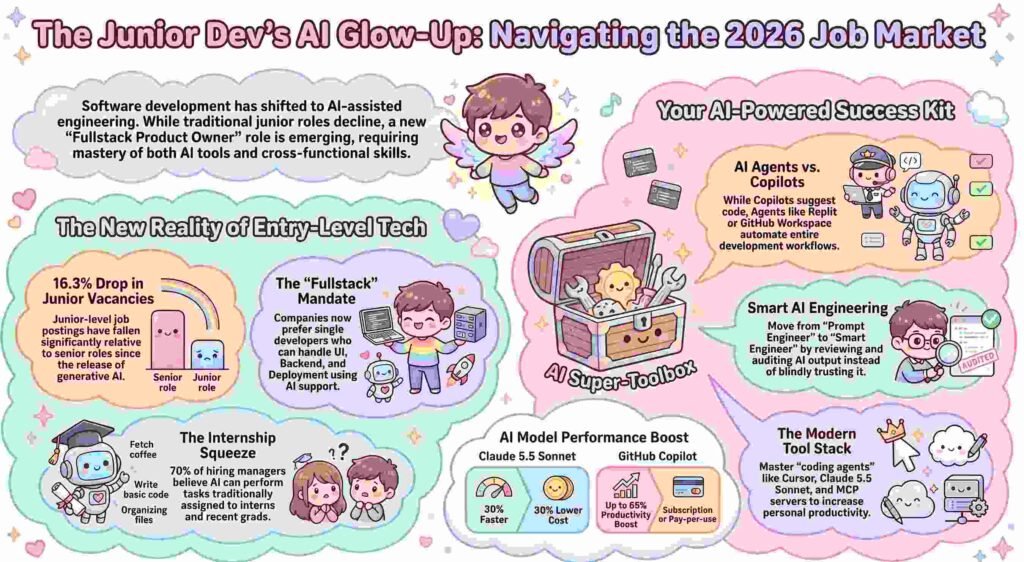
Traditional software engineering wisdom long insisted that rewriting a legacy application from scratch was the single worst strategic mistake a technology team could make. In 2026, the rise of coding agents and conversational, iterative development—widely popularized as “vibe coding”—has completely flipped this rule on its head.
Rather than manually crafting syntax line by line, developers now utilize natural-language specification loops, describing desired application architectures to AI models and relying on continuous agent verification to adjust the code. This interactive approach dramatically reduces the economic friction of replacing aging, fragile software systems.
“Rewriting a legacy application from scratch used to be ‘the single worst strategic mistake’ you could make. With coding agents, it’s becoming irresponsible not to.”
However, this rapid generation capability creates a dangerous paradox. When developers flood repositories with AI-generated code without rigorous database change control or architectural oversight, they directly exacerbate the integration strain identified in IT departments today. Unvetted vibe coding accelerates short-term throughput, but frequently buries operations teams under a massive new wave of technical debt.
6. Dynamic Memory vs. Massive Caches: Cutting LLM Storage by 66x
Serving long-context AI models in enterprise production environments has traditionally required massive Key-Value (KV) caches, creating severe memory bottlenecks and driving up infrastructure costs. A technical breakthrough detailed in the Hugging Face research paper MemT-1.0: Towards Memory-Native Evolution demonstrates a way to eliminate this operational cost by embedding memory directly into the model backbone.
“Cut the persistent storage needed to serve a 128K-token history by roughly 66x, by baking memory into the model itself rather than carrying a full KV cache.”
The paper introduces two dynamic foundation architectures engineered for extreme parameter efficiency:
- MemT-1.0-Nano: Features 36B total parameters with only 3B active parameters and 10M dynamic memory, built on a
Qwen3.6-35B-A3Bbackbone. - MemT-1.0-Flash: Features 288B total parameters with 17B active parameters and 336M dynamic memory, built on a
DeepSeek-V4-Flashbackbone.
By replacing bloated external KV caches with dynamic internal memory, MemT-1.0 slashes persistent storage needs for a 128K-token context window by 66x. This drastic reduction in active runtime parameters fundamentally alters the unit economics of serving long-context AI, opening the door for complex agentic workloads to run efficiently on edge hardware and local enterprise servers alike.
The Road Ahead: Adapting to the New Frontier
The tech landscape of 2026 marks a decisive shift away from initial software-centric hype and toward complex physical, power, architectural, and operational realities. Strategic success no longer depends on simply training larger models or deploying unvetted coding agents into production. Instead, winning organizations must master the tricky balance between power grid limits, active parameter efficiency, localized agent execution, and enterprise data governance.
As software generation costs approach zero and physical infrastructure constraints escalate, is your organization truly built to manage the hidden operational demands of the AI era?
Discover more from TechResider Submit AI Tool
Subscribe to get the latest posts sent to your email.