
1. Introduction: The Efficiency Paradox
The era of “growth at all costs” has been unceremoniously replaced by the “Rule of 40.” In this new regime, a SaaS company’s combined growth rate and profit margin must meet or exceed 40% to be considered healthy. However, as the market prepares to swell to a projected $315–320 billion in 2025, a systemic breakdown is occurring within the internal mechanics of software growth.
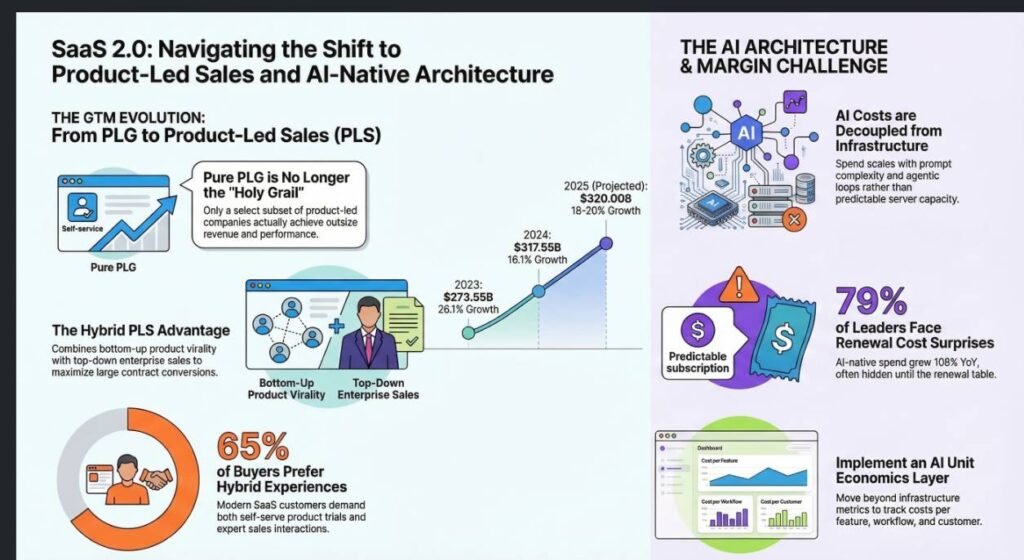
We are currently witnessing the Efficiency Paradox: while AI was promised as a tool for radical cost reduction, 61% of IT leaders have actually been forced to cut planned projects over the last 12 months due to “unplanned price increases.” The very technology meant to save the budget is, through its current delivery models, frequently cannibalizing it.
2. The “Death of the Seat” and the Decoupling of Cost from Portfolio Size
The traditional per-user or per-seat licensing model—the foundation of SaaS predictability for two decades—is rapidly becoming a relic. Driven by the AI gold rush, vendors are aggressively pivoting toward hybrid and consumption-based models utilizing credits, tokens, and capacity.
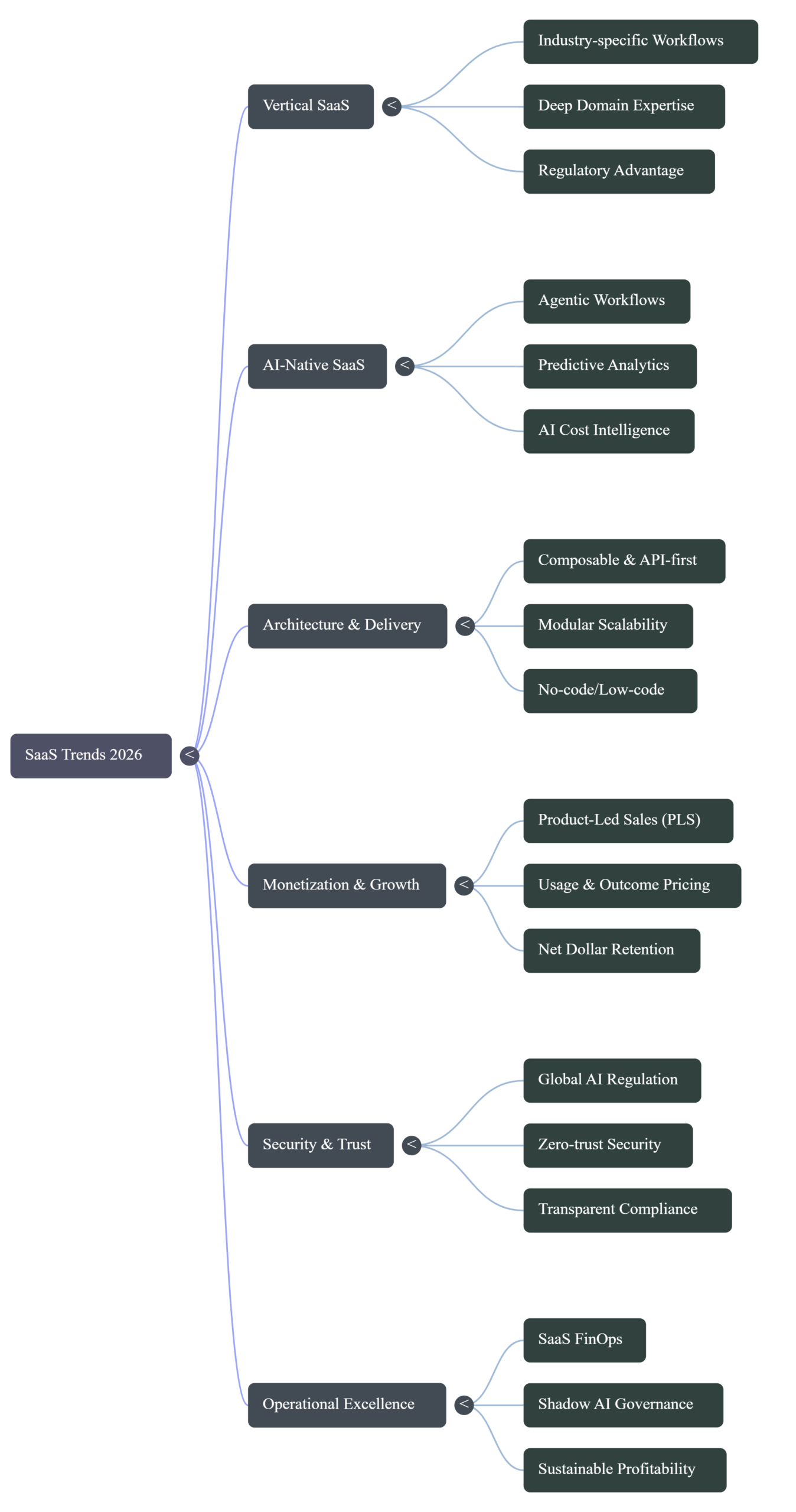
This shift has resulted in a radical decoupling of portfolio size and total cost. For the first time, spend is increasing while the number of apps remains stagnant. Data shows that while average SaaS portfolios remained virtually flat (falling by a marginal 0.1%), total spending rose by 8%. In large enterprises, spend on AI-native applications surged by nearly 400% YoY. Because costs now scale with runtime usage rather than headcount, 78% of IT leaders were hit with unexpected charges in the last year.
“By 2028, pure seat-based pricing will be obsolete as AI agents rapidly replace manual repetitive tasks with digital labor, forcing 70% of vendors to refactor their value proposition into new models.” — IDC/Forbes
3. The PLG Paradox: From Pure Adoption to Product-Led Sales (PLS)
Product-Led Growth (PLG) has long been marketed as the ultimate strategy for efficient scaling. However, recent McKinsey research suggests that pure PLG is underperforming for the majority of the market. Average-performing PLG businesses spend significantly more on operating expenses than their sales-led peers for only marginal performance gains.
The actual winners are those adopting a Product-Led Sales (PLS) hybrid model. This approach merges bottom-up user adoption with top-down enterprise negotiation. The strategic bridge in this model is the Product Qualified Account (PQA). Unlike traditional leads, PQAs are identified through product usage analytics—scoring accounts that have already experienced value through freemium or trial tiers—allowing sales teams to target “landings” rather than just “landing big.”
Success in 2026 requires what McKinsey describes as “simultaneously going bottom-up with individual developers and top-down with technology executives.”
4. The Margin Trap: Navigating AI Unit Economics
There is a massive distinction between “AI-augmented” SaaS (adding a chatbot to an existing tool) and “AI-native” SaaS (where AI is the core execution logic). For the latter, architecture is a margin decision.
The “architectural margin-killer” is that costs now scale with runtime behavior rather than predictable infrastructure. Specifically, three “agentic multipliers” drive this cost volatility: loops (autonomous multi-step tasks), retries (repeated execution upon failure), and memory (expanding context windows and token usage over time).
To protect margins, I recommend two critical architectural shifts:
- Central Orchestration Service: Move orchestration logic out of the application code and into a dedicated gateway. This allows for multi-model routing (using cheaper models for simple tasks and premium models only when needed) and centralized cost governance.
- Isolated Tenancy Models: High-performing teams share the model access layer across tenants but isolate retrieval indexes and vector databases per tenant. This prevents “noisy neighbor” scenarios where one power user’s complex retrieval depth thins the margins of the entire customer base.
Teams must track AI Unit Economics via four essential metrics: Cost per Feature, Cost per Workflow, Cost per Customer, and Cost per Outcome.
5. High-Stakes Shadow AI: The New Budgetary Landmine
Shadow IT has mutated into Shadow AI, and the financial “blast radius” is expanding. While fewer individual employees are expensing software overall, the amount of expensed spend has skyrocketed by 267% YoY, led almost entirely by ChatGPT and similar LLM tools.
This explosion is driven by a massive shift in procurement power: Lines of Business (LOBs) now control 81% of total SaaS spend, while IT’s share has hit an all-time low of 15%. This decentralization has created a catastrophic blind spot. When 81% of the budget is managed outside the central IT command, visibility into data governance, risk, and cost becomes nearly impossible. Total visibility into AI usage is no longer just a “nice-to-have” for IT—it is the only way to prevent a total loss of portfolio control.
6. From Software-as-a-Service to Service-as-a-Software
The value proposition is shifting from providing a tool to providing a finished result. In this “Service-as-a-Software” model, customers buy outcomes (e.g., “accounting as a service” where AI does the work and humans merely verify) rather than access.
This transition is being accelerated by the rise of Voice-First B2B Interfaces and composable architectures. By 2026, we expect SaaS interfaces to be navigable entirely by voice, allowing for hands-free B2B workflows. Simultaneously, “API-first” microservices—best-of-breed tools for payments, authentication, and messaging—are replacing monolithic “walled gardens,” allowing enterprises to swap in new AI capabilities without a total system rewrite.
7. Conclusion: Building a “FinOps” Culture for SaaS
As we approach 2026, the baseline for survival is “renewal discipline” and real-time cost management. The goal is no longer just “consolidating sprawl” but restoring predictability to the financial roadmap. Organizations must adopt a FinOps operating model, where consumption is monitored in real time and automated alerts trigger before a consumption-based renewal becomes a budgetary crisis.
The market has shifted. As AI agents begin to replace digital labor, will your current pricing model—and your current architecture—survive the transition from selling “access” to selling “outcomes”?
Discover more from TechResider Submit AI Tool
Subscribe to get the latest posts sent to your email.

