In the history of machines, 2025 will be remembered as the year of the stumble—but 2026 will be remembered as the year the pavement began to smoke. On April 19, 2026, at the second Humanoid Robot Half Marathon in Beijing’s E-Town, the mechanical student officially overtook the biological master. While the world watched, an autonomous
machine didn’t just finish the race; it obliterated the human half-marathon world record.
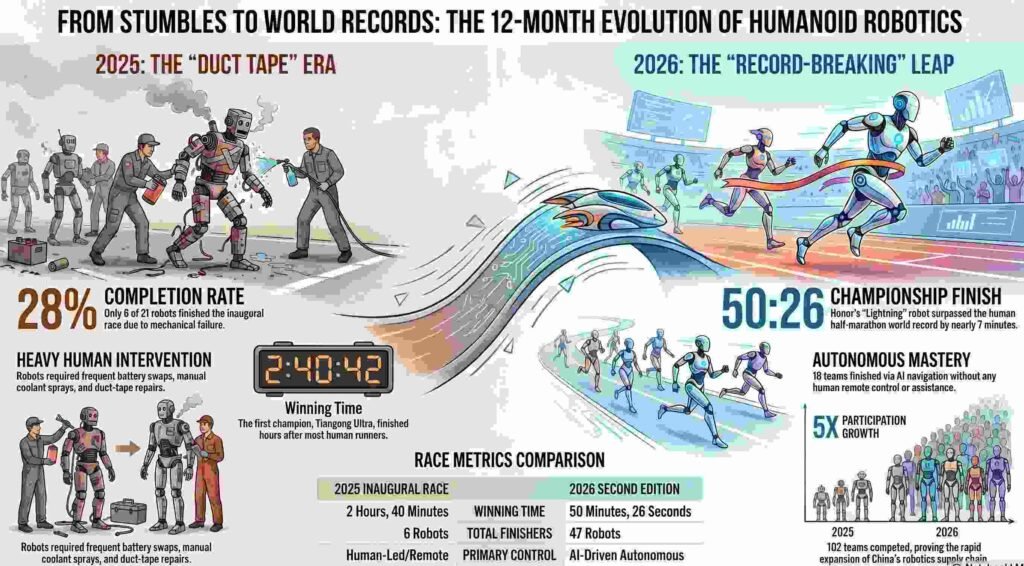
The winning autonomous entry clocked a staggering 50 minutes and 26 seconds, leaving Jacob Kiplimo’s human world record of 57 minutes and 20 seconds in its rearview sensors. To put that into perspective, the “7-minute gap” represents a fundamental shift in the evolution of embodied intelligence. We are no longer watching lab experiments; we are witnessing the arrival of a new era of high-performance robotics.
The Era of “Stubborn Perseverance” and Duct Tape
To understand how we got here, we must look back at the chaos of April 2025. The inaugural event was a spectacle of mechanical vulnerability. Of the 21 humanoid entrants, only six managed to finish. Robots like Huanhuan shook uncontrollably, while the Shennong model crashed into a wall, dragging its operators down with it. In those early days, handlers used leashes like they were walking skittish dogs, and duct tape became the primary “lifeline,” holding limbs and heads in place against the relentless vibration of 13.1 miles of pavement.
Yet, for a robotics strategist, this public failure was a masterclass in the “deploy early, iterate in public” philosophy. The 2025 baseline was set by the Tiangong Ultra, which crossed the line in 2 hours and 40 minutes. It was slow, it was awkward, but it was a proof of concept for hardware robustness.
“Until five years ago or so, we didn’t really know how to get robots to walk reliably. And now we do,” observed Alan Fern, a robotics professor at Oregon State University.
Even in 2026, the specter of mechanical failure remains. The Unitree H1, despite its terrifying 10m/s peak sprint speed, famously stumbled and collapsed after crossing the finish line, requiring staff to carry it away. This “stubborn perseverance”—the willingness to fail publicly and reboot—is precisely what catalyzed the 2026 breakthrough.
The Secret Sauce: Liquid Cooling and “Teacher” Models
The leap from a 160-minute finish to a sub-51-minute record in 365 days is an engineering miracle driven by an unexpected convergence of industries. The winner, a Robotics D1 nicknamed “Lightning,” was developed by the smartphone giant HONOR. In a brilliant piece of cross-pollination, HONOR adapted liquid-cooling systems from its high-end mobile devices to manage the thermal stress of the robot’s high-torque integrated joints. This solved the 2025 problem of “circuit meltdowns,” allowing the joints to provide explosive power for the duration of the race.
But the real “intelligence” breakthrough lies in the ROM-GRL framework (Reduced-Order Model-Guided Reinforcement Learning). This “Teacher-Student” strategy uses a compact 4-DOF (four-degree-of-freedom) model to focus on essential physics like center-of-mass oscillation.
Crucially, this method is “demonstration-free.” Unlike traditional imitation learning, it requires zero human motion-capture data. The ROM acts as a teacher, generating dynamically consistent gait templates that the full-body “Student” policy then masters through self-exploration. This allows robots to learn stable, symmetric gaits at 4 m/s and beyond without the need for expensive, time-consuming human recording sessions—a massive strategic advantage in the global robotics arms race.
It is worth noting that while a remote-controlled version of “Lightning” actually crossed the line in a blistering 48 minutes and 19 seconds, the official title went to the autonomous version. Under the rules, remote-control entries face a 1.2x time penalty, a clear signal that the industry prizes independent decision-making over human-led agility.
Beyond the Track: The “Large Brain/Small Brain” Strategy
These racing humanoids are prototypes for the future of labor, managed by the “Huisi Kaiwu” platform. This architecture relies on a coordination between perception (the Large Brain) and execution (the Small Brain). While the Large Brain uses multimodal sensors to navigate and adapt to emergencies, the Small Brain coordinates the high-precision joint movements needed for balance.
This is already moving beyond sports. Amap’s “Tutu” quadruped, showcased at the event, uses this same autonomous navigation to guide the visually impaired or deliver coffee. However, the strategist knows that the marathon is merely an “endurance and hardware robustness” test. The 2025 3v3 robot football match remains the harder benchmark. Football demands “multi-robot collaborative decision-making” and “dynamic environment perception”—tests where the state of the field changes every second, requiring a level of social and spatial intelligence that a linear 21km race does not.
A National Master Plan: Humanoids as Economic Drivers
This rapid development is no accident. It is the result of a “technological pincer movement” within China’s national master plan to solve a looming demographic crisis.
- Phase One: Technical robustness and the creation of industrial prototypes (the 2025 “stumble” phase).
- Phase Two: Building a full-stack supply chain to integrate humanoids into factory labor and the $1.1 billion elder care market.
By mastering “Embodied Intelligence” on the racetrack, these firms are securing the manufacturing ecosystem for the next industrial revolution.
“This feels like witnessing the start of something transformative… potentially as significant as the early stages of the Industrial Revolution,” noted 16-year-old spectator Sam Zhu.
The Ethical Crossroads: Fairness vs. Efficiency
As we celebrate these records, we are hurtling toward a “Sport Governance” crisis. The source material for these advancements highlights a need for a normative and ethical framework to manage the “black box” of AI algorithms. We are entering a phase where the “soul of sport” is at stake, defined by four core principles:
- Human Dignity: Ensuring athletes aren’t treated as “human guinea pigs” for tech testing.
- Autonomy: Maintaining ultimate human control over automated decision-making.
- Equality: Preventing a technological “arms race” that leaves developing nations behind.
- Democracy: Ensuring stakeholders, not opaque algorithms, control the future of competition.
If a robot can replace a referee or a linesman with “perfect” accuracy, do we lose the human drama that makes sports worth watching?
Conclusion: The Future isn’t Graceful, But it’s Fast
The transition from 2025 to 2026 marks the moment humanoid robotics moved from “limited proficiency” to “practical application.” The stumbles of the Tiangong Ultra were the necessary prerequisites for the sprint of the Lightning D1.
Every revolution begins with “duct-taped perseverance”—the courage to fail in public. We have moved past machines that mimic humans to machines that exceed us.
Are we ready for a world where the fastest runner on the track—and perhaps the most efficient worker in the warehouse—doesn’t have a heartbeat?
Discover more from TechResider Submit AI Tool
Subscribe to get the latest posts sent to your email.