Summary Quick-View
We have all felt it—that sudden, primal spike of cortisol when the signal bars on your smartphone vanish. Whether you are navigating a remote mountain pass, sailing offshore, or simply driving through a rural stretch of “nothing,” the “No Service” icon is more than a technical glitch; it is a severing of our digital safety net. For decades, staying connected in these gaps required the “brick”—a one-pound, $3,000 handset that looked more like a cold-war relic than a communication tool.

But the “grid” is officially expanding into the heavens. We are witnessing a fundamental shift where satellite connectivity is moving from an expensive emergency backup to a baseline standard of the modern human experience. The technology that once required a dedicated suitcase of equipment now resides in a silent conversation between your pulse and a piece of spinning aluminum hundreds—or even thousands—of miles above.

The Biosphere on Your Wrist: From SOS to Sentience
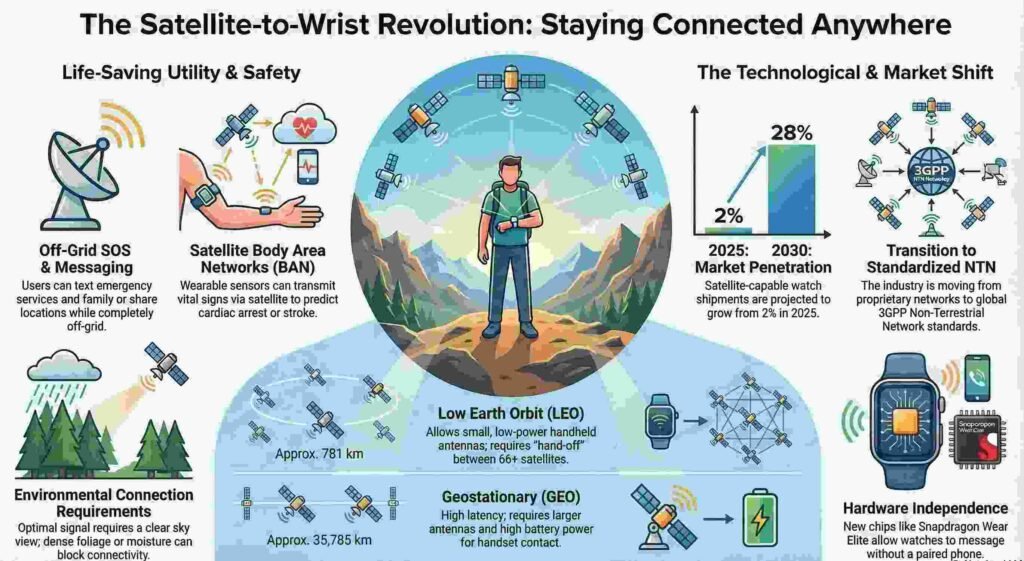
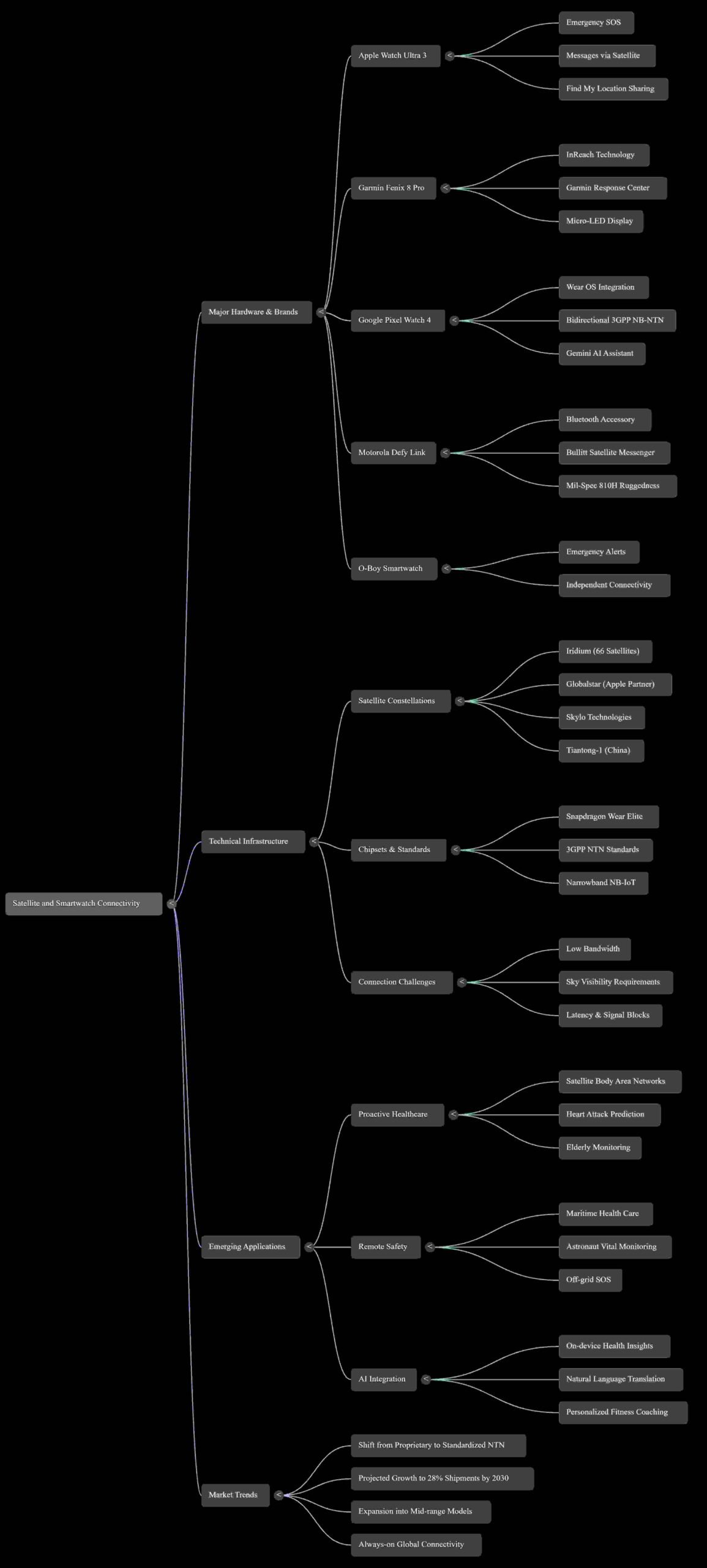
The most profound shift in wearables isn’t how they look, but how they think. We are entering the era of the “Satellite-based Body Area Network” (BAN). This is not just about a watch that can text for help; it is about a proactive medical “guardian angel.” By integrating sensors that monitor blood pressure, pulse, and ECG, these devices can transfer a compressed stream of vital data to a central hub via satellite to predict a crisis before it manifests.
This moves us from reactive “Emergency SOS” to preventative healthcare, a change that is a moral imperative rather than a luxury. In India, approximately four people die of a heart attack every minute; in Canada, one person faces a cardiac crisis every seven minutes. For these populations—especially those in rural or maritime environments far from a cellular tower—the satellite link is a bridge across a literal life-and-death divide.
“The use of satellite technology will enable the services to be ubiquitous and provide the facilities even to the remotest places on earth thereby bridging the digital divide.” — Mohanchur Sarkar, ISRO
The Silicon Renaissance: Snapdragon and the NB-NTN Standard
The democratization of space communication is no longer a proprietary game of “walled gardens.” It is being hard-coded into the silicon. The Snapdragon Wear Elite chip, announced at MWC 2026, features a dedicated Hexagon NPU capable of running on-device AI models with 2 billion parameters. This “brain” allows a watch to process complex health data or transcribe messages locally before sending a vital, compressed burst via satellite.
By adopting 3GPP Narrowband Non-Terrestrial Network (NB-NTN) standards, manufacturers like Google, Samsung, and Motorola are building off-grid connectivity into the baseline of the next generation of Android devices. This interoperability is why analysts project that satellite-capable smartwatches will grow from a mere 2% of shipments today to a staggering 28% by 2030.
The Ghost of Iridium and the $5 Billion Gamble
To appreciate where we are, we must remember the catastrophic beauty of the 1990s. The Iridium constellation, financed by Motorola at a setup cost of roughly $5 billion, was a technical miracle but a commercial ghost ship. It required 66 satellites in polar orbit to ensure global coverage, yet it failed because the market for one-pound phones that didn’t work indoors was virtually non-existent.
The original Iridium satellites were famous for “Iridium flares”—momentary flashes of reflected sunlight that made them the brightest objects in the night sky. While the company famously collapsed into one of the largest bankruptcies in U.S. history, its mesh network laid the foundation for the miniaturization we see today. The miracle is no longer the flare; it is the fact that an Apple Watch Ultra 3 can achieve global reach while worn naturally on your wrist, without the user even needing to raise their arm.
“Regarding people having ‘one number that they could carry with them anywhere’ as ‘expensive… There never was a viable market.'” — The New York Times, 1999
Embracing the “Slow” Miracle: The Reality of Space Communication
Despite our culture of instant gratification, we are still bound by the laws of physics. Satellite communication involves two distinct “miracles.” Low Earth Orbit (LEO) satellites, like those used by Apple and Iridium, zip along just 485 miles up. Conversely, geostationary systems, utilized by the Motorola Defy link, sit at a staggering altitude of 22,236 miles.
When you send a message via a geostationary satellite, that data travels a nearly 50,000-mile round trip. A 30-second delay isn’t “lag”—it is a triumph of engineering over the vastness of space. However, this reach has its limits; most satellite features currently fail above 62° latitude (northern Alaska), and environmental factors remain the final gatekeeper.
Quick Stats: The Physics of the Connection
- Ideal Conditions (Clear horizon): ~20–30 Seconds
- Light Foliage (Under trees): 1 Minute+
- Heavy Foliage/Canyons: Signal likely blocked
- Geographic Ceiling: Generally unavailable above 62° latitude
- Environmental Status: Wet hardware can significantly degrade signal strength
Democratizing the Void: Breaking the Flagship Monopoly
Safety shouldn’t be a privilege of those who can afford a $1,000 flagship. The Motorola Defy satellite link represents the “plug-and-play” democratization of this technology. For $99, this rugged, Bluetooth-enabled pebble allows any smartphone running iOS 14 or Android 10 or newer to gain satellite powers.
By decoupling the service from the handset, satellite connectivity becomes a gift-worthy accessory. It breathes new life into “old” hardware, ensuring that a hiker with a three-year-old phone has the same access to the FocusPoint SOS response center—which has handled over 100,000 rescues—as someone with the latest Ultra-tier wearable.
Conclusion: A World Without Silence
We have transitioned from the “failed experiment” of the 1990s to a world where a global mesh network is the essential backbone of the 2030s. As the “dead zone” becomes an endangered species, our relationship with the planet changes. We are entering an era where you can be monitored for health crises in the middle of the ocean and reached in the deepest forest.
But as we erase the last silent places on the map—the isolated work sites and the stretches of open water where humans were once truly alone—we must ask: Is being reachable everywhere a ultimate safety blessing, or does it mark the end of true solitude? In a world where the “No Service” icon no longer exists, we have gained a guardian angel, but we may have lost the ability to truly escape.
Discover more from TechResider Submit AI Tool
Subscribe to get the latest posts sent to your email.