September 2026 may feel like a distant horizon, but in the fast-moving world of consumer technology, the blueprint for Apple’s next flagship is already coming into sharp focus. For the sophisticated observer, this year’s rumor cycle suggests more than just an incremental spec bump; it hints at a seismic shift in Apple’s launch strategy.
Rumors are swirling that Apple may skip the standard iPhone 18 entirely, choosing instead to debut the Pro series alongside its first-ever foldable flagship. This leaves potential buyers with a calculated dilemma: invest in today’s hardware or wait for a generation that promises to redefine the “Pro” moniker.

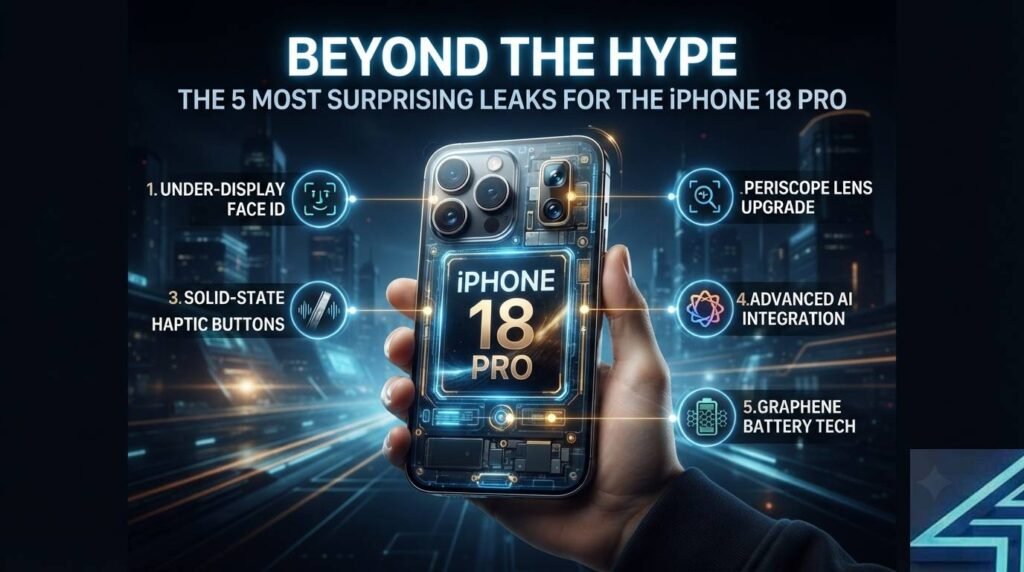
*Only a pictorial representation
1. A Camera That Mimics the Human Eye
While photography enthusiasts will be pleased to hear that Apple is retaining its triple 48-megapixel system, the real innovation lies within the glass. The iPhone 18 Pro Max is slated to debut the Sony IMX905 primary sensor, but the headline feature is a variable physical aperture.
In mobile photography, we have long relied on software algorithms to “fake” background blur. A variable aperture changes the game by allowing the lens to physically open or close, mimicking the human eye’s iris to control light intake and depth of field optically. Perhaps more surprising is the rumored “simplification” of the Camera Control button: reports suggest Apple is stripping away touch sensitivity and haptic feedback in favor of a pure, pressure-sensitive mechanical feel—a move that signals a return to tactile precision for serious shooters.
“Unlike software-generated background blur, a variable aperture can improve: low-light photography, natural depth of field, dynamic range, portrait photography, and overall image quality.”
2. Browsing the Web from Anywhere—Literally
Apple is continuing its march toward component independence with the debut of its in-house C2 modem. As the successor to the company’s first-generation C1 silicon, the C2 represents a major milestone in Apple’s connectivity roadmap.
The most disruptive leak involves the introduction of 5G via satellite. This is a significant evolution from the “Emergency SOS” features of previous years. By leveraging the C2’s efficiency, the iPhone 18 Pro aims to provide standard web browsing in cellular dead zones. For digital nomads and rural users, this effectively deletes the concept of being “off-grid,” bridging the final gap in the global connectivity envelope.
3. The 5,500mAh Milestone: Apple’s Biggest Battery Ever
For the first time in years, Apple appears to be abandoning its obsession with thinness to solve the perennial problem of endurance. Leaked specifications for the iPhone 18 Pro Max suggest a massive battery capacity range between 5,391mAh and 5,567mAh.
A Deliberate Shift Toward Endurance To support this cell—and a sophisticated new vapor chamber cooling system—the chassis is expected to be 0.25mm thicker and notably heavier. This is a calculated philosophical trade-off by Apple: leveraging a larger physical footprint and new LTPO+ display technology to ensure the device can survive the grueling thermal demands of high-duty-cycle AI workloads without tethering the user to a charger.
4. Silicon at the Atomic Scale: The 2nm A20 Pro
The heart of the device is the A20 Pro, a chip that represents the most significant node shrink in years. Built on TSMC’s cutting-edge 2nm manufacturing process, this chip is designed to maximize the “thermal envelope” of the slightly thicker chassis.
The A20 Pro is rumored to utilize “wafer-level” multi-chip module (MCM) packaging. This high-end technique integrates memory components directly into the silicon package to virtually eliminate latency, a requirement for the next era of “Apple Intelligence.”
The transition to 2nm architecture offers three critical technical advantages:
- Efficiency: Drastic reduction in power leakage, extending the silicon roadmap for multi-day use.
- AI Performance: Massive throughput gains specifically for on-device generative AI models.
- Thermal Management: Reduced heat generation during sustained graphics-intensive tasks or 4K ProRes editing.
5. Aesthetic Evolution: From Cosmic Orange to Dark Cherry
While the silhouette remains iconic, the visual language of the iPhone 18 Pro is maturing. The standout addition is “Dark Cherry,” a sophisticated finish that signals a departure from the experimental “Cosmic Orange” and “Deep Blue,” both of which are reportedly being discontinued. The hardware is also expected to feature a more seamless frosted finish on the Ceramic Shield for a refined tactile experience.
Functional beauty also gets a boost; by moving critical Face ID hardware under the display, Apple is expected to shrink the Dynamic Island by 35%. This is the closest we have ever been to the “all-screen” ideal.
“The Dark Cherry color profile is a deep red with muted pink undertones, offering a more understated and premium look than previous bold color editions.”
The Price of Innovation: Crossing the $1,499 Threshold
Leading-edge hardware carries a literal cost. The combination of rising memory prices, the premium on 2nm wafers, and the specialized hardware for 5G satellite browsing is expected to push the Pro Max into a new pricing tier.
| Expected Model | Estimated Starting Price |
| iPhone 18 Pro | $1,099 – $1,299 |
| iPhone 18 Pro Max | $1,299 – $1,499 |
Conclusion: To Wait or Not to Wait?
The iPhone 18 Pro series represents a rare convergence of fundamental hardware leaps: 2nm silicon, true satellite internet, and a physically adjustable optical system. These are not merely iterative refinements; they are “state-of-the-market” shifts that clarify Apple’s vision for the next decade.
However, with the Pro Max potentially reaching a $1,499 starting price, the “innovation tax” has never been higher. It leaves us with a compelling question: In an age where Apple Intelligence is designed to do the heavy lifting, does the sheer power of the hardware still justify the premium, or have we reached the point where the software is finally the only thing that matters? For those who demand the absolute ceiling of mobile technology, September 2026 cannot come soon enough.
Discover more from TechResider Submit AI Tool
Subscribe to get the latest posts sent to your email.