1. Introduction: The Local AI Ceiling Just Broke
For years, the professional developer’s relationship with AI has been a hostage situation involving a high-interest “API tax.” If you wanted “Frontier-class” reasoning for complex architectural refactors or multi-step debugging, you paid the toll to Anthropic or OpenAI. You traded data privacy for performance and accepted the latency of the cloud because local models—while charmingly efficient—simply couldn’t match the logic of a trillion-parameter giant.
April 2026 has officially ended that era of compromise. With the release of the Qwen 3.6 27B family, the “open-weight” floor didn’t just rise; it collided with the closed-weight ceiling. We have reached the “Goldilocks” moment of local AI: a model small enough to fit on a single high-end consumer GPU but powerful enough to rival Claude 4.5 Opus. While the landscape is currently littered with “fake” hype and over-polished model cards, a new class of architecture is proving that you can finally run world-class reasoning on hardware you actually own.
2. The 3-Minute Masterpiece: When Hype Becomes the Experiment
Before we dissect the benchmarks, we need to address the elephant in the local AI room: the ease of manufacturing credibility. The community recently learned a hard lesson via DJLougen’s “Qwable-5-27B-Coder” release.
Framed as a “distilled agentic coder” trained on heavyweight “teacher” models like Fable 5, the model garnered massive attention. However, a post-release debrief revealed a startling truth: the model was trained in exactly three minutes on a total of only 10 traces. It was a deliberate experiment in the power of framing. As DJLougen noted:
“The ecosystem currently rewards hype over rigor, and that is a problem the community has to solve from the inside. This is a working demonstration of how little it takes to manufacture credibility… demand real evals over ‘impressive teacher names.'”
This serves as a necessary wake-up call. While the base Qwen 3.6 is a technical marvel, the community must remain skeptical of any derivative that prioritizes a flashy banner over reproducible, open evaluations.
3. The David vs. Goliath Paradox: 27B Dense Outperforms 397B MoE
The most counter-intuitive data point of mid-2026 is the performance of the Qwen 3.6 27B dense model. In an industry where “bigger is better” usually dictates the narrative, Alibaba’s 27B dense model is consistently outperforming its own 397B Mixture-of-Experts (MoE) predecessor on agentic coding tasks.
For the self-hosted developer, this is the breakthrough. While the massive MoE remains out of reach for anyone without a server rack, the 27B dense model is the “sweet spot” for an RTX 5090 or dual-3090 setup. It targets the 24GB/32GB VRAM sweet spot with startling precision, though be warned: the 262k context window eats VRAM aggressively, often requiring a step down to lower quantizations for long-horizon vision tasks.
Key Benchmarks: Qwen 3.6 27B vs. The Field
- Terminal-Bench 2.0: 59.3 (Exactly matching Claude 4.5 Opus).
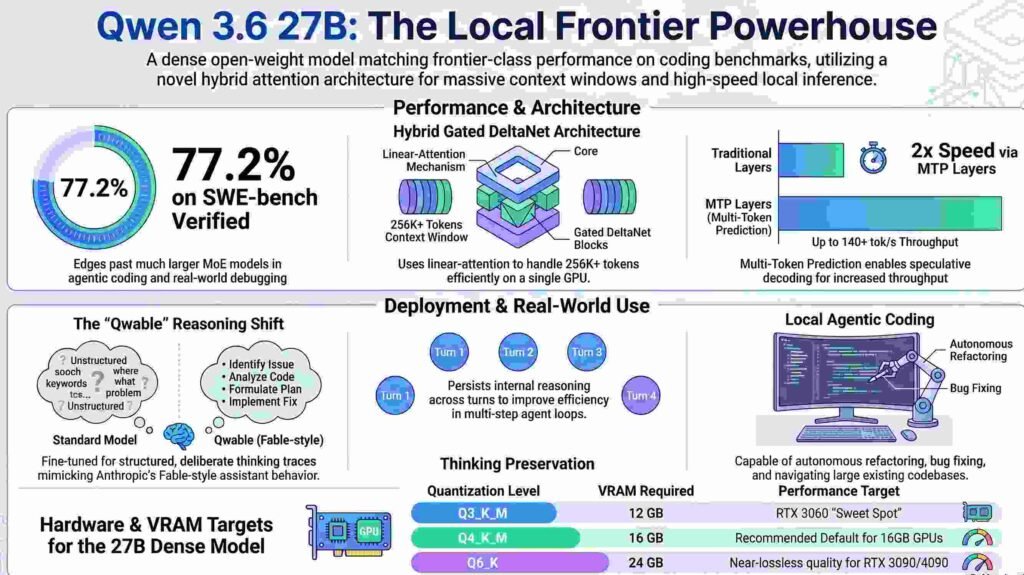
- SWE-bench Verified: 77.2 (Outperforming the 397B MoE’s 76.2).
- MMLU-Pro: 86.2 (A significant jump from the previous generation’s 84.8).
- AndroidWorld: 70.3 (Proving high-tier competence in multimodal UI navigation).
4. The Secret Sauce: Hybrid Attention and the End of the KV-Cache Crisis
How does a 27B model handle a massive 262k native context window without choking an 80GB GPU? The answer is a radical shift in architecture: the Gated DeltaNet layout.
Standard transformers suffer from quadratic complexity; as your context grows, the KV-cache (the model’s “short-term memory”) expands until it consumes all available VRAM. Qwen 3.6 27B solves this by using a 1-in-4 layer mixing strategy:
- Linear Attention (Gated DeltaNet): Three out of every four sublayers use this linear-attention variant. It runs in O(n) time and stores a constant-size recurrent state rather than a per-token cache.
- Gated Attention: The final layer in each block remains a traditional global attention mechanism to ensure high-level coherence.
This architecture is the “holy grail” for local developers. It makes serving 262k context—and even extending to 1 million tokens via YaRN scaling—practical on a single node. You can now feed a 200-file repository into a single window without the catastrophic performance degradation of older quadratic models.
5. MTP: The “Free” Speed Upgrade You Can’t Ignore
In agentic workflows, speed isn’t a luxury—it’s a requirement for success. Qwen 3.6 27B introduces native Multi-Token Prediction (MTP), which enables speculative decoding within llama.cpp and vLLM.
Recent verification on an RTX 5090 shows a dramatic throughput shift:
- Standard (MTP-less): ~74 tok/s
- MTP-Enabled: 140+ tok/s
However, there is an “insider” catch: MTP Q4 is a trap. Verification data from zephel01 indicates that the MTP Q4 version is unstable, with a 15% failure rate on complex tasks. To maintain the accuracy promised by the benchmarks, Q5 quantization is the mandatory floor. At Q5, you recover the accuracy lost in the 4-bit quants while still enjoying nearly double the throughput of the standard model.
6. Thinking Preservation: The Memory Upgrade for AI Agents
One of the most impactful features for agents is the preserve_thinking flag. In traditional chat templates, when a model deliberates—producing a <think> block—that trace is usually discarded in the next turn to save space.
By setting enable_thinking: true, Qwen 3.6 27B allows the model to “remember” its earlier deliberations. This is the difference between a model that re-invents the wheel every time you reply and one that maintains a continuous line of reasoning. As noted by the Tosea.ai team:
“The model can build on its earlier deliberation rather than re-derive it… this is the difference between a model that ‘reasons fresh every turn’ and one that ‘remembers what it was working on’ in multi-turn agent loops.”
7. Conclusion: The “Potato PC” Revolution
As of mid-2026, the definition of a “Potato PC” has shifted. In our world, a “Potato” is now the dual-3090 setup you picked up second-hand—and it’s enough to run Frontier-tier AI.
With a 27B model matching Claude 4.5 Opus in terminal-based debugging and outperforming massive MoEs on SWE-bench, the era of subsidized API giants is drawing to a close. The residency and privacy arguments are finally backed by undeniable raw power. Why send your proprietary codebase to a third-party server when a local model can solve the bug, explain the fix, and run the tests at 140 tokens per second?
We’ve reached a definitive turning point: Local is no longer a downgrade; it’s a feature.
Discover more from TechResider Submit AI Tool
Subscribe to get the latest posts sent to your email.