
1. Introduction: The 19-Second Window
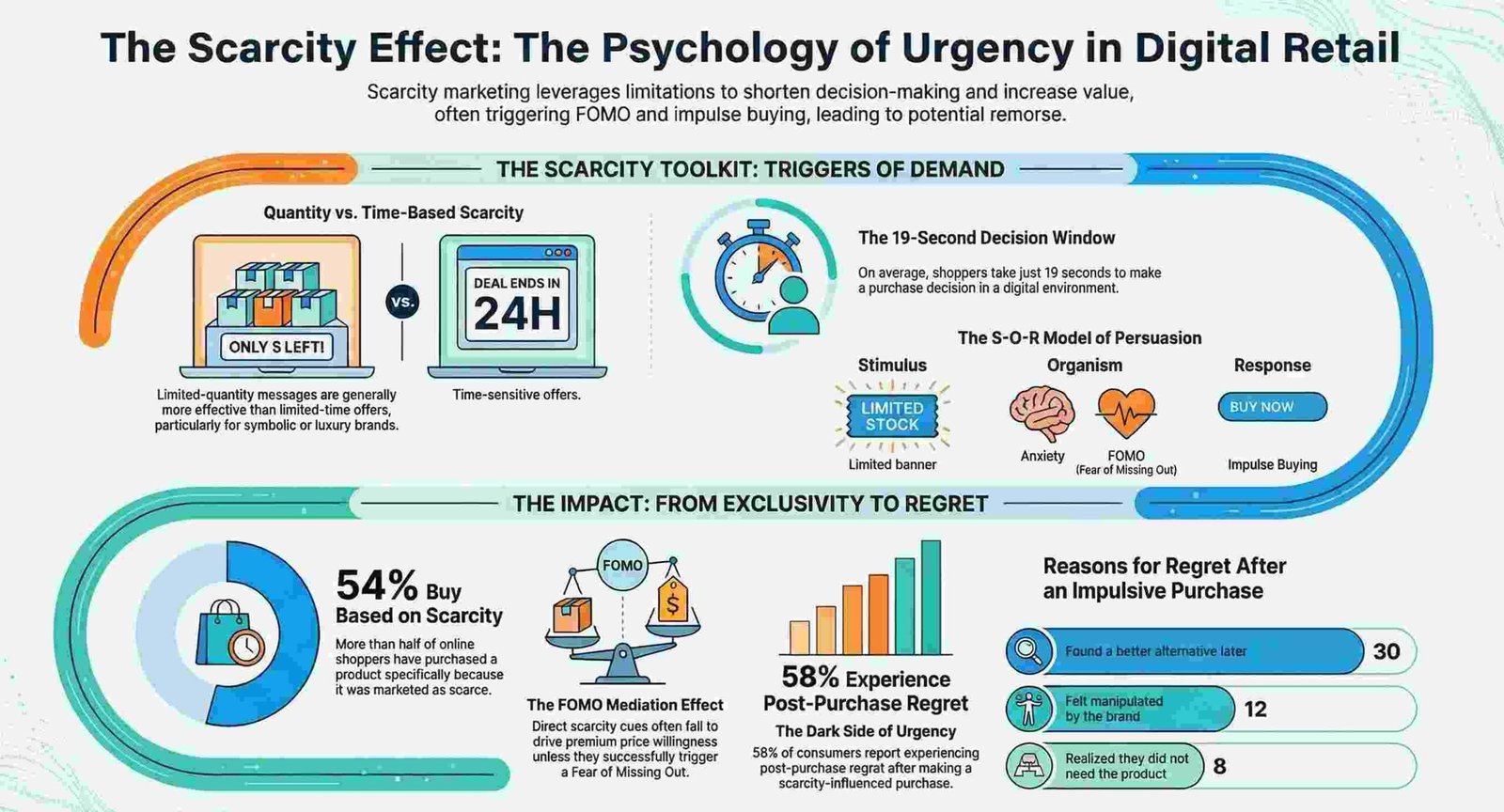
In the high-velocity environment of digital commerce, the window for persuasion is remarkably narrow. Research suggests that the average shopper takes a mere 19 seconds to make a purchase decision. Within this heartbeat of time, the primary obstacle for a brand is not competition, but “choice overload”—a psychological paralysis where an abundance of options leads to decision fatigue and abandonment.
To navigate this, sophisticated brands employ scarcity marketing. Far from a crude sales gimmick, scarcity is a precision tool used to cut through the cognitive noise. By introducing perceived or real limitations, marketers can bypass the “central route” of rational deliberation and trigger a rapid, emotional response that transforms passive browsing into immediate action.
2. More Than Just “Low Stock”: The Three Faces of Scarcity
Behavioral research categorizes scarcity into three distinct psychological triggers. Understanding the nuance between them is critical for strategic positioning.
- Quantity-Based (Supply-Related): This stems from deliberate production limits, such as “Limited Edition” runs. It leverages Uniqueness Theory, where a product serves as a proxy for status and social differentiation.
- Quantity-Based (Demand-Related): These cues, such as “Selling Fast!” or the empty shelves seen at Indian festive brand Biba during Diwali, signal that others are buying. This triggers a “bandwagon effect,” where popularity is inferred as a guarantee of quality.
- Time-Based: These are temporal restrictions, such as the 15-minute “Bumper Sales” used by platforms like Meesho or seasonal “Limited Time” capsule collections.
Strategic Insight: Research by Aggarwal et al. provides a crucial nuance: limited-quantity messages are consistently more effective than limited-time messages, particularly for symbolic or luxury brands. While a countdown timer suggests a mere promotional window, a quantity limit signals a competitive race for a finite asset, intensifying the urge to secure the item.
3. The FOMO Engine: Why We Pay a Premium
To understand why consumers pay a premium for scarce goods, we must look at the Stimulus-Organism-Response (S-O-R) model. In this framework, Scarcity is the Stimulus. It does not always directly increase a product’s rational value; instead, it affects the Organism by triggering an emotional state: the Fear of Missing Out (FOMO).
“Fear of Missing Out (FOMO) is a pervasive anxiety about potentially missing valuable experiences others might be enjoying, emphasizing a persistent desire to remain continuously connected with others’ activities.”
This anxiety acts as the mediator for the Response (the purchase). When FOMO is activated, the consumer shifts from evaluating price-to-utility to managing emotional risk. The “cost” of the item is redefined not by its MSRP, but by the psychological price of regret.
4. The Luxury “Spell”: Lessons from Stone Island and Louis Vuitton
Luxury houses maintain an “aura” of exclusivity by ensuring that supply never meets demand. A definitive example of the “scarcity spell” can be found in the Italian brand Stone Island. Their standard “Ghost Piece” jacket, priced at $850, typically takes three months to reach its sales targets. In contrast, the Prototype Research Series, priced at a staggering $3,000, has been known to sell out within hours. This contrast proves that extreme scarcity can supersede rational price considerations.
Similarly, Louis Vuitton utilizes waiting lists and deliberate stockouts to maintain prestige. For high-end brands like Richard Mille, scarcity is “real” rather than just perceived, using rare materials like Graphene to create physical constraints on production. In these cases, scarcity creates a “Veblen effect,” where higher prices and lower availability actually increase desirability, turning a product into a club that consumers are desperate to join.
5. The “Dark Side”: Manipulation and the Broken Spell
When scarcity is manufactured through deceptive means—such as fake countdown timers that reset or fabricated “low stock” alerts—the brand risks the “Broken Spell.”
If a consumer perceives scarcity as artificial, they experience “Reactance Theory” in reverse: the urge to restore their freedom by rejecting the brand entirely. Deceptive tactics lead to post-purchase regret, where the buyer compares the item to “foregone alternatives” they might have chosen without the pressure.
There is also a vital distinction between Impulse Buying (spontaneous, unplanned purchases) and Panic Buying. While impulse is often driven by positive excitement, panic buying is a mass behavior driven by perceived supply disruption and uncertainty, often leading to “stockpiling.” Brands that exploit panic or use “Hunger Marketing” to create false urgency risk permanent erosion of trust. Data from Label Insight confirms the stakes: 94% of consumers are more likely to remain loyal to a brand that offers full transparency.
6. Scarcity in Practice: Tactical Manifestations
Scarcity is no longer exclusive to luxury; it is a cross-sector imperative. Modern applications include:
- Exclusive Collaborations: The Sabyasachi x H&M collection, which blended Indian textiles with fast-fashion, famously sold out in just 7 minutes online.
- Super-Low Deposits: Tesla utilizes $250 fully refundable deposits to create “sold out” narratives and gauge demand without binding commitments.
- Physical and Virtual Queues: Apple has historically used physical lines at stores to signal demand-related scarcity, while digital platforms now use “live social proof” notifications to show how many people are currently viewing a product.
- Gaming and Software Tokens: The use of limited-supply fictional currencies or waiting lists for AI tools like ChatGPT Pro or the Rabbit R1 (which sold out in 24 hours).
7. Conclusion: The Future of Persuasion
Scarcity marketing remains one of the most potent triggers in the human psyche because it speaks to our primal, risk-averse nature. However, as consumers become increasingly savvy, the “magician’s trick” becomes harder to perform.
The future of the strategy lies in what Markus Kramer calls a “culture of excellence.” Scarcity only creates long-term value when the quality of the product justifies the hurdle of acquisition.
The next time you are faced with a “limited-time” offer, take a moment to look past the 19-second window. Ask yourself: Is this a purchase you are making because of the product’s inherent excellence, or are you simply reacting to a psychological architecture designed to make you fear the void of a missed opportunity?
Discover more from TechResider Submit AI Tool
Subscribe to get the latest posts sent to your email.

