In the modern search landscape, manual intervention has become a strategic liability. SEO has entered a high-frequency, algorithmic era where the traditional “grind”—spending hours merging CSVs in Excel or navigating the rigid functional ceilings of standard GUI tools—is no longer a viable path to growth. For the elite practitioner, Python is not a “developer-only” luxury; it is a force multiplier that enables a level of scalability, precision, and risk mitigation that traditional workflows simply cannot replicate.

The purpose of this post is to look past basic automation and reveal the high-impact, often counter-intuitive ways Python is being deployed to build repeatable data pipelines that outperform traditional SEO strategies.
1. Breaking the 5,000-Row Ceiling: Why the GSC Interface is Holding You Back
The standard Google Search Console (GSC) web interface is an essential tool, yet its constraints are a significant barrier for enterprise-level properties. With a display limit of only 5,000 rows and a historical window of just 16 months, many teams are making high-stakes decisions based on a fraction of their actual data.
By pairing the GSC API with Python, specifically the Pandas library, technical SEOs can extract hundreds of thousands of rows of granular performance data. This allows for a deep-dive analysis of “long-tail” opportunities that remain invisible in the standard interface. Beyond simple data retrieval, sophisticated teams are leveraging Natural Language Processing (NLP) to generate N-grams (bigrams and trigrams).
Moving to phrase-based analysis is a strategic necessity; it allows SEOs to align their content with Google’s own phrase-based indexing patents. By understanding topical context and related terms at scale, you can move beyond individual keywords to dominate entire thematic clusters.
“This is the solution for one of the biggest problems in Excel, namely row limit and speed. Nowadays, you have way more alternatives to analyze data than before and that’s where Python comes into play.”
2. The “Indisputable Evidence” of Server Logs
Log file analysis provides a level of clarity regarding search engine behavior that third-party tools—which rely on estimations and third-party bots—cannot match. While many practitioners avoid log files due to their massive size and the “unfriendly” formats of Apache, Nginx, or IIS, Python allows you to parse and validate this data with surgical precision.
By automating the analysis of these raw server responses, you can identify exactly how Googlebot navigates your architecture. This reveals:
- Wasted Crawl Budget: Detecting low-value pages or parameter-heavy URLs that are siphoning bot attention.
- Indexation Bottlenecks: Real-time discovery of why critical revenue-driving pages are being ignored by search engines.
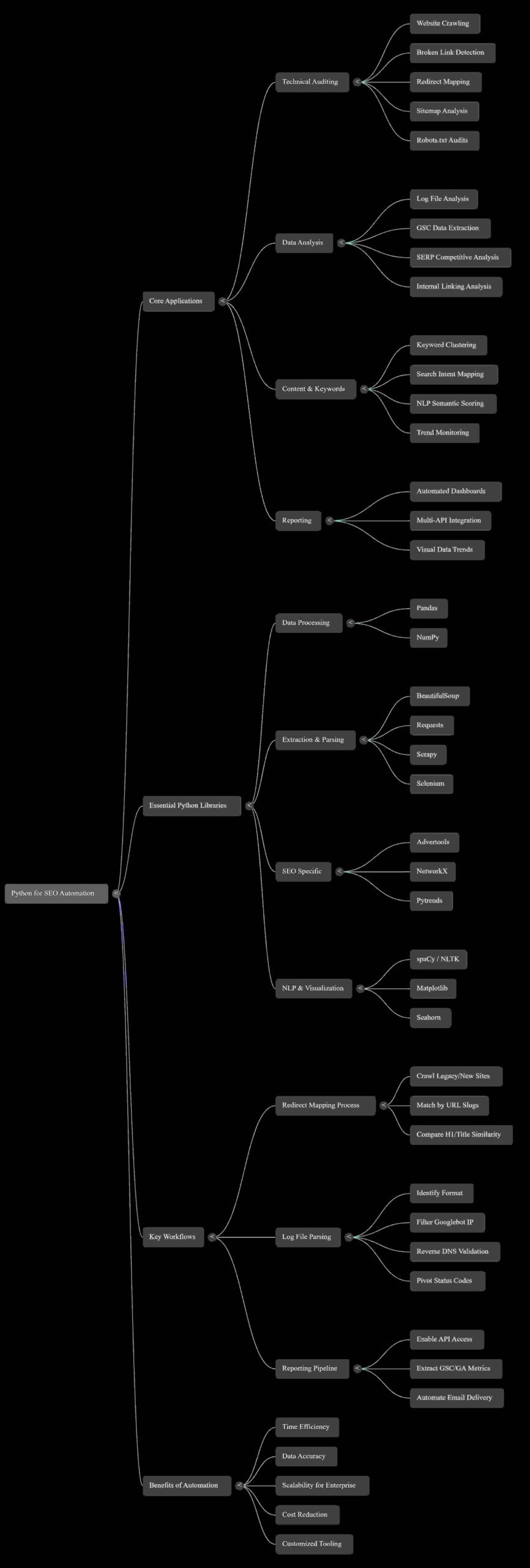
- Reverse DNS Validation: Utilizing libraries like dnspython to perform reverse lookups, ensuring your data is not being skewed by spoofed bots or unauthorized crawlers.
The Strategic Benefits of Log Analysis:
- Validation: Providing indisputable evidence of Google’s actual crawl patterns.
- Prioritization: Defining the true scale of technical debt and the projected impact of fixes.
- Discovery: Uncovering architectural issues that standard site audits frequently overlook.
3. Automated Redirect Mapping: Eliminating Traffic Loss in Migrations
Site migrations are high-risk maneuvers where human error often leads to devastating traffic loss. Manual redirect mapping is not just slow; it is a liability when dealing with tens of thousands of URLs. Python-driven automation transforms this process from a “best-guess” manual effort into a high-fidelity data operation.
Elite teams use scripts that run through five distinct logic iterations to ensure the highest possible match accuracy:
- Mapping based on full URL paths.
- Mapping based on the URL slug (the final directory).
- Matching via Title 1 tags.
- Matching via H1-1 tags.
- Matching via H2-1 tags.
By programmatically comparing these attributes from legacy and new site crawls, the script calculates a Similarity Score. We treat a score of >= 0.90 as the benchmark for a high-fidelity match. This level of automation allows a practitioner to map a massive percentage of a site—particularly complex e-commerce templates—in minutes, ensuring that ranking equity is preserved without the risk of 404-driven erosion.
4. Internal Linking as a Living Map (Not Just a List)
Internal linking is the circulatory system of your website. Most audits treat it as a static list of URLs, but by using the Networkx library, we can visualize the site as a living graph—a network of interconnected nodes.
Visualizing your site as a “crawl diagram” uncovers structural flaws that spreadsheets mask:
- Bottlenecks: Identifying critical silos where thousands of sub-pages (like regional trends) are only accessible via a single “lobby” page.
- Outskirts: Revealing “non-indexable” or orphaned nodes that sit on the periphery, disconnected from the core authority of the site.
- Authority Distribution: By scaling node size based on inlinks or backlinks and color-coding by indexability status, you can instantly see if your most valuable pages are truly receiving the authority they require to rank.
5. From 5 Hours to 10 Minutes: The New Reporting Reality
Manual reporting is a significant drain on human capital, often involving a tedious cycle of logging into disparate platforms, downloading CSVs, and merging data in Excel. The modern SEO stack replaces this with automated data orchestration via APIs.
Specific Python libraries enable this transformation:
- Pandas: For cleaning, structuring, and deduplicating massive multi-source datasets.
- Matplotlib and Seaborn: For generating sophisticated trend visualizations of keyword shifts and traffic growth.
- SMTPLIB: For scheduled, automated delivery of high-level insights directly to stakeholders.
“Manual Approach: Logging into each SEO tool, downloading CSV files, merging data, and creating charts in Excel = 3-5 hours per week. Automated Approach: Running a Python script that fetches data, processes it, and generates a report = 5-10 minutes per week.”
Conclusion: The Strategic SEO of 2026
As we look toward 2026, the competitive edge in organic search belongs to teams that view Python as a core component of their strategic stack. Python does not replace the intuition of a seasoned SEO; it amplifies it. By building repeatable data pipelines, you shift your focus from the “how” of data collection to the “why” of strategic decision-making.
In an industry where speed and precision define the winners, the question remains: Is your SEO strategy limited by your ideas, or simply by the tools you’re using to execute them?
Discover more from TechResider Submit AI Tool
Subscribe to get the latest posts sent to your email.