1. The Invisible AR Revolution
When most people hear the term Augmented Reality (AR), their immediate reference points remain firmly rooted in consumer novelty: playful puppy ear face filters on social media, or crowds of smartphone users wandering through public parks hunting virtual pocket monsters in Pokémon Go. For nearly a decade, mainstream culture has treated AR as an entertaining distraction—a gimmick confined to mobile screens and viral consumer apps.

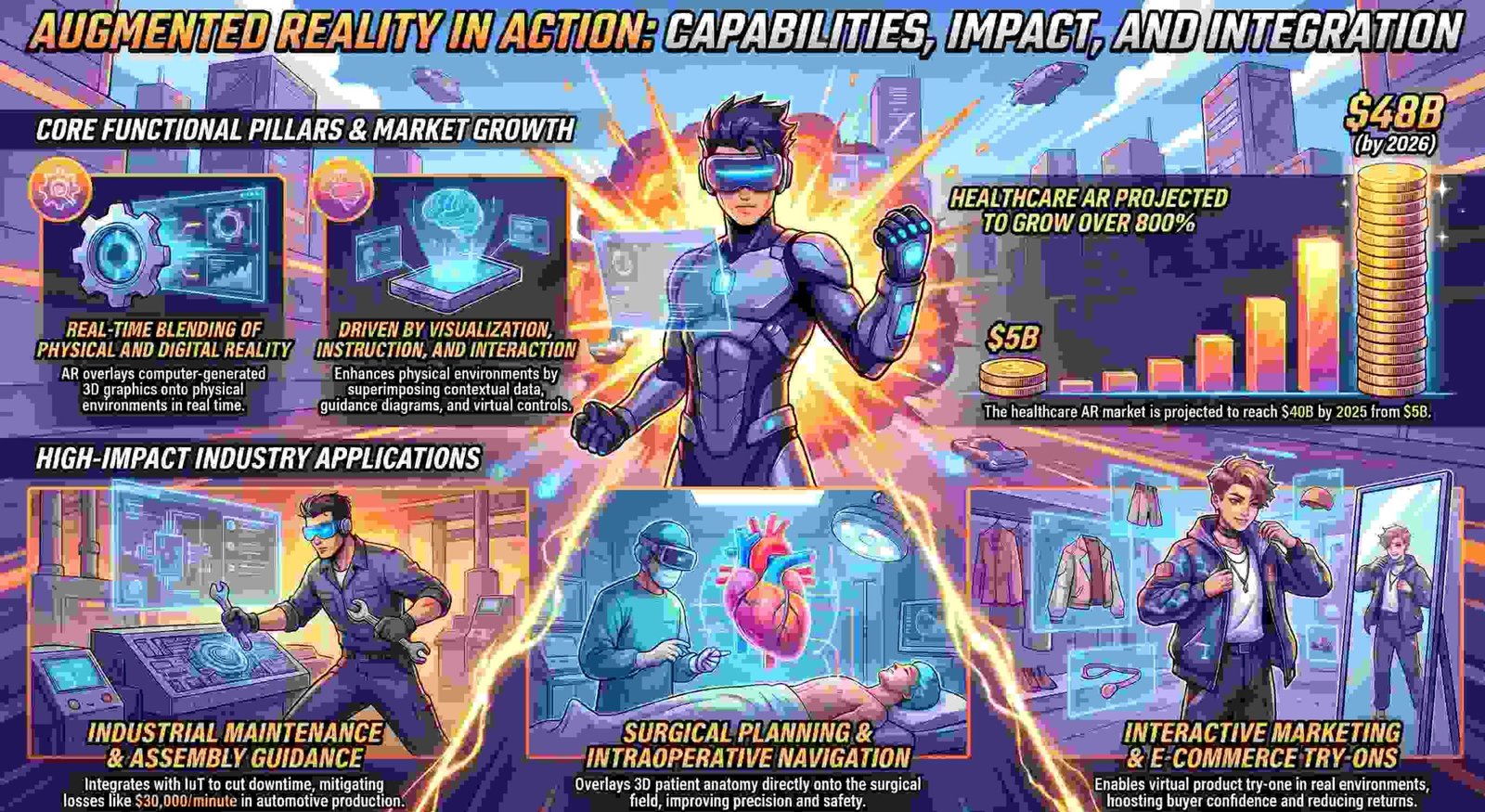
Beneath the media noise, however, spatial computing is writing a new operational playbook across the global economy. Beyond consumer eyes, AR has quietly evolved into a foundational, high-ROI infrastructure spanning heavy industrial assembly lines, high-stakes surgical suites, and multi-billion-dollar enterprise ecosystems. Behind closed doors, spatial overlays are generating staggering commercial value, streamlining intricate workflows, and in critical operating environments, driving human error rates down to absolute zero.
From real-time volumetric surgical navigation to hands-free industrial headsets linked into predictive AI, spatial technology is fundamentally altering how human workers interpret and manipulate physical space. Here is an executive analysis of six ways augmented reality is quietly reshaping modern business and industry.
2. Zero Errors and $30,000-a-Minute Stakes: How Heavy Industry Uses AR to Eliminate Costly Mistakes
In heavy industrial manufacturing, operational efficiency is measured in seconds, and mistakes carry catastrophic financial weight. Beyond immediate line stoppages, industrial enterprises face a severe macroeconomic threat: an aging workforce and the rapid retirement of veteran technicians. Capturing, retaining, and transferring tacit operational knowledge before it walks out the door has become an urgent business imperative.
Hands-free smart glasses are rapidly outpacing traditional handheld mobile devices in shop-floor environments. By keeping the technician at the absolute center of the operational experience, wearable displays project step-by-step instructions, digital checklists, and live step-verification directly into the worker’s natural line of sight. This unobtrusive delivery enables unbroken physical workflows, drastically reducing cognitive load while elevating shop-floor safety.
The transformative operational impact of industrial AR is clearly reflected across key performance metrics:
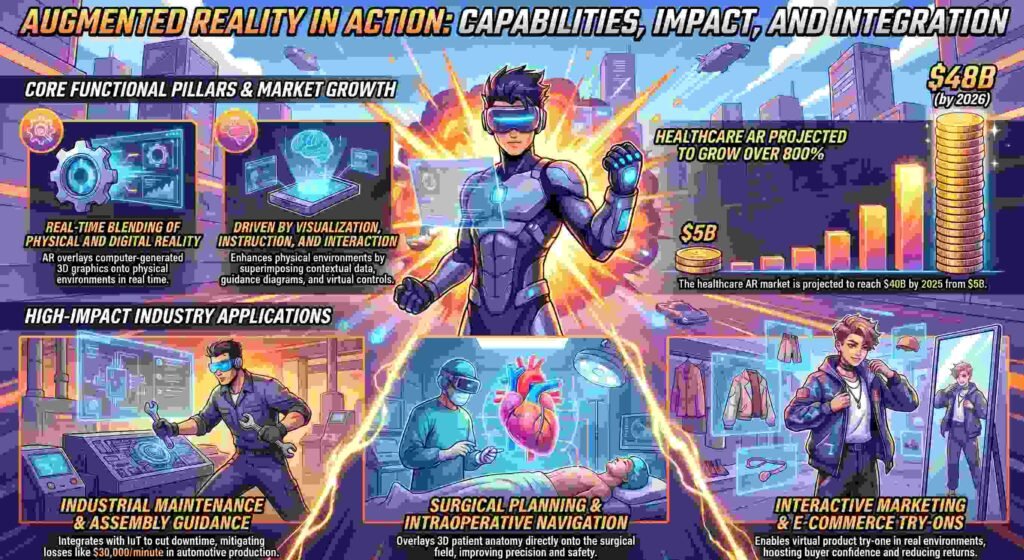
- $30,000 per minute: The estimated baseline cost of unplanned downtime in automotive manufacturing, where major assembly plants average one finished vehicle rolling off the line every 60 seconds.
- 0% error rate: The record accuracy achieved by assembly technicians using Microsoft HoloLens smart glasses during NASA’s Orion spacecraft program, where thousands of intricate components required precise positioning.
- 90% less time: The reduction in total assembly duration achieved on the Orion spacecraft project compared to legacy paper schematics and manual measurement protocols.
“High complexity leads to severe downtime and inefficiency cost, which AR can lessen. Training and knowledge share are critical thanks to that complexity, and AR can enhance training efficacy and retention…” — Eric Abbruzzese, Research Director at ABI Research
3. From $580 Million to $3 Billion: The E-Commerce Revenue Explosion Powered by Virtual Try-Ons
Just as spatial visual guidance eliminates guesswork for technicians on the factory floor, visual certainty is fundamentally transforming consumer balance sheets across global e-commerce. Historically, online retail has suffered from a persistent structural hurdle: purchase hesitation caused by consumer uncertainty around physical sizing, aesthetic compatibility, and real-world fit. Augmented reality directly eliminates this friction, bridging the gap between digital convenience and in-store confidence to turn visual proof into immediate conversions.
Consider the financial trajectory of Sephora’s “Virtual Artist” app. By scanning a consumer’s facial features and mapping cosmetics in real time, the app allows shoppers to evaluate shades under hyper-realistic simulated lighting environments—ranging from outdoor daylight to low-light evening settings. By taking the guesswork out of digital beauty purchases, Sephora scaled its e-commerce net sales from $580 million in 2016 to over $3 billion in 2022.
Similarly, IKEA’s “Place” app empowers consumers to overlay true-to-scale 3D models of furniture directly inside their living spaces. Shoppers can instantly confirm whether a sectional sofa physically fits their floor plan and visually harmonizes with existing decor before committing to a purchase. By providing definitive spatial context prior to checkout, IKEA directly eliminates buyer remorse, driving down costly product return rates and logistical overhead.
4. The $48 Billion Surgical Revolution (and Its Surprising Bottleneck)
Few environments demand absolute precision like the operating room. Healthcare spatial computing represents one of the fastest-growing technology sectors on Earth, with market projections accelerating from $5 billion in 2021 to $48 billion in 2026—an explosive expansion rate exceeding 800%.
In complex neurosurgery, oncology, and craniomaxillofacial procedures, AR elevates surgical navigation by transforming flat medical imaging into real-time volumetric guidance. By superimposing 3D anatomical models reconstructed from patient CT and MRI scans directly onto the patient’s physical body, surgeons gain unprecedented spatial awareness. This real-time visual overlay allows surgical teams to track anatomical depth, preserve critical neurovascular structures, and project precise incision trajectories without taking their eyes off the surgical site to consult distant 2D monitors.
However, this rapid hardware rollout has collided with a critical, counter-intuitive bottleneck: a severe deficit of accessible AR authoring tools. Currently, constructing customized, patient-specific 3D spatial workflows requires extensive software engineering expertise. Because clinicians lack intuitive, no-code authoring platforms to convert DICOM datasets directly into spatial overlays, medical organizations remain dependent on technical middlemen. Without user-friendly authoring tools designed specifically for medical practitioners, the healthcare industry faces a growing quality gap between world-class visual hardware and the availability of rich, flexible surgical content.
5. The Real Superpower of Enterprise AR Isn’t Hardware—It’s the “Digital Thread”
While isolated AR deployments—such as ad-hoc remote expert calls—deliver localized efficiency gains, standalone applications barely scratch the surface of spatial technology’s financial potential. The true superpower of enterprise AR lies in its ability to integrate into an organization’s existing software fabric, serving as the interactive visual interface for the enterprise Digital Thread.
The Digital Thread establishes a continuous, bidirectional data flow between smart glasses, Internet of Things (IoT) sensors, Product Lifecycle Management (PLM), Enterprise Resource Planning (ERP), Customer Relationship Management (CRM), and Artificial Intelligence (AI). Crucially, AR acts as the real-time visual window into Digital Twins—allowing technicians on the factory floor to view and manipulate interactive, virtual replicas of physical machinery overlaid with live IoT sensor telemetry.
+-------------------------------------------------------------------+
|                        THE DIGITAL THREAD                         |
|                                                                   |
|   +------------------+     Data     +-------------------------+   |
|   |   AR & DIGITAL   | -----------> |   IoT & CENTRAL DATA    |   |
|   |      TWIN        |  Capture     |        PLATFORMS        |   |
|   +------------------+              +-------------------------+   |
|            ^                                     |                |
|            | Real-Time                           | Predictive     |
|            | Delivery                            v Analytics      |
|   +-----------------------------------------------------------+   |
|   |                   AI ENGINE & WORKFLOWS                   |   |
|   +-----------------------------------------------------------+   |
+-------------------------------------------------------------------+
- Data Capture: The worker interacts with a Digital Twin via AR, while embedded sensors and automated vision logging capture physical manual tasks and operational metrics in real time.
- AI Analysis: This operational stream feeds directly into central IoT and AI analytics engines, where machine learning algorithms process floor metrics to predict hardware failures or refine assembly sequences.
- Real-Time Delivery: The optimized workflow, predictive maintenance alert, or updated schematic is instantly pushed back to the technician’s head-mounted display with precise spatial anchoring.
When AR operates in isolation, ROI is linear; when integrated into a unified Digital Thread across core business platforms, enterprise ROI grows exponentially.
6. Guerilla Marketing Goes 3D: “Burning” Competitor Ads for Free Burgers
Beyond shop floors and surgical suites, forward-thinking brands are turning to spatial computing to execute aggressive, highly interactive marketing campaigns that achieve engagement levels static media simply cannot match. By transforming passive viewers into active players, gamified AR drives unprecedented brand recall and viral organic reach.
A masterclass in disruptive spatial advertising was Burger King’s “Burn That Ad” campaign in Brazil. Burger King integrated an AR tool into its mobile app, prompting users to point their smartphone cameras at competitor advertisements—including McDonald’s billboards, print fliers, and digital banners. When viewed through the screen, the rival ad appeared to realistically catch fire and burn away in 3D, revealing a Burger King advertisement underneath and instantly awarding the user a coupon for a free Whopper.
In a similar vein, PepsiCo launched Malaysia’s first AR virtual concert to connect with digital-native audiences. By scanning Pepsi product cans with their smartphones, consumers unlocked an interactive 3D virtual stage featuring local icon Siti Nordiana alongside performers discovered through the crowdsourced #PepsiBoldTalent audition campaign. By blending product packaging, spatial entertainment, and user-generated content, Pepsi demonstrated how AR can turn physical consumer goods into dynamic distribution channels for regional talent discovery.
7. You Don’t Need Years to Build It: The “Off-the-Shelf” SDK Shortcut
Historically, deploying proprietary spatial technology required building computer vision engines, visual-inertial odometry tracking, and rendering pipelines from scratch—an engineering effort taking years of high-risk R&D and millions in capital investment. Today, the executive decision has shifted from a complex “build” process to a streamlined “buy” strategy through commercial Augmented Reality Software Development Kits (SDKs) like Banuba, Apple’s ARKit, and Google’s ARCore.
Crucially, adopting modular off-the-shelf SDKs solves the critical engineering trade-off of app bloat vs. functional versatility. Modern modular SDKs allow development teams to pick and choose hyper-specific spatial features—such as real-time face touch-up, 3D mask rendering, or neural background segmentation—without bundling unused code that inflates application binary sizes, degrades frame rates on lower-end hardware, or incurs licensing overhead for unused capabilities.
Using modular SDK architectures, software engineering teams can deploy commercial-grade AR features in as little as two simple steps:
- Obtain a Token: Request an enterprise trial token and download the SDK framework archive.
- Integrate the Pipeline: Link the SDK documentation, cross-platform plugins, and pre-built asset pipelines directly into the app’s existing codebase.
By leveraging pre-packaged SDK pipelines, enterprises dramatically compress product development timelines from years to weeks, minimizing upfront capital exposure while deploying agile, high-performance spatial features.
8. The Fused Reality Ahead
Augmented reality has decisively outgrown its origins as a consumer novelty. No longer bound to novel face filters or casual mobile games, spatial computing has emerged as a vital, high-value framework driving industrial precision, surgical accuracy, and multi-billion-dollar retail growth. By driving assembly error rates to zero, offering real-time volumetric guidance in operating rooms, and transforming passive retail catalogs into interactive spatial storefronts, AR is delivering indisputable bottom-line performance.
As optical displays become lighter, computer vision pipelines become more intelligent, and modular SDKs make spatial integration effortless, the boundary separating digital intelligence from physical reality will vanish entirely.
For executive leadership, the strategic question is no longer when spatial computing will mature—but how your enterprise workflow will adapt when ambient digital overlays become as natural and invisible as the physical world around us.
Discover more from TechResider Submit AI Tool
Subscribe to get the latest posts sent to your email.