1. The 6-Second Reality Check
Standing out in today’s professional landscape is no longer about submitting a polished, multi-page resume and hoping for a callback.
We are living in an economy where artificial intelligence is actively repricing job functions, retitling roles, and revaluing human capital on the fly. As automated screeners filter applications and market values shift overnight, executive decision-makers operate under extreme time scarcity: they glance at your professional profile for less than six seconds before deciding whether you command authority or warrant dismissal.
Static credentials and title-heavy resumes no longer protect your market leverage. When your professional signal is vague, the market defaults to pricing your work at a discount.
Building a distinctive personal brand is not an vanity project—it is the operational strategy that determines your market valuation. Here are six counter-intuitive truths that redefine how modern executives establish authority, command leverage, and future-proof their careers.
2. Personal Branding Is Not Self-Promotion—It’s Managing Your Signal
The most pervasive reason high-performing leaders resist personal branding is the misconception that it requires self-aggrandizement. Many view branding as superficial grandstanding—loudly publicizing routine achievements to capture short-term attention.
In business strategy, personal branding and self-promotion are fundamentally opposed:
- Self-Promotion is the tactical act of broadcasting accomplishments to demand personal recognition.
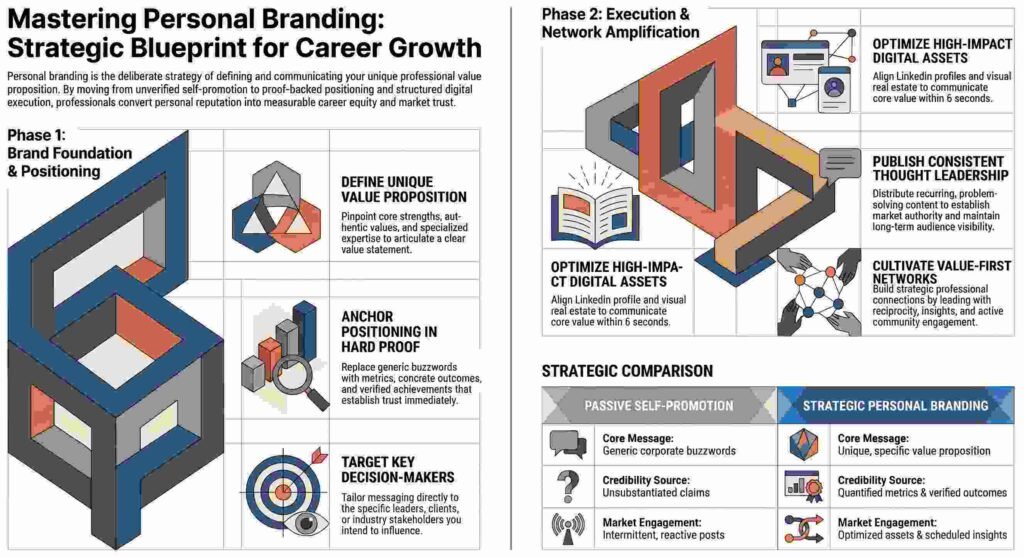
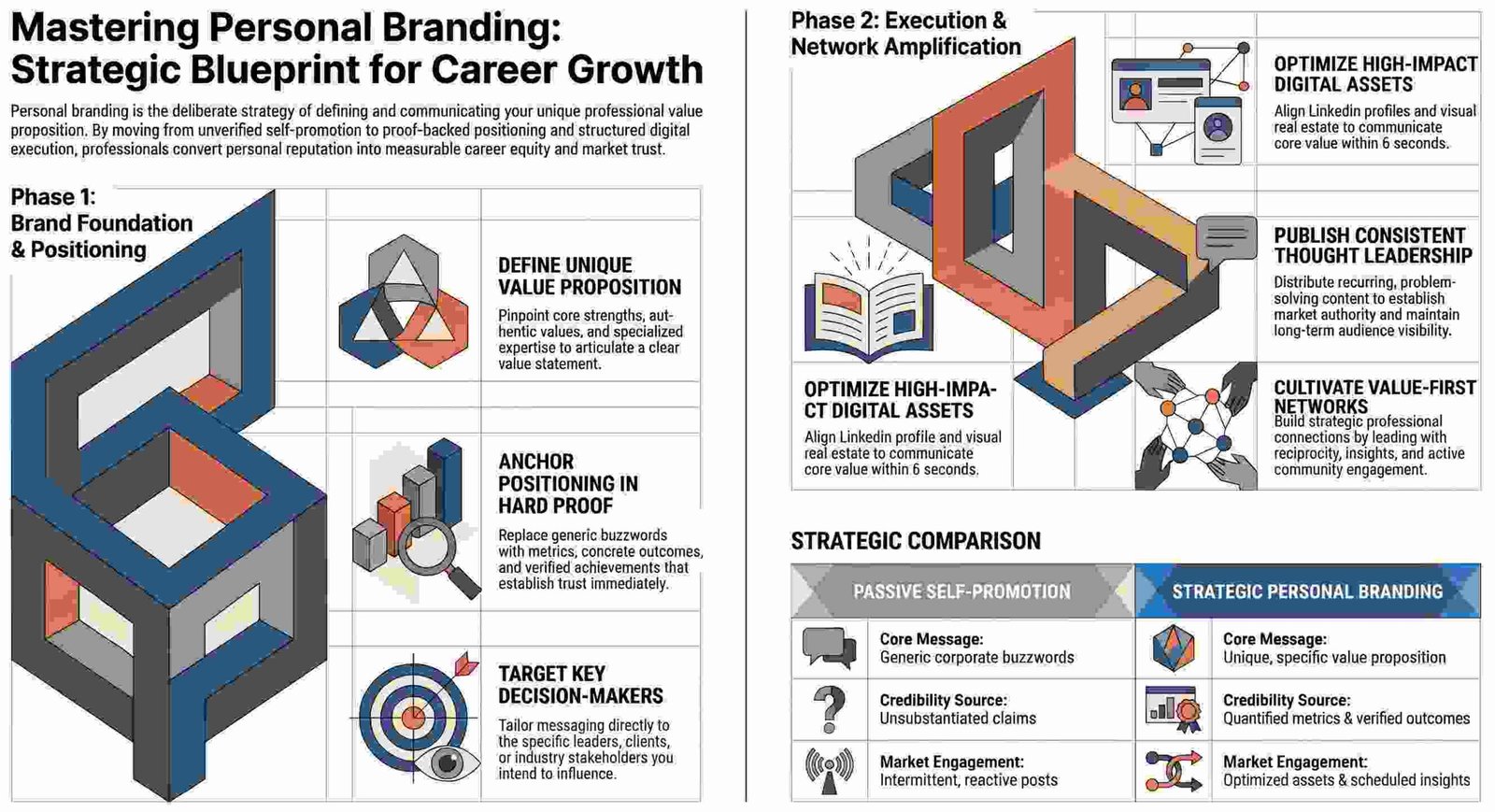
- Personal Branding is the strategic management of your professional asset. As detailed across frameworks from NMS Consulting, Business News Daily, and Berkeley Exec Ed, it requires articulating your Positioning (the specialized niche you own), protecting your Reputation (what stakeholders say when you leave the room), and broadcasting a clear Signal (verifiable proof of the outcomes you deliver).
Reframing this dynamic shifts your orientation from seeking applause to delivering high-value signal clarity.
“Personal branding is the overlap between how you see yourself and how others see you. It’s your job to be the chief marketing officer for the brand called you.” — Kellie McElhaney, Faculty Director: Equity Fluent Leadership, Berkeley Exec Ed
When you act as the Chief Marketing Officer of “Brand You,” your objective becomes risk reduction for decision-makers. You clearly define the precise problems you solve, allowing buyers, board members, and executive recruiters to evaluate your asset with absolute confidence.
3. Hiring Managers Care More About Your Brand Than Your Resume
Executive recruitment has evolved from retrospective credential-checking to active digital discovery. Empirical research demonstrates that investing in clear personal positioning yields quantifiable compound returns in hiring velocity, internal mobility, and total earning power.
- Digital Vetting Dominance: Over 70% of hiring managers review a candidate’s online presence before initiating contact (Richard Reid), and more than 70% agree that a strong personal brand carries more weight than a standard LinkedIn profile (Prospects.ac.uk).
- Social Risk & Rejection Rates: Digital hygiene directly impacts executive viability; 54% of employers report rejecting job candidates based on negative or unprofessional content discovered on their public profiles (Prospects.ac.uk).
- Promotion Velocity: Internal positioning dictates progression speed. Research from the Chartered Management Institute (CMI) shows that professionals with strong personal brands are 27% more likely to be promoted, while Gartner Research reveals that 83% of executives agree a clear personal brand significantly accelerates internal promotion tracks.
- Earning Power & Inbound Demand: Market positioning directly impacts financial leverage. Data from Robert Half UK confirms that clear personal positioning generates 31% more job interviews and commands 15% to 40% higher compensation packages compared to peers in equivalent roles.
4. Specificity and Storytelling Always Beat Titles and Corporate Jargon
Corporate buzzwords have become digital noise. Descriptors like “thought leader,” “passionate innovator,” “guru,” or “leveraging synergies” signals a lack of substance. These empty phrases obscure value because they carry zero proof and can be claimed by anyone.
To capture attention within that critical six-second window, replace generic titles with concrete metrics, specific operating scales, and narrative-driven proof points. Effective storytelling establishes immediate authority by detailing the exact friction you remove, the scale of resources you manage, and the hard numbers you deliver.
Weak vs. Powerful Positioning
❌ Weak (Generic & Jargon-Heavy): “Entrepreneur | Passionate about innovation | Helping businesses grow through strategic leadership” Why it fails: It relies on tired buzzwords, lacks operational context, and provides zero verifiable evidence.
✅ Powerful Founder Positioning (Scale & Origin Framework): “From a small-town engineering shop to building AI for global mining giants | CEO @ Aereo | 150,000 sq km mapped | 11 patents | 5 countries” Why it works: It pairs a compelling arc with indisputable metrics, IP ownership, and international operating scale (The Growth Square).
✅ Powerful Corporate Operator Positioning (Targeted Niche Framework): “Tech-savvy recruiter specializing in scaling enterprise engineering teams | Track record of placing hard-to-find cybersecurity talent in under 10 days” Why it works: It replaces generic HR jargon with a precise domain focus, a clear pain point, and an undeniable speed-to-hire metric (Halian).
5. Apply the “Billboard Principle” and Network with Value, Not Requests
When structuring your professional narrative, apply the Billboard Principle: present your digital footprint like an ad passing a passenger on a high-speed train (Prospects.ac.uk). Your positioning should not attempt to detail every operational task of your career; it must convey immediate strategic value and compel the decision-maker to investigate further.
To operationalize this presence, execute the Four C’s Framework (Berkeley Exec Ed):
- Clarity: Define your exact value proposition, target audience, and domain boundary.
- Consistency: Maintain alignment in messaging, tone, and delivery quality across every professional touchpoint.
- Content: Share high-signal reflections, work frameworks, and market analysis that demonstrate your expertise.
- Communication: Build strategic, multi-directional relationships using a direct and accessible tone.
Cultivating a high-leverage network does not require drafting daily manifestos, nor does it mean burning social capital by issuing transactional requests for meetings or favors (Halian). Instead, operationalize your distribution through strategic efficiency: use workflow automation tools like Buffer to maintain regular publishing cadences (Prospects.ac.uk), share curated takeaways after attending elite industry workshops, and offer immediate insight or assistance before ever making an ask.
“Thought leadership earns what advertising cannot buy: a place in the buyer’s thinking before the buyer is ready to talk to sales.” — Eran Regev, Founder & CEO, Growth Engines
6. Consistency and Delivered Work Outperform Pure Content Volume
A damaging myth in personal branding is that executive presence requires posting social content daily or attempting to engineer viral reach. In practice, executive authority is never built on one-off viral moments; it is forged through reliable patterns of behavior and verified work execution over time (NMS Consulting).
Decision-makers trust structural predictability over high-volume noise. Rather than chasing platform algorithms with shallow content, implement a sustainable execution cadence centered around tangible work evidence:
- Weekly Rhythm: Share one practical operating framework or tactical insight derived from an actual business decision or project milestone from your current work.
- Monthly Rhythm: Publish an in-depth case study breaking down a complex before-and-after organizational transformation, outlining your precise methodology, metrics, and key risk factors.
- Ongoing Engagement: Maintain a deliberate presence in key industry conversations by adding analytical commentary, demonstrating your strategic problem-solving approach in public forums.
7. Stop Chasing Vanity Metrics—Measure Real Career and Business Outcomes
The most common failure rate in brand development comes from tracking vanity metrics—chasing impressions, post likes, and broad follower counts. Broad engagement does not correlate with market value.
Your personal brand must be audited against quantitative business outcomes and high-leverage qualitative indicators across three specific categories (NMS Consulting; Growth Engines; Richard Reid):
Career Impact & Leverage
- Inbound Leadership Inquiries: A steady pipeline of unsolicited executive opportunities, board offers, and strategic advisory requests.
- Team Performance Leverage: Teams led by executives with strong personal brands report 23% higher employee engagement (Richard Reid).
- Promotion Velocity: Accelerated advancement tracks and direct selection for high-visibility organizational transformations.
- Compensation Leverage: Enhanced pricing power during executive search negotiations, resulting in 15–40% premium compensation packages (Robert Half UK).
Business Development & Pipeline
- Board Appointment Probability: A distinct personal brand increases your likelihood of securing board appointments by 44% (Richard Reid).
- Deal Pitch Win Rates: Subject matter experts with established market authority secure 51% more business compared to unbranded competitors (Richard Reid).
- Conversion Velocity: Shorter sales and hiring deal cycles with significantly higher conversion rates from initial meeting to signed agreement.
Industry Authority & Validation
- Speaking Invitations: Branded industry leaders receive 67% more speaking opportunities at major conferences and keynotes (Richard Reid).
- Media & Advisory Demand: Direct requests for expert commentary from tier-one business outlets and industry panels.
- Early Strategic Inclusion: Stakeholders pull you into high-level decision-making processes earlier in the planning cycle.
8. Evolving Your Brand in an AI-Driven Landscape
Your personal brand is not a static document or a passive LinkedIn profile; it is an evolving signal of your professional capital (Career Nomad; Berkeley Exec Ed). In a market where artificial intelligence continuously compresses the value of commoditized skills, taking active, intentional ownership of your positioning is the single most effective defense against market margin compression.
Building an enduring brand requires continuous iteration, structured feedback from trusted mentors, and rigorous alignment with your delivered outcomes. By managing your signal with intention, grounding your authority in verifiable metrics, and consistently serving your ecosystem with strategic insights, you build a portable career asset that compounds across market cycles.
Your Audit Question Today: If an executive decision-maker spent exactly six seconds reviewing your digital signal right now, would they see a generic resume title—or an undeniable showcase of specialized value?
Discover more from TechResider Submit AI Tool
Subscribe to get the latest posts sent to your email.