The most significant technological transformations shaping 2026 are occurring at a physical scale invisible to the naked eye. Operating between 1 and 100 nanometers, scientists and engineers are fundamentally altering how physical matter behaves at its most basic level.
While artificial intelligence and software grab daily headlines, physical hardware, medical treatments, and energy grids are hitting hard physical limits that macro-scale engineering cannot overcome. Nanoscale manipulation provides the precise molecular toolkit required to break through these physical bottlenecks.
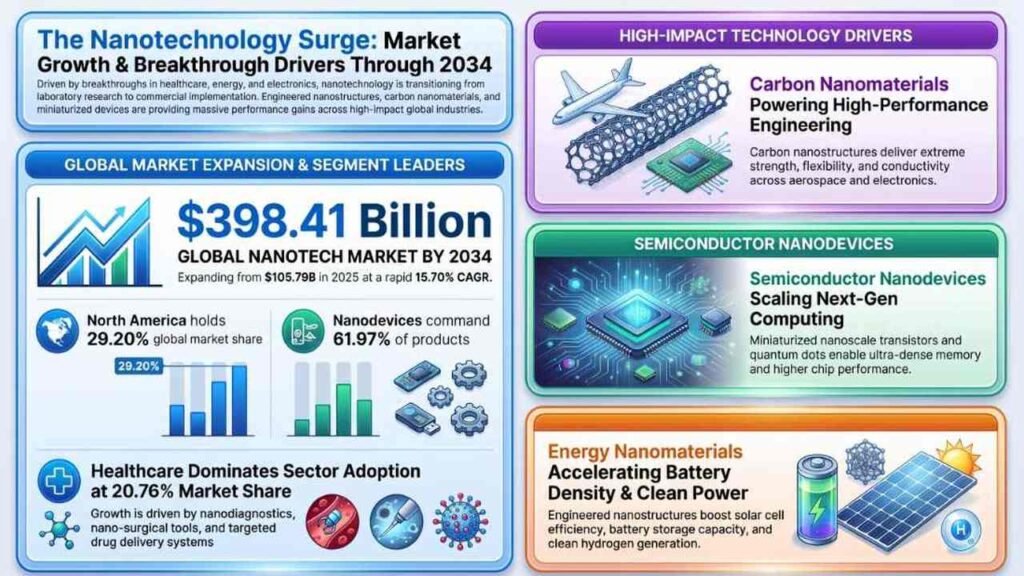
What was once theoretical laboratory research has rapidly matured into a massive commercial reality. Market data indicates the global nanotechnology sector is valued at USD 118.7 billion in 2026, with market analysts projecting expansion to USD 398.41 billion by 2034.
Here are five counter-intuitive, high-impact takeaways from 2026 that illustrate how nanoscale innovations are quietly altering our physical world. From circular electronics to sunlight-triggered medicine, the unseen revolution has officially arrived.
1. We Are Now Turning Plastic Trash into Quantum-Grade Electronics
Traditional synthesis of high-performance carbon nanomaterials via Chemical Vapor Deposition (CVD) has long been hamstrung by massive thermal budgets and a heavy reliance on virgin fossil feedstocks. Modern green nano-fabrication is disrupting this model by leveraging circular chemistry to upcycle post-consumer waste into superior structural inputs.
Leading this charge, Singaporean startup Nanomatics deploys room-pressure, water-free pyrolysis to thermally decompose post-consumer plastic waste. This process converts environmental pollution directly into eco-friendly multi-walled carbon nanotubes (MWCNTs) featuring exceptionally low metal content.
By bypassing virgin fossil resources and eliminating industrial wastewater steps, this circular method slashes industrial carbon footprints while dramatically lowering production costs. The resulting high-conductivity MWCNTs act as vital nanofillers for next-generation energy storage cells and ultra-responsive electronics.
“Circular economy measures facilitate the development of eco-friendly carbon nanotubes directly from plastic and agricultural waste—eliminating fossil resources while reducing industrial carbon footprints.”
2. Sunlight Can Synthesize Cancer-Fighting Nanoparticles in Just Five Minutes
Biomanufacturing oncology drugs usually requires complex chemical reducing agents, energy-intensive autoclaves, and toxic reagents. In a startling green chemistry breakthrough, researchers discovered that ambient sunlight acts as a zero-cost catalyst to synthesize drug-bearing gold nanoparticles in just five minutes using commercial vincristine formulations.
This rapid, one-pot photoreaction completely eliminates toxic reducing agents like sodium borohydride while radically simplifying the manufacturing pipeline for targeted therapies. Crucially, the light-synthesized gold nanoparticles preserve anti-proliferative activity against colon cancer cells (such as Colo-205 models) and demonstrate superior DPPH free-radical scavenging compared to unformulated vincristine.
This breakthrough accelerates a broader nanomedicine market that now commands 20.76% of the global nanotechnology end-user sector. Parallel clinical advancements include bio-polymeric solid lipid nanoshells engineered for controlled drug release, alongside target-responsive DNA nanoprobes that light up tumor margins during fluorescence-guided surgery.
“By encapsulating therapeutic payloads within engineered nanoscale carriers, modern medicine delivers drugs directly to diseased cells, dramatically reducing the toxic side effects of traditional chemotherapy.”
3. Silicon Transistors Have Scaled Down Below One Nanometer
For decades, semiconductor progress was defined by shrinking bulk silicon, moving from 250-nanometer nodes at the turn of the century to physical brick walls driven by quantum leakage. In 2026, chipmakers officially shattered the single-nanometer barrier, proving that sub-nanometer computing is no longer purely theoretical.
IBM spearheaded this milestone with its Nanostack™ architecture at the 0.7-nanometer node, pushing silicon integration to absolute atomic thresholds. Achieving this feat required structural breakthroughs, including 3D nanosheet stacking, ultra-thin dielectric bonding, dual-channel engineering, SRAM scaling, and nanometer-scale transistor integration.
Beyond traditional logic gates, specialized semiconductor nanodevices are opening new frontiers in sensing and data hardware. Dutch startup QDI Systems fabricates lead sulfide-based quantum dots for ultra-high-resolution X-ray imaging, while Swiss startup NanoDecoder utilizes CMOS molecular electronic chips with nanopore sensing to write digital data directly into synthetic molecules for tamper-proof product verification.
4. Nanomaterials Are Harvesting Clean Energy from Human Motion and Zero-Energy Water Filtration
As global energy and resource demands strain centralized infrastructure, engineered nanostructures are decentralizing utility networks. By manipulating physical interfaces at the atomic scale, novel materials are extracting clean power and fresh water directly from local ambient environments.
Key real-world deployments in 2026 include:
- Gravity-Powered Desalination: UK startup Aavalor manufactures scalable graphene nanofiltration membranes that strip out heavy metals, bacteria, and salt using natural gravitational force, completely bypassing energy-hungry high-pressure pumps.
- Kinetic Nanogenerators: Bulgarian startup Nanoacts merges bio-hybrid nanocomposites with real-time artificial intelligence to harvest electrical voltage from mechanical motion and chemical friction, self-powering IoT networks and wearable health monitors.
“Molybdenum disulphide and graphene nanofiltration membranes can filter up to five times more water than conventional systems, delivering clean drinking water at low cost without high energy consumption.”
5. Computational Nanotechnology Has Shortened Material Discovery from Decades to Days
Historical material science relied on painstaking, trial-and-error laboratory synthesis that dragged discovery timelines out over decades. Today, computational modeling powered by genetic algorithms and particle swarm optimization allows scientists to evaluate synthetic “nanoparticle mega libraries” entirely in silico in a matter of hours.
French startup C12 harnesses this atomic precision to grow ultrapure carbon nanotubes atom-by-atom directly onto silicon substrates. By eliminating structural impurities, C12 suppresses nuclear-electron spin coupling noise—the primary source of qubit decoherence that breaks quantum processors.
In the life sciences sector, Belgian startup PUXANO pairs structural biology with nanoscale computational platforms to revolutionize protein engineering. This high-throughput pipeline accelerates target protein characterization and high-resolution design for biopharmaceutical development.
Looking Ahead: Living in an Engineered Reality
The steady accumulation of microscopic breakthroughs—from self-healing industrial coatings and lighter aerospace nanocomposites to smart biosensors—is propelling the nanotech industry toward its projected valuation of USD 398.41 billion by 2034. Atomic-level engineering is no longer an emerging niche, but the underlying backbone of modern material science.
Unlocking this full commercial trajectory still requires conquering critical operational hurdles. Industry leaders are working alongside regulatory agencies to resolve nanotoxicity concerns, standardize mass-production scaling, and establish safe environmental frameworks for long-term deployment.
When every surface, medicine, and microchip around us is engineered at the atomic level, where will the line between natural and synthetic materials finally land?
Discover more from TechResider Submit AI Tool
Subscribe to get the latest posts sent to your email.