Introduction: The Day the Internet Held Its Breath
On October 21, 2026, the global internet experienced a quiet panic. Government portals, municipal services, public transit frameworks, and corporate web platforms across Europe, Asia, and the Americas abruptly went dark. System administrators were not merely dealing with a routine patch Tuesday—they were scrambling to contain a digital wildfire.
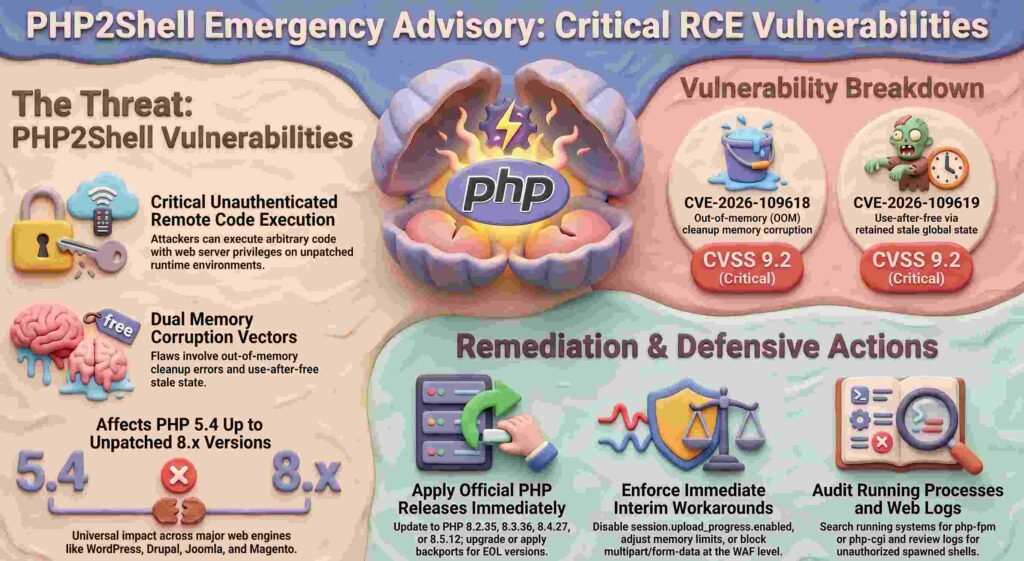
The epicenter of the crisis was a pair of critical flaws in PHP, the bedrock server-side scripting language that underpins over 70% of all websites with known technologies. From massive content management frameworks like WordPress, Drupal, Joomla, and Magento to bespoke enterprise control panels, the affected runtime represents the digital plumbing of the modern web.
Tracked as CVE-2026-109618 and CVE-2026-109619—and collectively dubbed “PHP2Shell”—these vulnerabilities carry a critical CVSS v4.0 score of 9.2. They grant unauthenticated remote code execution (RCE) at the system privileges of the web worker process. Because details leaked ahead of coordinated disclosure, organizations faced an unprecedented, high-stakes sprint to patch before automated exploit engines achieved mass compromise.
Here are the five most unsettling technical and strategic truths exposed by the PHP2Shell emergency—and what they signal for the future of enterprise defense.
AI Discovered a 10-Year-Old Bug—and Then Weaponized the Patch
The underlying vulnerabilities in the PHP runtime were not discovered by traditional manual auditing. Two months prior, researchers at cybersecurity firm Calif uncovered the memory corruption flaws using OpenAI’s tools through the “Patch the Planet” initiative. Simultaneously, cloud security vendor Wiz deployed its autonomous research tool, Wiz Atlas, alongside Google’s Gemini 4 Argon and OpenAI’s GPT-5.6 Sol, identifying flaws lurking in the open-source codebase for over a decade. Wiz and Calif coordinated disclosures across a coalition of infrastructure titans, including Google Cloud, AWS, Microsoft, Automattic, Cloudflare, and Quarkslab.
Before AI, proving such intricate runtime execution paths required hundreds of hours of manual reverse-engineering. Autonomous AI agents eliminated that scaling barrier, surfacing memory lifecycle defects that human audits had missed for ten years.
However, the event immediately demonstrated the adversarial symmetry of AI. Within minutes of the vendor releasing patch commits on GitHub, threat actors used generative models to diff the source code and reverse-engineer the fixes. Within an hour, weaponized proof-of-concept (PoC) exploits were being “vibecoded” and deployed across public scanning networks.
“AI was powering a ‘race to exploit.’ The next step was the ‘mass compromise of every vulnerable web server on the internet.'” — Costin Raiu, Co-founder of TLP: Black
The traditional defender’s advantage—the multi-day “patch gap” between vendor disclosure and reliable exploit development—has officially collapsed. Security teams no longer have days or weeks to evaluate updates; AI has compressed the window between patch publication and active weaponization down to minutes.
World Leaders and Governments Chose “Total Dark Mode”
Faced with automated AI exploitation tools scanning the internet before binary patches could be compiled and distributed, public and private sector leadership made an extraordinary choice: proactive, total offline isolation.
Rather than leaving vulnerable PHP web servers exposed to public traffic, entities worldwide systematically shut down public services:
- Dutch National Cyber Security Centre (NCSC): Severed its own web presence as a precaution, alongside national portal Overheid.nl, the Port of Rotterdam, the Dutch national football association (KNVB), top political party portals, and regional hospital portals.
- French Interior Ministry: Placed official government web properties, including info.gouv.fr, into emergency preventive maintenance.
- Finnish State IT Services (Valtori): Disconnected state public network infrastructure to neutralize public exposure.
- Danish Municipal IT (Kombit): Temporarily offline-isolated national school communication frameworks.
- Wikipedia & Public Infrastructure: Wikimedia engineers took backend administrative systems offline, while commercial platforms like Nintendo and OBS Project temporarily suspended public web utilities.
The operational severity reached the highest levels of statecraft. Japanese Prime Minister Sanae Takaichi issued an emergency alert on X, bypassing standard administrative channels to urge every corporate and public website operator to verify whether live environments ran PHP and prepare for immediate server isolations and upgrades.
It Strikes Before Your App Code (or WAF) Can Even Process It
The most alarming technical aspect of PHP2Shell is where the flaw triggers within the execution lifecycle. Standard application security architectures operate under the assumption that defensive code gets a chance to inspect incoming traffic. PHP2Shell completely invalidates that assumption.
Memory corruption occurs inside PHP’s core C-runtime during initial HTTP request parsing—when the engine processes headers, streams multipart/form-data, or parses session upload tracking. Because the memory fault occurs while PHP is assembling the request context, in-process security tools fail entirely:
[ Incoming HTTP Request ]
│
▼
┌────────────────────────────────────────┐
│ PHP Runtime Request Parsing Phase │ ◄── [PHP2Shell Triggers Here!]
└────────────────────────────────────────┘ (Memory corruption / Crash / RCE)
│
▼
┌────────────────────────────────────────┐
│ Application Framework / Engine Init │
└────────────────────────────────────────┘
│
▼
┌────────────────────────────────────────┐
│ In-Process RASP & Security Plugins │ ◄── [FAILS: Hooks never execute!]
└────────────────────────────────────────┘
│
▼
┌────────────────────────────────────────┐
│ Application Logic (WordPress, etc.) │
└────────────────────────────────────────┘
Runtime Application Self-Protection (RASP) agents, OpenTelemetry hooks, and embedded application firewalls (such as WordPress security plugins) run inside the PHP engine after request parsing completes. When an attacker sends a malicious payload, PHP corrupts memory or aborts before application execution hooks fire. Embedded security plugins never even see the request.
To block attack payloads at the network boundary, Cloudflare had to engineer and deploy a novel “full transaction detection” WAF capability. By evaluating signals from both the initial HTTP request and origin server responses within the same HTTP transaction, Cloudflare deployed managed rules that intercepted attack traffic 9 hours ahead of public vendor disclosure.
The Two Technical Faces of PHP2Shell (CVE Breakdowns)
PHP2Shell comprises two distinct memory corruption mechanisms within the PHP runtime:
Vulnerability & Core Mechanism Impact & Exploitation Path
CVE-2026-109618
Memory corruption triggered during Out-Of-Memory (OOM) handling while parsing multipart/form-data. When memory allocation fails during input parsing, PHP abruptly abandons processing; cleanup routines execute using uninitialized or partially populated internal request data. Enables unauthenticated pre-execution Remote Code Execution (RCE) or denial of service. Attackers exhaust memory limits via crafted multipart form data or application-level allocations to trigger corrupt cleanup routines before application scripts run.
CVE-2026-109619
Use-after-free vulnerability where global state retains pointers to memory freed at the end of a previous request. Interrupted cleanup (via fatal errors, timeouts, or post-reset diagnostics) leaves stale pointers accessed by subsequent requests handled by the same worker process. Enables worker process contamination across recycled HTTP requests. Exploitable via PHP 8.5’s fatal_error_backtraces feature or session lifecycle features like session.upload_progress.enabled to achieve RCE or expose sensitive process memory across request boundaries.
The execution environment dictates the primary attack surface:
- Apache mod_php (Highest Risk): Because mod_php executes engine cleanup routines within the Apache web server worker even when request startup fails, attackers can achieve pre-execution arbitrary code execution reliably without needing valid application endpoints.
- PHP-FPM & php-cgi: PHP-FPM terminates worker processes when startup parsing fails, mitigating pre-startup paths for CVE-2026-109618. However, PHP-FPM is heavily vulnerable post-startup to CVE-2026-109619 across persistent worker recycling loops, where stale global state persists across multiple HTTP requests handled by the same worker process.
Millions of Legacy Systems Are Sitting Ducks Without Patches
While the PHP Project published official binary updates for actively supported branches (PHP 8.2.35, 8.3.36, 8.4.27, and 8.5.12), global telemetry indicates roughly half of all web servers run end-of-life versions (PHP 8.1 and older).
While source-only backports were published for PHP 7.4, 8.0, and 8.1, compiling custom binaries from source is unfeasible for millions of small businesses, legacy appliances, and unmanaged hosting environments.
“That’s the risk with this one: the flaws became public before the fix did, so both sides are starting at the same time… So the question this week is this: do you know where all your PHP is running? If yes, this is an afternoon of updates. If no, the risk is in the systems you’ve forgotten: an old marketing site, a hosting control panel, a device with PHP built in. And speed matters more than ever.” — Joviane Jardim, Senior Security Researcher at Detectify
For engineering teams unable to deploy binary patches immediately, temporary configuration workarounds can mitigate specific execution vectors—provided they are applied with strict operational discipline:
Critical Mitigation Rules & Configuration Safeguards
- Enforce Administrative Configuration Timing: Setting mitigations like memory_limit=-1 (which removes PHP’s per-request cap to disable the predictable allocation failure path) or session.upload_progress.enabled=0 via runtime ini_set() calls or directory-level .user.ini files is completely ineffective. These file overrides execute after initial request parsing begins. Directives MUST be set administratively inside main php.ini files or master PHP-FPM pool configuration files. On PHP 8.5 environments, administrators must also set fatal_error_backtraces=0.
- Mandatory Worker Restarts & Live Request Verification: Any configuration edit requires a full restart of all underlying PHP-FPM, Apache, or LiteSpeed worker processes. Furthermore, administrators must verify active settings via an actual HTTP web request running phpinfo(). Verifying configuration via the command-line interface (php -i) is a dangerous trap because the CLI binary utilizes entirely separate configuration files and execution contexts from web worker pools.
- Avoid Dangerous Workaround Traps: Attempting to mitigate memory exhaustion using container/cgroup memory limits or OS-level process bounds like RLIMIT_AS or RLIMIT_DATA is extremely dangerous. External memory caps enforce abrupt kernel-level allocation failures, which can inadvertently trigger the exact internal OOM cleanup paths exploited in CVE-2026-109618 or terminate master process controllers.
- Enforce Strict Perimeter Input Limits: Set post_max_size = 8M (or 32M where file uploads are strictly necessary) and keep upload_max_filesize below that threshold. Web servers and WAFs should bound request body sizes, header counts, and multipart nesting depth. If an application does not require file upload functionality, block multipart/form-data requests entirely at the reverse-proxy or WAF layer before traffic reaches the PHP interpreter.
Conclusion: The New Reality of System Visibility
The PHP2Shell outage marks a permanent shift in cyber defense. When autonomous AI engines scan open-source codebases, reverse-engineer binary commits, and synthesize functional exploits in under an hour, perimeter security based on reactive patch schedules is no longer viable.
True resilience depends on absolute runtime asset visibility. Security teams must inventory PHP deployments from live execution evidence—identifying active process names like php-fpm, php-cgi, and embedded binaries bundled inside third-party appliances—rather than relying on stale CMDB records or static software manifests.
Do you truly know every legacy script, third-party appliance, or hosting control panel running in your environment today?
Discover more from TechResider Submit AI Tool
Subscribe to get the latest posts sent to your email.