1. The Death of the “Passive” Smart Device
For the past decade, the Internet of Things (IoT) promised to seamlessly digitize our physical world. Yet, if we are being honest, most “smart” devices today remain frustratingly passive. Your connected thermostat, smart factory vibration monitor, or agricultural soil sensor functions primarily as a glorified, over-engineered data logger. It collects telemetry, packages a log, and transmits it upward to the cloud, where static rules engines or centralized dashboards make rudimentary decisions.
As the global network footprint explodes toward tens of billions of connected endpoints—with industry forecasts projecting up to 75 billion devices worldwide—this cloud-dependent, passive model is reaching its breaking point. Traditional IoT and AIoT (Artificial Intelligence of Things) architectures rely on centralized, task-specific, pre-trained machine learning models or simple “if-this-then-that” event-driven rules. When real-world physical conditions diverge from these pre-programmed parameters, the system breaks. Traditional setups cannot reason through physical friction, adapt to sudden network degradation, or negotiate complex multi-device tasks on the fly.
We are witnessing a monumental architectural pivot. By marrying autonomous Agentic AI with next-generation Low-Power Wide-Area Networks (LPWAN) and decentralized edge computing, physical hardware is evolving from passive data reporters into active cognitive entities. Connected devices are gaining the capacity to perceive their physical environment, reason through ambiguous events, construct dynamic execution plans, trigger physical actions, and continuously learn from operational outcomes.
Here are the five transformative technical advancements bridging physical hardware with cognitive AI, low-power long-range networks, and cross-layer security frameworks.
2. Connected Devices Are Gaining Minds of Their Own (“Agentic IoT”)
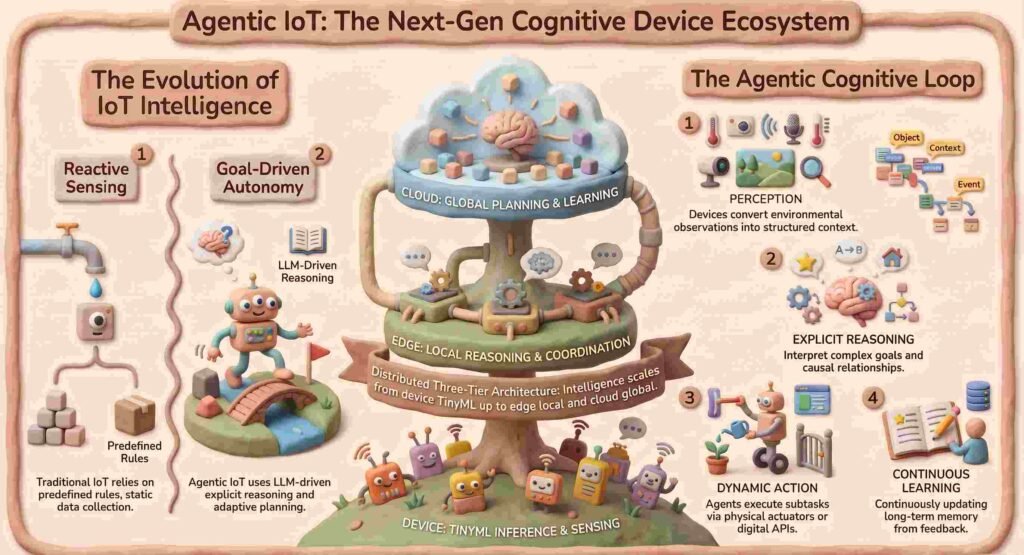
The transition from traditional IoT to AIoT integrated predictive analytics and ML classification into edge streams. However, AIoT remains fundamentally reactive and model-locked. Agentic IoT marks a radical paradigm shift: transforming connected hardware from isolated sensing nodes into distributed cognitive agent ecosystems operating seamlessly across the device-edge-cloud continuum.
Instead of running rigid, linear execution pipelines, Agentic IoT endpoints execute a continuous, stateful Agent Cognitive Loop:
Perceive \longrightarrow Reason \longrightarrow Plan \longrightarrow Act \longrightarrow Learn
- Perceive: The agent ingests raw sensor telemetry, system state metrics, and peer messages, translating them into structured, context-aware information.
- Reason: Utilizing explicit reasoning frameworks (such as Chain-of-Thought or ReAct), the agent evaluates evidence, weighs operational trade-offs, and analyzes why an anomaly or state shift is occurring relative to its overall system goals.
- Plan: The agent dynamically decomposes high-level instructions into multi-step execution paths, recalculating workflow steps if local physical conditions unexpectedly drift.
- Act: The agent triggers local physical actuators, calls external APIs, or delegates specialized sub-tasks to neighboring devices.
- Learn: The agent evaluates the real-world impact of its action against operational targets, updating its memory buffers to refine future cognitive cycles.
“Agentic IoT is a next-generation cognitive IoT paradigm that transforms IoT from networks of connected devices into distributed cognitive agent ecosystems by integrating the perception, reasoning, planning, learning, and action capabilities of autonomous AI agents with cyber-physical systems.”
To execute this cognitive loop across constrained hardware without creating systemic operational bottlenecks, Agentic IoT relies on a Three-Tier Reference Architecture:
- Tier 1: Device Agents (Physical/Device Layer): Embedded directly on microcontrollers (MCUs), sensors, and actuators. Armed with hyper-compact TinyML models, these agents run millisecond-level perception and immediate physical actuation loops directly at the data source.
- Tier 2: Edge Agents (Edge/Fog Layer): Situated on local industrial gateways, edge servers, and fog nodes. They maintain short-term operational context, execute multi-device tactical reasoning, manage local task coordination, and host critical protocol bridging.
- Tier 3: Cloud Agents (Cloud/Intelligence Layer): Positioned on scalable cloud platforms. These agents manage global planning, orchestrate long-term memory via Retrieval-Augmented Generation (RAG), run macro-analytics, and refine global system policies.
Crucially, spanning all three layers is the Cross-Layer Agentic Intelligence Plane. Rather than trapping intelligence in isolated hardware silos, this unified plane binds shared modules—for Memory, Tool Use, Communication, Coordination, and Safety & Governance—across every tier. This structure ensures that a safety policy or governance constraint defined in the cloud is enforced symmetrically when a Device Agent triggers a valve on an factory floor, preventing dangerous reasoning and security gaps.
By equipping physical hardware with multi-step reasoning, autonomous agents can independently resolve factory line friction, optimize precision agricultural irrigation based on live weather shifts, or reroute urban traffic grids without waiting for cloud-bound human oversight.
3. Small Language Models (SLMs) Are Bringing Brainpower Straight to the Edge
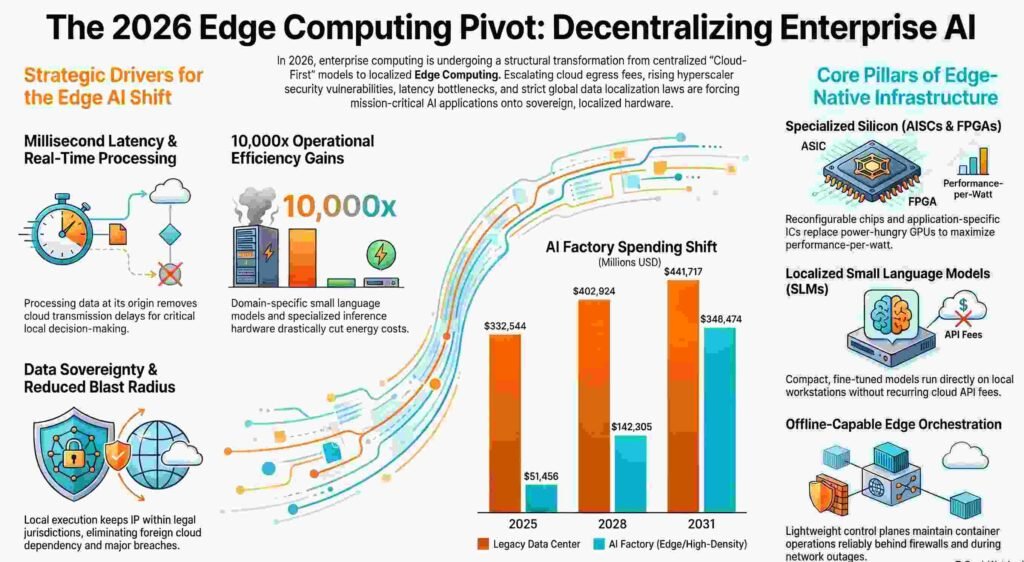
Historically, executing high-level semantic reasoning required routing data streams to massive cloud Foundation Models. In real-world physical environments, however, cloud dependence introduces unacceptable latency, skyrocketing bandwidth expenses, serious data privacy risks, and catastrophic failure during network dropouts.
The solution lies in the rapid rise of Edge-Native Small Language Models (SLMs). Breakthrough compact architectures—such as DeepSeek-R1 Distill, Falcon 3, SmolLM2, LLaMA 3.2, and vision-language edge models like SmolVLM2 (ranging from 256M to 500M parameters for edge-level visual perception)—are packing advanced reasoning, tool calling, and multimodal understanding into small parameter footprints ranging from 135 million to 3 billion parameters.
Architectural innovations are specifically tailored for resource-constrained edge endpoints. For example, models like Falcon-E utilize novel hybrid architectures (Transformer + Mamba) optimized specifically for CPU-only inference on low-power microcontrollers (MCUs). When combined with post-training quantization (compressing weights to INT4 or INT8 precision) and specialized TinyML execution runtimes, these SLMs run high-level cognitive logic directly on local hardware.
The Edge SLM Execution Pipeline:
- Cloud Foundation Models (Massive reasoning core & policy generation)
- \downarrow (Quantization to INT4/INT8 & Knowledge Distillation)
- Edge-Native SLMs (DeepSeek-R1 Distill, Falcon-E, SmolLM2, SmolVLM2, LLaMA 3.2)
- \downarrow (TinyML & CPU-Optimized Hybrid Runtimes)
- Constrained Hardware & Gateways (Direct sub-second local inference at the physical edge)
Bringing direct high-level cognition to edge hardware provides three non-negotiable operational advantages:
- Sub-Second Local Latency: Reasoning cycles and decision processing complete locally in milliseconds at the physical point of data generation.
- Enhanced Data Privacy: Sensitive video, audio, and physical telemetry remain safely on-premises rather than streaming continuously over public networks.
- Total Offline Autonomy: Devices and edge gateways preserve local reasoning, planning, and operational safety even when cloud connectivity is completely lost.
4. The Unlikely Marriage of Legacy IoT Protocols and AI Protocols
A fundamental challenge in modern industrial engineering is protocol fragmentation. Traditional IoT hardware relies on ultra-lightweight telemetry protocols built strictly to minimize byte counts over constrained radio links. Conversely, modern generative AI agents operate over complex semantic protocols designed for rich context exchange, tool discovery, and task negotiation.
Legacy telemetry protocols fail when applied directly to agentic reasoning: protocols like MQTT and CoAP are exceptional at pushing raw metrics, but they lack native semantic mechanisms for capability advertising, goal negotiation, multi-agent task delegation, and external tool invocation.
To bridge this gap, Tier 2 Edge Agents act as a bi-directional Protocol Bridge, establishing a clear semantic boundary where raw data transforms into context, and abstract agent plans convert into byte-level hardware commands.
Telemetry Protocols vs. Cognitive Protocols:
- Telemetry Protocols (MQTT, CoAP, COSE): Optimized for low-bandwidth, high-latency, or power-constrained devices. Data payload structures leverage COSE (Concise Binary Object Representation)—which utilizes compact CBOR binary structures rather than verbose text formats like JSON—to drastically compress packet sizes and minimize radio bandwidth consumption on microcontrollers.
- Cognitive Protocols (MCP, A2A, ACPs): Standardized interaction frameworks designed for autonomous AI agents. The Model Context Protocol (MCP) standardizes tool, API, and context integration. The Agent-to-Agent (A2A) protocol and Agent Collaboration Protocols (ACPs) manage multi-agent registration, capability discovery, task decomposition, and inter-agent collaboration.
The Edge Protocol Bridging Workflow:
- Physical Sensors & Actuators \longleftrightarrow [MQTT / CoAP / Binary COSE] \longleftrightarrow Edge Agent Protocol Bridge \longleftrightarrow [MCP / A2A / ACPs] \longleftrightarrow Cloud & Peer Autonomous Agents
Upward, the Edge Agent ingests raw MQTT payloads, CoAP datagrams, or compact binary COSE objects, assembling them into semantically rich, structured observations that language models can evaluate. Downward, when an agent formulates an operational plan using high-level standards like MCP or A2A, the Edge Agent translates those abstract goals back into precise, binary-encoded commands understood by physical machinery.
5. The End of Battery Changes (LPWAN 2.0 & Energy Harvesting)
Autonomous physical intelligence is useless if remote endpoints require constant maintenance or run out of battery after a few weeks. Scalable outdoor deployments—such as precision agriculture, remote asset tracking, regional smart water grids, and environmental hazard monitoring—cannot support manual battery replacements or wired grid infrastructure.
Next-generation Low-Power Wide-Area Networks (LPWAN 2.0)—including LoRaWAN, Sigfox, and Narrowband IoT (NB-IoT)—resolve the wide-area communication challenge. Operating in sub-GHz unlicensed and licensed spectrum bands (such as 868 MHz in Europe and 915 MHz in North America), these signals achieve long propagation distances—reaching up to 15 kilometers in rural environments—while penetrating dense urban concrete, physical barriers, and underground utility vaults.
To maintain continuous field operations for up to a decade on minimal energy budgets, LPWAN endpoints integrate cutting-edge power conservation mechanisms:
- Adaptive Power Management: Endpoints utilize aggressive duty-cycling and deep-sleep modes, waking up for millisecond bursts only to run local TinyML perception routines or transmit compressed telemetry.
- Low-Power System-on-Chip (SoC): Highly integrated silicon combines the processing core, memory, and radio transceivers into a single die, drastically reducing active and idle current draws.
- Ambient Energy Harvesting: Next-gen endpoints harvest environmental energy using mini solar cells, thermal gradient generators, and kinetic movement converters. By pairing low-power silicon with ambient energy harvesting, sensors achieve self-sustaining, battery-less operational lifespans.
Furthermore, LPWAN 2.0 operates alongside complementary next-generation cellular technologies: 5G-Advanced URLLC (Ultra-Reliable Low-Latency Communication) and Network Slicing. While sub-GHz LPWAN handles long-range, low-power telemetry, 5G-Advanced network slices allocate dedicated, low-latency pipes for high-bandwidth edge agents, forming a robust, multi-tier wireless backbone.
6. Zero Trust & Immutable Ledgers for Autonomous Physical Actions
When software agents gain the authority to alter physical reality—opening industrial fluid valves, overriding high-voltage circuit breakers, executing automated financial micro-transactions, or dispatching autonomous delivery drones—traditional perimeter cybersecurity becomes dangerously obsolete. If an agent’s reasoning loop is hijacked or corrupted, the failure mode is no longer just a data breach; it is a physical safety incident.
Securing autonomous physical actions requires a multi-layered governance architecture combining continuous identity verification, automated threat monitoring, and immutable auditing:
Zero Trust Architecture (ZTA) & Micro-Segmentation
Operating under the Principle of Least Privilege, Zero Trust assumes no implicit trust across any device, agent, or network segment. Every action request undergo continuous verification based on live device health, cryptographic identity, and contextual risk. Micro-segmentation isolates physical networks into compartmentalized zones, ensuring that if a single edge sensor is compromised, the breach cannot cascade across the broader industrial facility.
Lightweight Cryptography (ECC & COSE)
Resource-constrained microcontrollers lack the processing power and memory overhead for heavy legacy encryption standards like RSA. Elliptic Curve Cryptography (ECC)—utilizing algorithms like ECDH for key exchange and ECDSA for digital signatures—delivers robust public-key security with dramatically smaller key sizes and minimal computational overhead. Paired with compact binary COSE formatting, every physical action is cryptographically signed and encrypted without saturating narrow network channels.
AI-Driven Intrusion Detection (IDPS)
Modern edge networks deploy Intrusion Detection and Prevention Systems (IDPS) powered by lightweight machine learning algorithms. By continuously analyzing network traffic patterns and behavioral baselines directly at the gateway layer, these systems detect subtle anomalies—such as an agent attempting uncharacteristic tool calls or unexpected lateral movements—and isolate suspect endpoints in real time.
Secure Cryptographic OTA Firmware Updates
Maintaining long-term device integrity requires robust Over-The-Air (OTA) firmware updates. Modern edge update frameworks mandate digital signatures and cryptographic hashing to verify the source and authenticity of all binary updates before installation. Built-in, automated hardware rollback mechanisms ensure that if an update fails, corrupts, or introduces unexpected errors, the device automatically reverts to a known safe firmware state, preventing remote device bricking.
Blockchain & Smart Contracts
To establish transparent, multi-vendor accountability across autonomous agent networks, distributed ledgers provide an immutable, tamper-proof record of every agent decision, physical actuation, and configuration update. Smart contracts act as automated, code-enforced security guardians—validating access rights, enforcing operational safety parameters, and executing peer-to-peer device transactions without relying on a centralized intermediary.
Cross-Layer Security Architecture:
- Continuous Verification Layer: Zero Trust Least-Privilege Verification \rightarrow Dynamic Network Micro-Segmentation
- Cryptographic Layer: ECC (ECDH / ECDSA) Digital Signatures \rightarrow Binary COSE Data Protection
- Monitoring & Lifecycle Layer: Machine Learning IDPS Traffic Anomaly Detection \rightarrow Cryptographic OTA Updates with Auto-Rollback
- Audit & Governance Layer: Blockchain Immutable Transaction Logs \rightarrow Smart Contract Automated Policy Enforcement
7. The Path Forward into the Physical Web
We are stepping across the threshold of a major shift in computing. The Internet is migrating out from behind glass screens and cloud data centers, embedding itself directly into the physical infrastructure of our daily lives.
The convergence of Agentic AI, edge-native Small Language Models, LPWAN 2.0, protocol bridging, and Zero Trust cross-layer governance is permanently dismantling the era of the passive, reporting-only smart device. In its place, we are building self-aware, cognitive ecosystems capable of understanding local physical context, planning multi-step actions, optimizing resources, and protecting their own operational integrity in real time.
As these autonomous software agents assume direct stewardship over our smart factories, energy grids, supply chains, and municipal infrastructure, a crucial question shifts from the technical to the societal:
When machines begin reasoning, coordinating, and acting on our behalf in the physical world, how will we design the trust, safety boundaries, and legal accountability necessary to live alongside them?
Discover more from TechResider Submit AI Tool
Subscribe to get the latest posts sent to your email.