1. The Death of the 2015 Backlink Playbook
Most off-page strategies executed today are fundamentally broken, built on recycled relics from a decade ago. If your search team is still grinding out low-tier guest posts, spamming webmasters with generic cold emails, or chasing transactional link schemes, you are throwing budget into an algorithmic void. Search engines have evolved far beyond the simple manipulation of hyperlink counts, rendering legacy 2015-era playbooks obsolete.
Discovery is no longer constrained to traditional Google blue links. We have officially entered the era of AI-driven discovery engines and Large Language Models (LLMs) like ChatGPT, Perplexity, and Google’s AI Overviews. These platforms do not evaluate authority merely by counting raw PageRank; they reconstruct industry authority through context, entity relationships, and verifiable consensus across trusted networks.
To secure visibility across both classic search engine results pages and AI-generated answers, executive search leaders must pivot immediately. Modern link building is no longer about raw link volume; it is about establishing verifiable brand authority and feeding contextual vectors to search systems.
2. You’re Not Just Building Links for Google Anymore—You’re Feeding AI Engines
Backlinks are no longer evaluated solely as conduits for passing PageRank equity. In the age of Answer Engine Optimization (AEO) and Generative Engine Optimization (GEO), Large Language Models and AI search engines digest off-page signals mechanically through entity mapping and semantic relationship extraction. During retrieval-augmented generation (RAG) and model training phases, LLMs ingest unstructured web text to map brand entities within multi-dimensional knowledge graphs. Rather than calculating raw mathematical link weight, these systems measure weighted co-occurrence vectors—evaluating how frequently and contextually your brand entity appears alongside trusted industry topics, competing entities, and authoritative sources.
This mechanical shift completely upends traditional SEO dogma surrounding “nofollow” links. For years, SEOs discarded links tagged with rel="nofollow", rel="sponsored", or rel="ugc" as useless because they did not pass traditional PageRank. Today, Google treats these attributes as contextual processing hints, while LLMs consume the surrounding semantic text regardless of HTML tags. A landmark study conducted by Semrush and Growth Advisor Kevin Indig demonstrated that nofollow links and unlinked brand mentions impact AI search visibility at virtually the same rate as standard dofollow links.
Search systems and LLMs use these references as co-citations to validate that your brand is an industry leader. If you evaluate off-page campaigns purely through the lens of dofollow link equity, you are completely blind to how modern AI discovery platforms establish brand trust.
Google officially clarified its processing model for link attributes:
“All the link attributes—sponsored, ugc, and nofollow—are treated as hints about which links to consider or exclude within Search. We’ll use these hints—along with other signals—as a way to better understand how to appropriately analyze and use links within our systems.”
Validating this mechanics-first view, Semrush’s study on AI search performance confirmed:
“Nofollow links can still improve your AI visibility, too… link placement and context likely matter more than whether the link is nofollow.”
3. The Critical Divide Between “Link Producers” and “Association Producers”
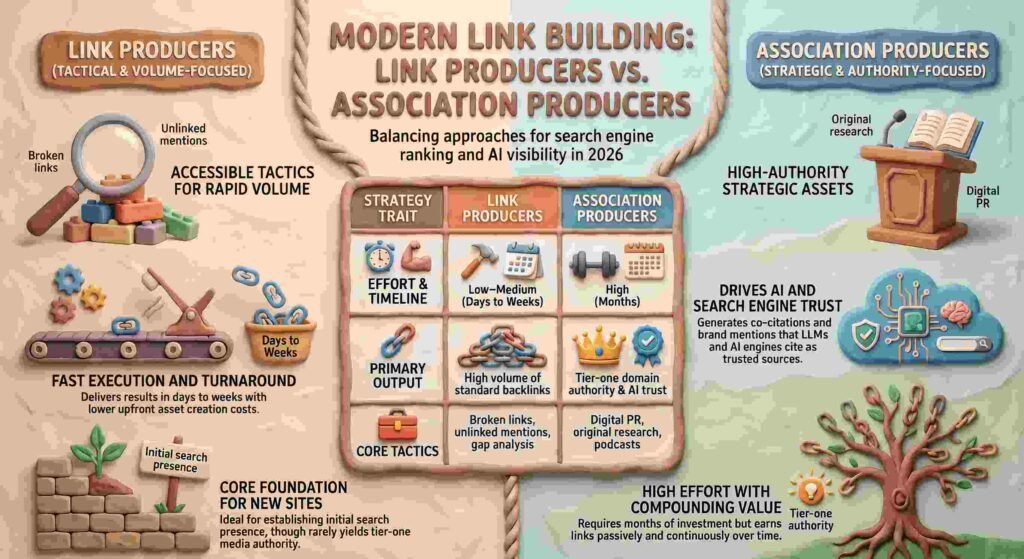
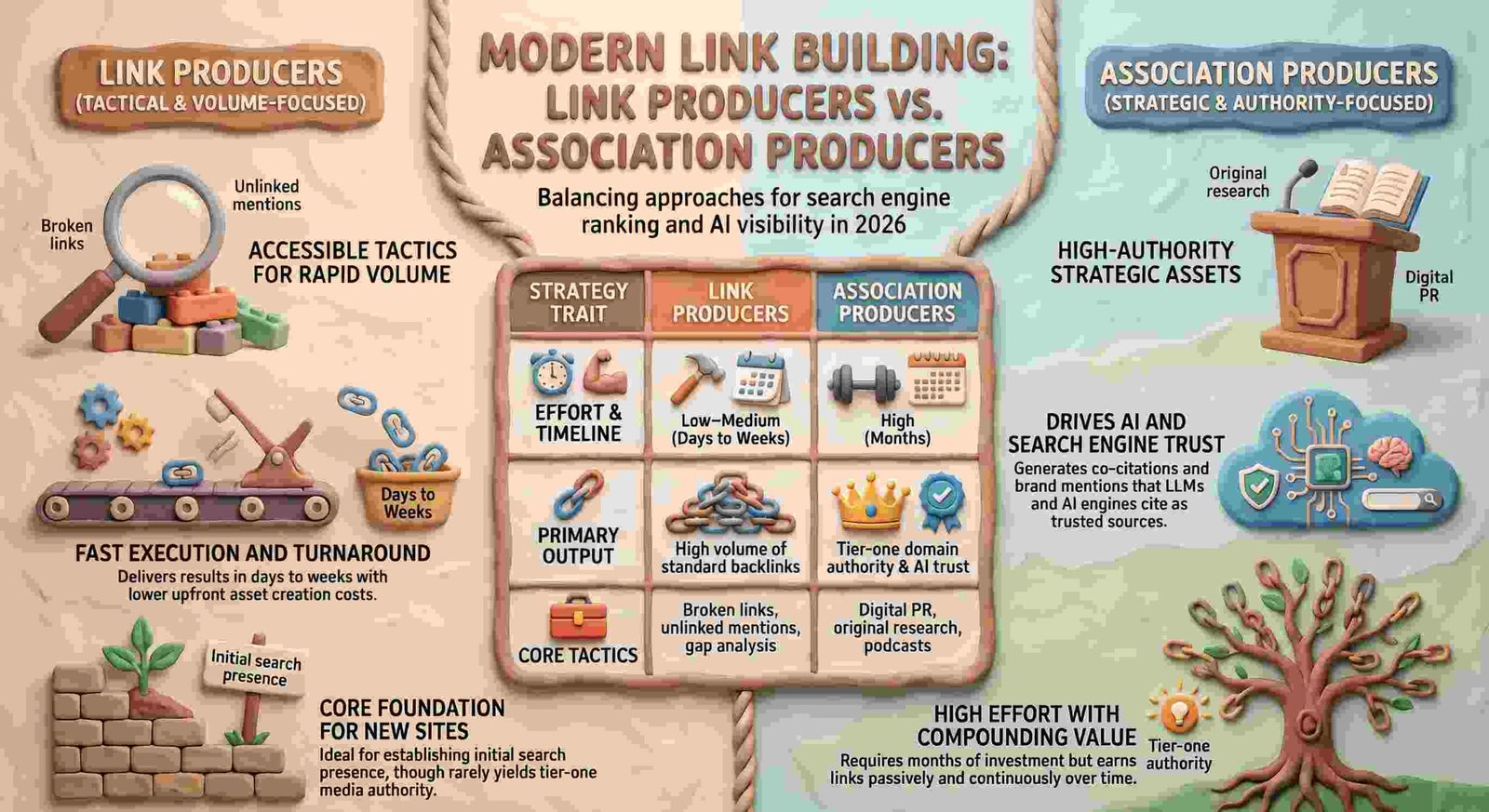
If your off-page strategy does not explicitly separate Link Producers from Association Producers, you are misallocating your SEO budget. Modern off-page tactics split into two distinct operational categories, each serving a fundamentally different function in search and AI ecosystems.
Link Producers encompass accessible, repeatable tactics (such as broken link building, unlinked mention reclamation, and competitor link analysis) focused primarily on securing standard hyperlinks. While essential for establishing foundational link volume and catching up to competitor baselines, they rarely generate strong brand association signals. Conversely, Association Producers—including Digital PR campaigns, proprietary data research, and strategic media placements—demand far more effort but embed your brand directly into high-authority, topically relevant environments.
| Category | Primary Tactics | Main Benefit |
| Link Producers | Email outreach, broken link building, reclaiming lost links, competitor link gap replication, resource page submissions | Highly accessible, predictable execution that scales foundational link volume and maintains backlink baselines |
| Association Producers | Digital PR, original data research, expert sourcing (HARO/Featured/Qwoted), tier-one media pitching, partner directories | Forges powerful entity co-occurrences, yields top-tier media references, and directly expands AI & search visibility |
To maximize organic ROI, enterprise marketing leaders must implement an explicit strategic split: allocate a baseline 20% operational cadence to Link Producers for quick tactical wins and backlink maintenance, while directing 80% of resources toward high-impact Association Producers. Relying exclusively on high-volume Link Producers leaves your brand vulnerable because standard hyperlinks without rich topical context do not build the brand equity LLMs look for. Association Producers generate the co-citations and entity co-occurrences required to establish industry category dominance in both search engines and AI engines.
4. Original Research Is the Ultimate Currency (95.9% of Digital PR Pros Agree)
Generic, surface-level blog content no longer earns high-authority editorial citations. In a search environment flooded with commodity AI content, primary data is the ultimate currency for acquiring unpurchasable backlinks. Industry survey data reveals that 95.9% of Digital PR professionals now prioritize data-led content as their primary link-earning strategy—because journalists, editors, and research analysts require concrete evidence to validate their stories.
However, dumping raw data onto a page will fail. Winning off-page strategies excel at “turning spreadsheets into stories.” Enterprise content teams must synthesize raw metrics into definitive narratives, supporting findings with clear visualizations, charts, and key takeaway cards that journalists can instantly embed into their coverage. Furthermore, publishing a rigorous, transparent methodology—detailing sample sizes, collection timelines, and analytical frameworks—instills journalistic confidence, transforming your asset into the definitive primary source for an entire category.
As highlighted by TrafficSoda’s research on unpurchasable authority assets:
“Proprietary research is particularly useful because it’s something no one else can recreate. This means it becomes a primary source that writers and researchers cite directly, yielding you a backlink.”
When you publish proprietary datasets or industry benchmark reports, you build an enduring link engine. Long after publication, writers researching industry statistics will continuously discover and cite your primary data, generating compounding, high-authority backlinks that competitors cannot buy or replicate.
5. Podcast Guesting Is an Underutilized Backlink & Authority Engine
Executive podcast guesting is one of the most underutilized off-page authority levers in digital marketing. Appearing as an expert guest on niche industry podcasts creates a multi-layered footprint of high-value touchpoints—generating contextual brand mentions, social citations, and valuable backlink equity.
To execute this strategy effectively, search leaders must understand a key technical distinction: major podcast directories like Spotify and Apple Podcasts issue standard rel="nofollow" links on their platform pages. However, individual show hosts and self-hosted podcast websites almost universally publish episode pages and detailed show notes containing indexable, contextually rich dofollow links. These host domain backlinks pass significant authority directly to your target URLs.
The power of this multi-touchpoint approach is demonstrated in a Rephonic case study analyzing entrepreneur Alex Hormozi. By guesting on over 100 industry podcasts over a nine-year period, Hormozi constructed a massive backlink profile dominated by host domain websites and podcast platforms. This systematic guesting cadence built immense domain authority and brand recognition simultaneously.
Podcast link building succeeds where cold email outreach fails because it operates on a genuine value exchange. Instead of begging a webmaster for a link, you provide podcast hosts with high-value expert content for their audience. In return, your domain receives authoritative dofollow backlinks embedded directly within relevant conversational context.
6. Digital PR Has Officially Replaced Traditional Link Outreach
Transactional link outreach is dead. Mass cold pitching for guest posts or resource link additions yields diminishing returns and exposes brands to algorithmic penalties. According to industry data from Outpace SEO, 48.6% of SEO professionals now rank Digital PR as the single most effective method for acquiring high-authority backlinks.
Digital PR replaces transactional outreach with real journalist value: newsjacking breaking industry stories, launching original data campaigns, and providing expert commentary via journalist-sourcing platforms such as Help a Reporter Out (HARO), Featured, and Qwoted.
To succeed operationally in Digital PR, enterprise teams must overhaul their outreach mechanics. Journalists operate under extreme deadline pressure; pitches that open with fluff or formal introductions get deleted immediately. Winning pitches lead directly with the strongest data point or primary executive credential in the first sentence, answer the core query concisely, and land strictly within narrow journalist response windows—often within hours of a query going live.
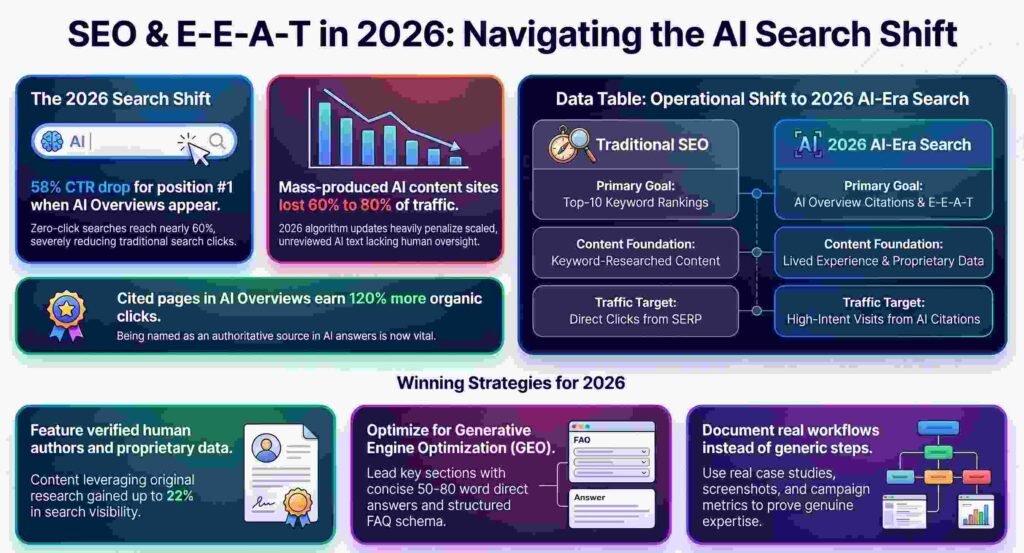
This approach aligns directly with Google’s E-E-A-T (Experience, Expertise, Authoritativeness, and Trustworthiness) guidelines. Editorial citations and quotes in tier-one media outlets carry an organizational trust signal that automated outreach or low-tier guest posts can never replicate. When major trade publications cite your executives, both Google and AI search platforms recognize your brand as a vetted industry leader.
7. The Future of Authority in an AI-First World
The off-page SEO playbook has been permanently rewritten. In an AI-first search environment where ChatGPT, Perplexity, and Google AI Overviews synthesize web content in real time, off-page success can no longer be measured by raw link volume or transactional guest post tallies. The future of search authority belongs to brands that generate genuine value exchange, forge unmistakable entity co-citations, and publish proprietary data that the rest of the web is forced to cite.
Are you still wasting budget grinding out legacy 2015-era guest posts, or are you building authority assets worth citing in 2026?
Discover more from TechResider Submit AI Tool
Subscribe to get the latest posts sent to your email.