For years, quantum computing inhabited a fragile boundary zone between theoretical physics and experimental laboratory hype. The industry discourse was dominated by Noisy Intermediate-Scale Quantum (NISQ) systems—delicate setups where 50 to 200 physical qubits decohered in microseconds, and gate error rates ranging between 10^{-3} and 10^{-2} restricted operations to shallow research pilots rather than production-grade enterprise workloads.
That boundary has officially dissolved. In 2026, quantum computing crossed critical engineering thresholds, shifting decisively from speculative physics experiments into a functional, scalable engineering discipline. Below is an analyst’s distillation of the top five most impactful, surprising takeaways defining this historic transition.
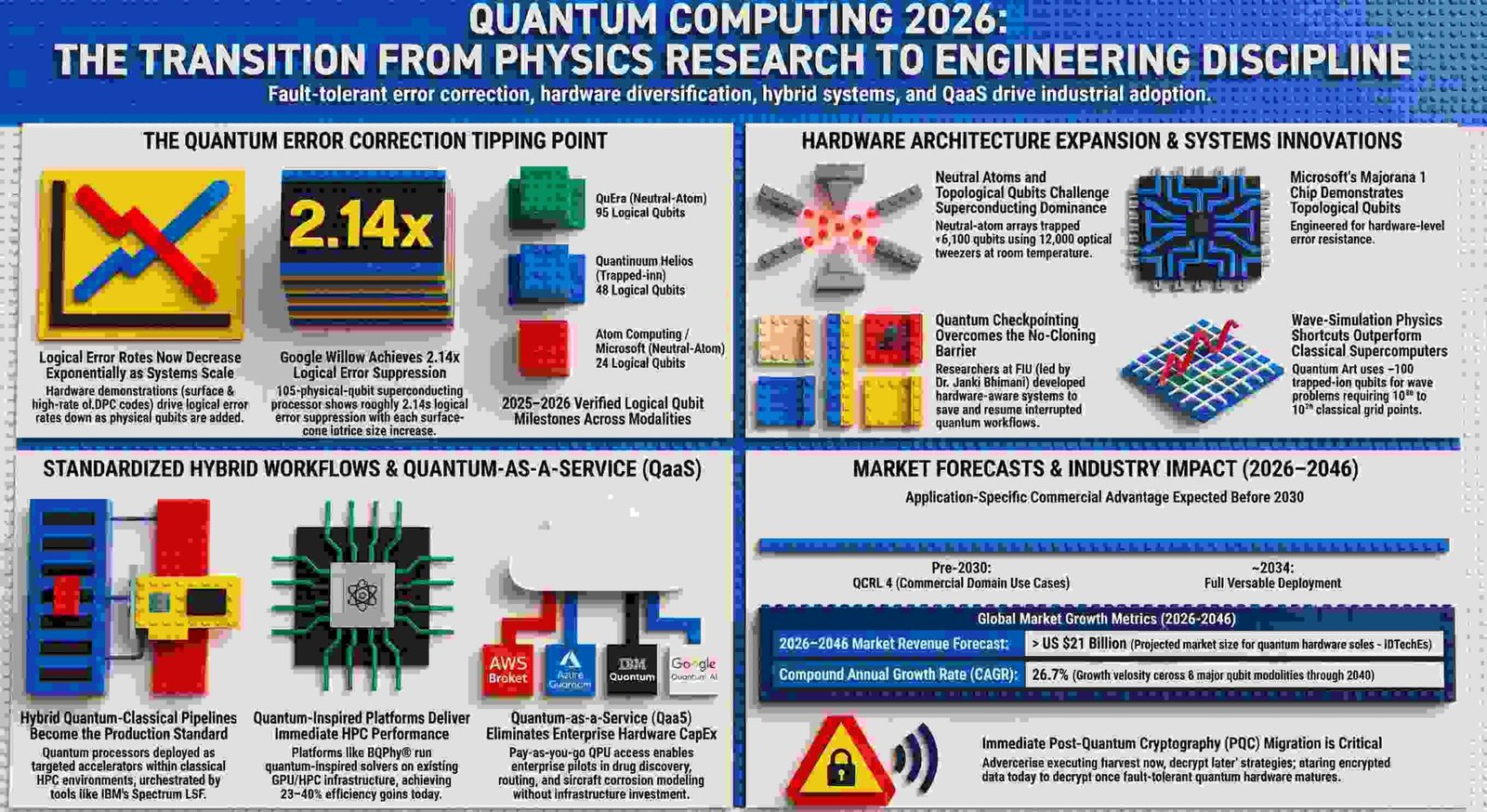
Error Correction Reaches an Engineering Tipping Point
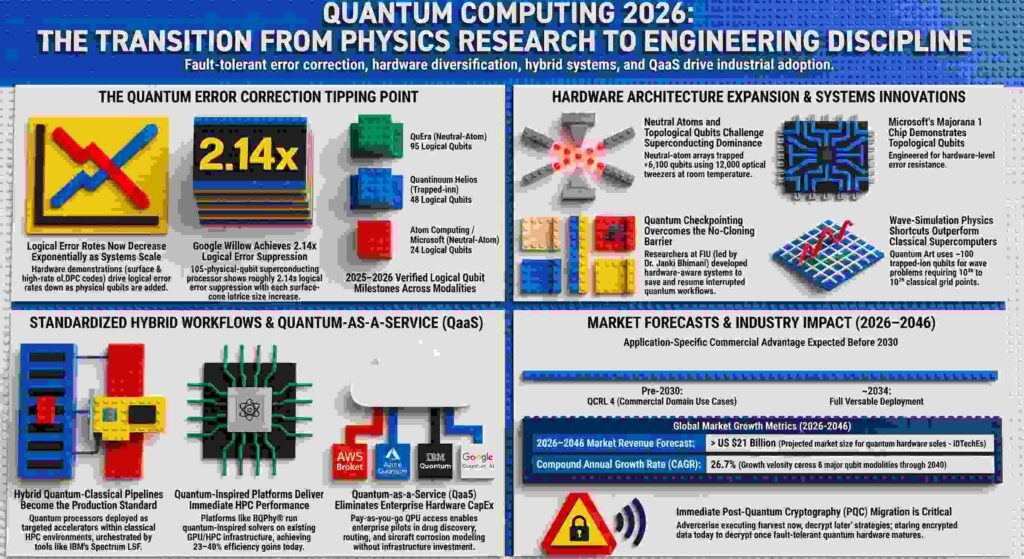
Entering 2026, qubit fragility remained the central bottleneck in quantum system architecture. Hardware developers faced a multi-decade dilemma: adding more physical qubits typically introduced more system noise, compounding overall error rates faster than the hardware could correct them. In 2026, leading hardware developers reached an monumental engineering tipping point, proving empirically that scaling up physical qubit counts in an error-correcting code exponentially suppresses logical error rates.
This threshold transition was demonstrated across several prominent hardware modalities:
- Google’s Willow Processor: A 105-physical-qubit superconducting architecture demonstrated that logical error rates fall exponentially—suppressing errors by a factor of approximately 2.14\times with each increase in surface-code lattice size. Willow provided the first hardware-scale proof that fault-tolerant architectures follow theoretical scaling curves.
- Atom Computing: Utilizing neutral-atom hardware, researchers created and entangled 24 logical qubits built from 112 physical qubits, subsequently executing algorithm circuits across 28 logical qubits running the Bernstein–Vazirani algorithm. Crucially, neutral-atom array reconfigurability enabled dynamic logical qubit allocation—allowing physical arrays to be repositioned on the fly to support varying logical circuit topologies.
- QuEra: Pushed neutral-atom capabilities into high-rate quantum Low-Density Parity-Check (qLDPC) codes, achieving a landmark milestone by encoding up to 96 logical qubits. QuEra demonstrated a clear engineering roadmap toward the “Teraquop regime”—defined as achieving roughly one error per trillion logical operations (10^{-12}).
This transition fundamentally alters software development roadmaps. Software engineers no longer need to write custom error-mitigation routines for individual, noisy physical qubits; instead, software compilers can now target standardized, abstracted logical qubit interfaces with predictable design parameters.
The transition from physical qubit metrics to fault-tolerant logical abstractions marks the end of the NISQ era. Raw physical qubit counts are now secondary to logical qubit fidelity, turning error correction into a predictable design parameter for enterprise hardware and software roadmaps.
Solving the Quantum “Save Game” Paradox with Checkpointing
In classical high-performance computing (HPC), complex calculations rely heavily on “checkpointing”—periodically saving the exact program state to non-volatile storage so that long-running workflows can immediately resume if interrupted by a hardware failure. In quantum computing, however, this capability is blocked by a fundamental physical law: the no-cloning theorem of quantum mechanics, which strictly forbids copying an unknown quantum state exactly. Because quantum states are extremely fragile, system interruptions or unexpected decoherence historically meant losing all computational progress and restarting from scratch.
To resolve this system architecture bottleneck, computer systems designer Janki Bhimani and her research team at Florida International University (FIU) engineered novel methods for “quantum checkpointing.” Designed to restore and restart interrupted quantum workflows across real-world IBM quantum hardware, their approach directly integrates physical QPU constraints and device properties rather than relying on idealized theoretical abstractions.
From an enterprise operations perspective, this systems-level checkpointing mechanism prevents catastrophic state loss, optimizing expensive QPU Quantum-as-a-Service (QaaS) duty cycles and preserving limited cloud compute budgets across deep-compute domains like hurricane and climate modeling, drug discovery, and quantum machine learning.
“Scientists working on everything from new drugs to hurricanes would benefit from saving their progress because today’s quantum computers are error-prone and can’t save. That’s what makes quantum checkpointing so exciting, the problem stretches from quantum theory to hardware limitations and finding a solution will impact science and society.” — Janki Bhimani, Director of the Data Management Research Laboratory, FIU
Using Wave Physics as an Algorithmic Shortcut
Simulating wave propagation—whether radio signals across urban environments, acoustic waves through architectural structures, or seismic waves through earth strata—demands astronomical classical compute capacity. A standard 3D simulation spanning tens of kilometers accurate to the centimeter requires between 10^{18} and 10^{21} classical grid points—a scale far exceeding the practical capacity of today’s largest supercomputers. Prior quantum algorithms attempted to solve these systems by treating wave physics as a generic, brute-force linear algebra problem, expending vast compute resources searching mathematical state spaces that violated basic physical conservation laws.
Quantum Art introduced a paradigm shift by embedding physical wave laws directly into algorithmic construction. Because a wave of a given frequency travels at a fixed speed within a uniform medium, every direction it can physically travel traces a perfect circle in vector space; any coordinate off that circle is physically impossible. Rather than using brute-force math to evaluate every theoretical state page-by-page, Quantum Art’s algorithm constructs only the exact circle of physically allowed wave directions and maps physical wave sources directly onto it.
By walking straight to physically valid solutions rather than searching a vast mathematical space, this physical shortcut achieves extraordinary efficiency:
- Low Qubit Footprint: High-fidelity 3D wave propagation simulations can be executed on quantum architectures utilizing on the order of 100 qubits.
- Constant Attempt Scaling: The required computational attempts remain roughly constant whether simulating a single room or an entire mountain range, with algorithm success probabilities actually improving as additional wave sources are integrated.
- Broad Domain Impact: The mathematical shortcut applies across optics, acoustics, structural engineering, radar design, seismic modeling, and materials science.
“This paper explains the underlying science behind our approach and shows it is not limited to radio and electromagnetic signals. The same principle applies to any wave governed by a fixed relationship between frequency and speed, which opens the door to simulating problems in sound, radar, and seismic wave propagation.” — Amit Ben Kish, Chief Technology Officer at Quantum Art
Hardware Diversification Beyond Superconducting Qubits
While superconducting qubit architectures from leaders like IBM and Google dominated early quantum headlines, 2026 ushered in a major diversification of qubit modalities. This shift protects enterprise adopters from single-vendor lock-in and demonstrates the structural resilience of the broader quantum ecosystem.
From a capital expenditure (CapEx) standpoint, classical superconducting chips require massive, highly complex cryogenic infrastructure (dilution refrigerators operating at millikelvin temperatures, or \sim mK). Emerging alternative modalities offer distinct thermodynamic and architectural trade-offs:
- Neutral Atoms: Caltech researchers successfully trapped and dynamically repositioned arrays of over 6,100 neutral-atom qubits using 12,000 optical tweezers. Operating at room temperature, this approach eliminates heavy dilution refrigeration while enabling dense, reconfigurable 2D and 3D qubit layouts with high all-to-all connectivity.
- Optical Systems: Stanford demonstrated room-temperature nanoscale optical devices that utilize twisted light interacting with \text{MoSe}_2 monolayers inside silicon nanostructures, further advancing non-cryogenic photonic processing.
- Topological Qubits: Microsoft advanced its Majorana 1 processor, constructed on topoconductors hosting Majorana modes. Microsoft reported eight topological qubits on a chip designed to scale to one million qubits. Topological qubits provide hardware-level error protection, potentially shrinking the physical-to-logical qubit ratio required for fault tolerance.
- Classical Benchmark Reality Check: Classical tensor-network algorithms developed by the Flatiron Institute’s Center for Computational Quantum Physics (CCQ) matched leading quantum processor performance on benchmark problems using standard classical workstations. This achievement demonstrates that classical HPC capabilities are a moving target, forcing QPU vendors to prove genuine quantum advantage against highly optimized classical tensor networks rather than outdated brute-force baselines.
You Don’t Have to Wait for Full Quantum Hardware (Hybrid Workflows & Quantum-Inspired Computing)
The primary commercial takeaway in 2026 is that enterprise organizations do not need to wait for fully fault-tolerant physical QPU hardware to capture operational value. Instead, forward-looking companies are driving measurable ROI today through standardized hybrid quantum-classical architectures and quantum-inspired solvers.
+-----------------------------------------------------------------------------------+
|                        ENTERPRISE WORKFLOW ORCHESTRATION                         |
|                     (e.g., IBM Spectrum LSF Workload Scheduler)                   |
+------------------------------------------+----------------------------------------+
                                           |
                    +----------------------+----------------------+
                    |                                             |
                    v                                             v
+---------------------------------------+     +---------------------------------------+
|        CLASSICAL HPC / GPU STACK      |     |           CLOUD QPU LAYER             |
|  - Routine Data Processing & Pre-Ops  |     |  - offloaded Combinatorial Core       |
|  - Quantum-Inspired Solvers (BQPhy®)  |     |  - Molecular & Physics Bottlenecks    |
|    (20-40% Gains via GPU Clusters)    |     |    (AWS Braket, Azure, IBM Quantum)   |
+---------------------------------------+     +---------------------------------------+
1. Hybrid Workflow Standardization
In 2026, enterprise IT environments standardized a hybrid deployment model: classical supercomputers and GPU clusters run routine processing, data ingestion, and orchestration, while offloading specific combinatorial optimization or molecular simulation bottlenecks to cloud-hosted QPUs (via AWS Braket, Azure Quantum, Google Quantum AI, or the IBM Quantum Network). IBM exemplified this paradigm by utilizing its Spectrum LSF workload scheduler to manage Qiskit Runtime primitives on cloud QPUs as standard compute resources alongside classical CPU and GPU nodes.
2. The Quantum-Inspired Commercial Bridge
Quantum-inspired computing applies the mathematical principles of quantum mechanics—such as variational algorithms, quantum annealing, and amplitude amplification—directly to existing classical GPU/HPC infrastructure. Platforms like BQPhy® allow enterprise teams to restructure multi-physics, CFD, and structural optimization problems into quantum-ready formulations today. These solvers deliver immediate 20% to 40% efficiency gains across aerospace, defense, logistics, and advanced manufacturing without requiring physical QPU hardware or cryogenic cooling.
3. Post-Quantum Cryptography (PQC) & Enterprise Risk Management
Enterprise adoption is further driven by risk management and cybersecurity imperatives. Under active “Harvest Now, Decrypt Later” (HNDL) adversary campaigns, hostile entities are capturing encrypted organizational data today to decrypt once fault-tolerant hardware matures. Modernizing enterprise data pipelines for Post-Quantum Cryptography (PQC) standards and building quantum-ready algorithmic architectures now is essential to mitigate future technical debt and critical security vulnerabilities.
Conclusion: The Road Ahead
The breakthroughs of 2026 confirm that quantum computing has successfully transitioned from an experimental physics domain into a scalable engineering discipline. Exponential logical error suppression, physical wave-simulation shortcuts, systems-level quantum checkpointing, and hardware diversification are laying the foundation for production-scale fault-tolerant computing.
As hybrid architectures and quantum-inspired platforms allow organizations to deploy quantum math on classical GPU clusters today, IT and executive leaders face a clear strategic prompt: Is your organization actively modernizing its data pipelines, algorithmic workflows, and cryptographic security for the fault-tolerant quantum era, or are you accumulating critical technical debt while waiting for physical hardware to reach ultimate maturity?
Discover more from TechResider Submit AI Tool
Subscribe to get the latest posts sent to your email.