Modern organizations are not suffering from a shortage of information. They are drowning in it while remaining starved for actionable intelligence. As data generation continues to scale exponentially across global networks, the operational gap between raw information and usable strategic direction has turned into a critical enterprise bottleneck.
According to projections from the World Economic Forum, global data creation was expected to reach 181 zettabytes. Yet, maintaining vast reservoirs of storage does not automatically yield commercial value or strategic foresight.
An estimated 68% of enterprise data goes completely unused, according to IBM benchmarks.
This disconnect demonstrates that modern enterprises do not face a raw data shortage; they face a structural workflow-fit shortage. In 2026, data mining is no longer a static corporate buzzword or a retrospective exercise in manual spreadsheet analysis. Instead, it is evolving into an automated, highly adaptive architecture driven by artificial intelligence, real-time ingestion pipelines, and strict privacy controls designed to transform raw records, documents, websites, and event streams into defensible decisions.
1. Generative AI Isn’t Just Reading Data—It’s Creating Synthetic Pipelines
Historically, traditional data mining relied heavily on legacy statistical methods and manual hypothesis testing to evaluate structured relational databases. These traditional frameworks struggled with unstructured and semi-structured formats—such as high-resolution images, complex text corpora, multi-modal sensor streams, and social media content—requiring extensive manual feature engineering and tedious data preparation.
The deep learning paradigm shift has evolved rapidly with the introduction of Generative AI for data modeling. Rather than merely parsing existing records, generative architectures—specifically Generative Adversarial Networks (GANs) and Variational Autoencoders (VAEs)—actively create synthetic data pipelines. These models learn the underlying joint probability distributions of complex datasets, allowing them to construct realistic synthetic records that replicate real-world statistical properties without containing or exposing sensitive Personally Identifiable Information (PII).
This synthetic augmentation fundamentally resolves both the data scarcity problem and model training barriers. In high-stakes environments like financial fraud detection and anomaly monitoring, real-world instances of malicious activity are exceptionally rare, leaving machine learning algorithms starved for training instances. Synthetic data eliminates the classic chicken-and-egg dilemma of needing historical records to train predictive models before those events can be recognized in the wild. By simulating low-probability anomalies directly from learned mathematical distributions, organizations can train robust detection engines on day one without waiting for costly operational failures or real-world security breaches.
2. Privacy Compliance Is Moving Upstream into Real-Time Streams
To architect an effective enterprise analytics stack, leadership must cleanly distinguish between data privacy and data security:
- Data Privacy governs what personal information can be collected, processed, and shared legally and ethically based on explicit individual consent and regulatory frameworks.
- Data Security focuses on protecting that data from unauthorized access, cyber threats, and exfiltration through technical safeguards like network encryption and perimeter defense.
Enforcing data privacy compliance is no longer a post-hoc cleanup task handled via delayed batch scripts. The organizational cost of regulatory failure and security oversight has become economically unsustainable.
Global data breach costs reached an average of $4.4 million, while regulatory enforcement actions—highlighted by Meta’s landmark €1.2 billion GDPR fine—demonstrate that privacy non-compliance represents a major existential threat to enterprise balance sheets.
To mitigate these risks, modern data architecture enforces privacy controls upstream directly at the ingestion and streaming level. Customer data platforms like RudderStack embed compliance enforcement directly into live data streams. User opt-in and opt-out preferences travel within the event payload itself via structured objects like context.consentManagement—a dedicated metadata container that instructs pipeline nodes whether to route, restrict, or drop events in real time.
Simultaneously, real-time transformation functions execute automated schema tracking, enforce field-level tokenization, hash sensitive attributes, and execute automated PII redaction before raw payload events ever touch downstream data warehouses or third-party analytical applications.
3. The Death of the ‘One-Size-Fits-All’ Data Science Suite
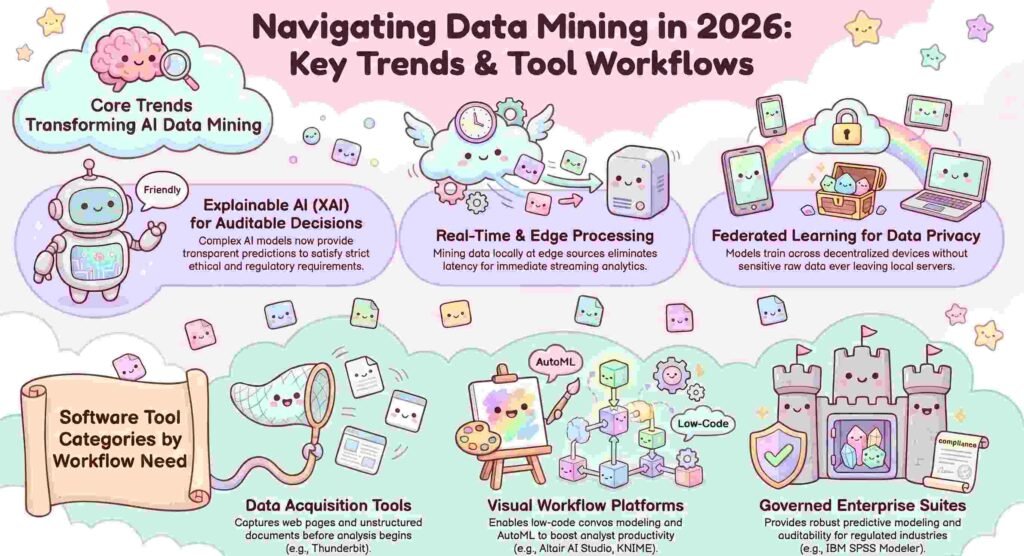
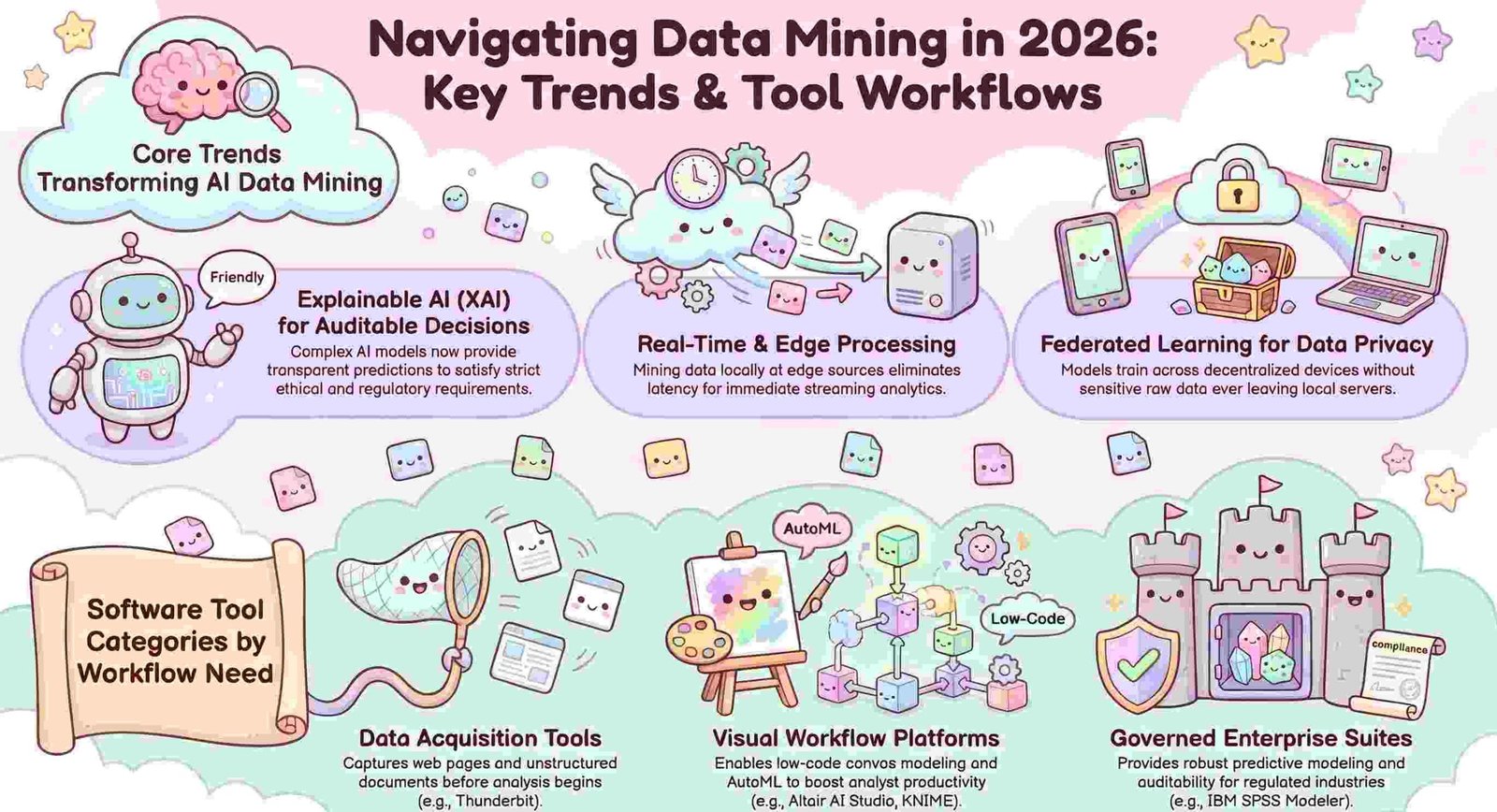
The software ecosystem for data mining has split into specialized tooling engineered to solve specific operational bottlenecks. In 2026, enterprise software evaluation revolves around four core buying motions:
- Data Acquisition Tools: Specialized software engineered to capture, extract, and structure raw web, document, or unstructured records before analytical processing begins.
- Visual Workflow Tools: No-code and low-code platforms allowing business analysts to prepare data, train algorithms, and construct repeatable visual pipelines.
- Enterprise Statistical & Predictive Suites: Fully governed, audit-compliant platforms built for deep statistical modeling within heavily regulated environments.
- Cloud & Infrastructure Layers: High-performance infrastructure supporting real-time stream processing, warehouse-scale compute, and automated MLOps.
Decision-makers are actively moving away from bloated, monolithic platforms that enterprise teams fail to adopt. The governing operational rule for 2026 is straightforward: Buy the least complex tool that actually clears your specific operational bottleneck.
Quick-Reference Tool Shortlist by Primary Bottleneck Category
- Category 1: Data Acquisition Bottlenecks (Raw Collection & Extraction)
- Thunderbit: AI-driven web scraping agent featuring automatic field suggestion, multi-page crawling, and automated structured export directly to Google Sheets, Excel, Airtable, or Notion.
- Category 2: Visual Workflow Bottlenecks (Analyst Productivity & No-Code Pipelines)
- Altair AI Studio: (Formerly RapidMiner Studio) Drag-and-drop visual canvas featuring guided AutoML, interactive data preparation, and visual modeling.
- KNIME Analytics Platform: Open-source, node-based pipeline tool offering transparent data transformation, extensive community extensions, and native Python/R integration.
- Alteryx: Self-service data preparation platform built for automating complex spreadsheet blending and repeatable analytics workflows.
- Orange / Weka / Rattle: Lightweight visual environments designed for algorithm experimentation, visual widget exploratory analysis, and rapid prototyping.
- Category 3: Enterprise Governance Bottlenecks (Regulated Predictive Suites)
- IBM SPSS Modeler: Visual data stream builder tailored for enterprise predictive modeling, text analytics, and compliance-oriented deployment.
- SAS Enterprise Miner: Industry-standard statistical modeling engine built for deep risk analysis, institutional auditing, and native SAS infrastructure integration.
- Spotfire Statistica: Advanced statistical suite combining deep analytics with compliance-driven quality control and reusable workflow governance.
- Category 4: Cloud & Infrastructure Bottlenecks (Scalable ML & Streaming Infrastructure)
- Microsoft Azure Machine Learning: Cloud-native workspace providing automated MLOps, managed model deployment, and deep integration with Azure enterprise estates.
- Dataiku: Collaborative platform bridging no-code business analysts with code-first data scientists through shared data pipelines and governed deployment.
- H2O.ai: Scalable AutoML platform engineered for rapid model iteration, distributed parallel processing, and model explainability.
- Teradata: In-database analytics engine designed for massive computational processing across enterprise warehouse environments.
- Google Cloud Dataflow: Fully managed streaming infrastructure running Apache Beam pipelines for real-time event processing and scale.
4. Moving Past Correlation: Explainable AI and Causal Discovery
For years, deep learning adoption faced a fundamental trade-off: high predictive accuracy came at the expense of model interpretability. Complex deep neural networks operated as “black boxes,” delivering precise predictions without providing clear visibility into their decision-making logic.
In high-stakes operational environments like healthcare diagnostics and financial risk modeling, unexplainable predictions represent an unacceptable regulatory and operational liability. This reality has driven the adoption of Explainable AI (XAI) frameworks. Diagnostic tools such as SHAP (SHapley Additive exPlanations, which calculates feature attribution based on game-theoretic Shapley values) and LIME (Local Interpretable Model-agnostic Explanations, which constructs local linear approximations around specific outputs) allow engineers and auditors to understand exactly why a model produced a given output.
Concurrently, research is accelerating around Neuro-Symbolic Integration—a hybrid artificial intelligence framework that combines the pattern-recognition capabilities of deep neural networks with the logical, rule-based reasoning of symbolic AI. By anchoring raw pattern extraction in deterministic logic, neuro-symbolic systems allow algorithms to move past mere statistical correlation and achieve true causal discovery, identifying actual cause-and-effect mechanisms in high-dimensional datasets.
5. Federated Learning and Edge Intelligence Protect Local Data
Enterprise data architecture is decentralizing, migrating execution closer to data sources rather than forcing every record into centralized cloud data lakes. This shift is enabled by two complementary technical strategies:
- Federated Learning: A distributed training framework where machine learning models are trained collaboratively across decentralized devices or isolated enterprise servers. Raw data never leaves its local jurisdiction; instead, nodes compute local gradient updates and transmit only mathematical model weights to a central server. When combined with differential privacy guarantees and homomorphic encryption, federated learning enables multi-party analytics across competing or heavily regulated institutions.
- Edge Intelligence & TinyML: The practice of deploying lightweight, optimized machine learning models via TinyML—a discipline focused on running inference directly on resource-constrained microcontrollers, smart sensors, and mobile hardware. By evaluating high-frequency event streams locally at the edge, organizations achieve real-time analytics for smart industrial infrastructure and immediate risk monitoring without paying cloud bandwidth costs or incurring latency delays.
6. Advanced Sensing and Physical Industry Tech-Transfers
One of the most notable dynamics in modern analytics is the technology transfer taking place between physical extraction industries (such as mining, geology, and heavy industry) and enterprise software pipelines.
Industries operating in physical space have long mastered multi-modal data processing—simultaneously mining structured relational databases alongside spatial GIS coordinates, satellite imagery, video feeds, and high-frequency IoT telemetry. Advanced sensing technologies refined for physical extraction are now establishing new blueprints for digital data ingestion:
- Hyperspectral Imaging: Advanced optical sensing systems that scan physical core samples across multiple light wavelengths to map geochemical composition—a multi-spectral technique now applied to digital material analysis and quality inspection pipelines.
- Drone-Based Geophysics: Autonomous aerial magnetic surveys that rapidly map complex subsurface geological structures, removing manual field sampling bottlenecks.
- Wireless IoT Networks: Ruggedized sensor networks, such as WorldSensing’s G7 wireless monitoring devices, which capture continuous, real-time telemetry across remote physical operations to feed real-time risk engines.
- Unified Lifecycle Platforms: Enterprise software suites—such as K-Mine or Datamine’s integrated ecosystem—that connect geological modeling, planning, and frontline shift execution. Benchmark updates highlight this impact: Datamine’s Studio RM 3.2 reduced realistic end-to-end resource modeling workflow runtimes by 68.9% (delivering a 3.22× execution speedup), allowing complex reviews to finish within a single working session. Furthermore, Datamine’s acquisition of Commit Works integrated the CiteOps platform, bridging high-level analytical models directly with frontline shift planning and short-interval control.
Just as military logistics algorithms historically migrated into commercial retail supply chains, industrial-grade multi-modal sensing and integrated lifecycle platforms are setting the benchmark for digital supply chain tracking, predictive maintenance, and operational risk management.
Conclusion & Strategic Guidance
The primary goal of data mining in 2026 is not to build the largest theoretical data warehouse or purchase software suites with the most overwhelming feature lists. Success is defined by how efficiently an organization builds a compliant, flexible, and automated path from a raw data point to a defensible decision.
To maintain an analytical advantage, enterprise decision-makers should focus on four operational imperatives:
- Invest in AI Explainability & Generative Pipelines: Augment sparse datasets using generative modeling while embedding XAI frameworks (like SHAP and LIME) to keep advanced predictive models fully auditable.
- Shift Ingestion Upstream into Real Time: Transition legacy batch-processing routines into real-time streaming architectures capable of evaluating events as they occur.
- Enforce Pipeline-Level Compliance: Embed consent tracking, field-level PII masking, and schema enforcement directly into data ingestion flows before data hits storage warehouses.
- Deploy Tools Matched to Bottlenecks: Audit team workflows and select the simplest visual, enterprise, or acquisition tools that resolve your primary friction point.
Auditing Your Organizational Bottleneck
To optimize your analytics stack today, identify where your operational momentum stalls: Is your decision engine bottlenecked by raw data acquisition failures, code complexity that blocks domain analysts, or vast lakes of unaddressed dark data sitting idle in storage? Pinpointing that exact friction point is the critical first step toward building a faster, smarter analytics strategy.
Discover more from TechResider Submit AI Tool
Subscribe to get the latest posts sent to your email.