In executive boardrooms, the digital transformation narrative is seductive: migrate to the public cloud, harness artificial intelligence, and unlock rapid operational agility. This momentum is undeniable, with industry data indicating that 96% of companies will leverage public cloud services by 2025. Yet, as enterprises aggressively scale their cloud estates and deploy complex AI models, a far more challenging reality is unfolding beneath the surface.
Beneath the promise of instant scalability lies an enterprise nightmare: runaway cloud expenditure, fragmented data architectures, and severe operational fatigue. Tech leaders who expected streamlined efficiency are instead wrestling with unexpected credit burn, brittle pipelines, and ungoverned data sprawl. The rush to innovate has created structural and financial friction that demands an immediate, disciplined reassessment of enterprise data estates.
To navigate this landscape, data leaders must move beyond high-level vendor promises and confront the underlying physics of cloud unit economics and architectural design. Distilled from recent industry benchmarks and enterprise data analysis, here are five uncomfortable truths about cloud costs, data strategy, and the structural shifts required to survive the AI era.
1: Businesses Are Throwing Away Up to 40% of Their Cloud Data Budget
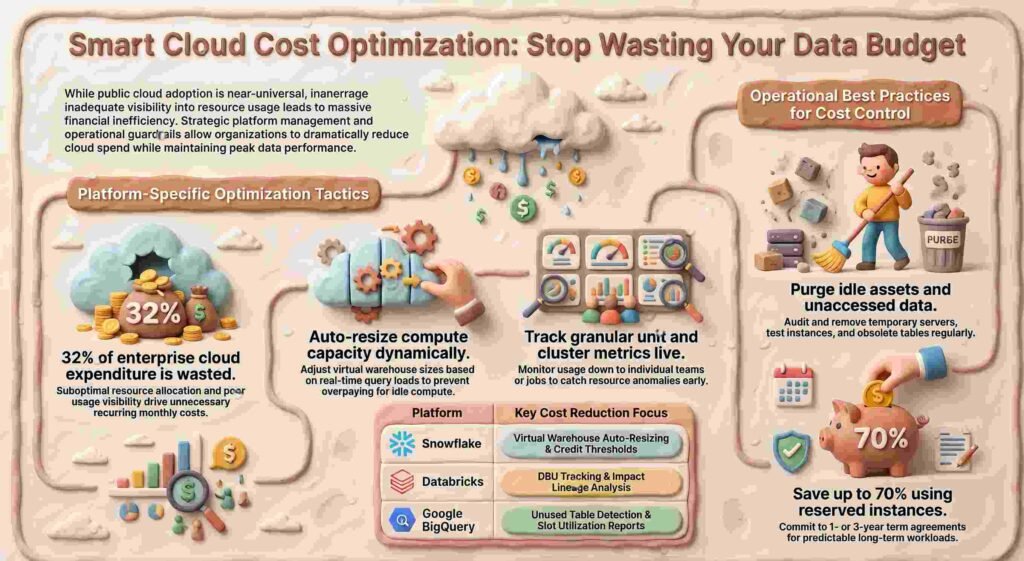
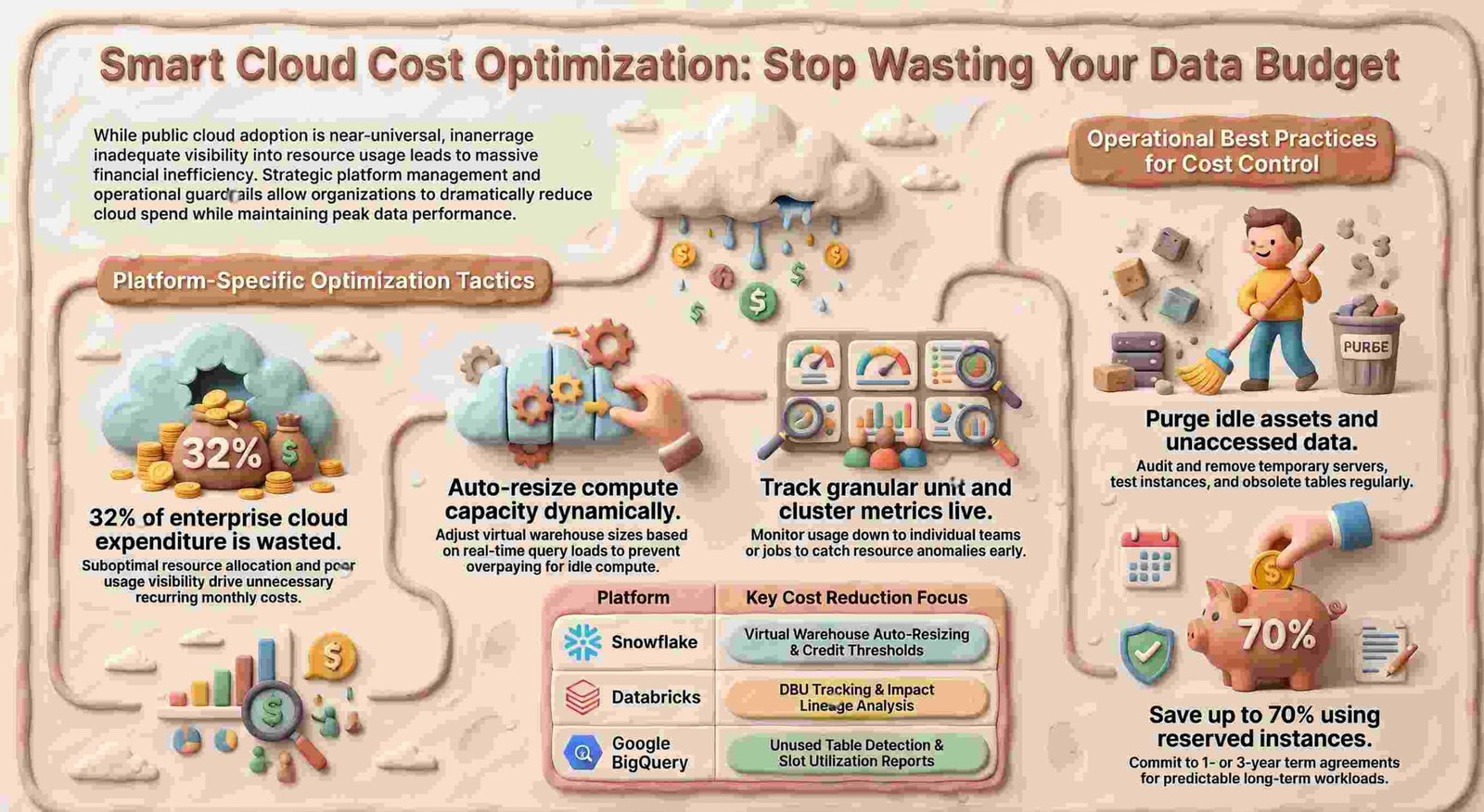
The dynamic, self-service nature of public cloud infrastructure makes provisioning compute effortless—and tracking its financial footprint notoriously difficult. Across general cloud infrastructure, organizations waste approximately 32% of their overall cloud expenditure due to suboptimal resource allocation and a lack of granular usage visibility.
When evaluating specialized enterprise data platforms, the fiscal leaks are even more alarming. Industry benchmark analyses consistently demonstrate that organizations throw away 20% to 40% of their Snowflake or Databricks spend on idle compute, unoptimized SQL queries, redundant pipelines, and unmanaged storage growth.
From a FinOps perspective, this financial waste is rarely driven by a single catastrophic oversight. Instead, it stems from the silent accumulation of micro-inefficiencies across decentralized engineering teams:
- Idle Virtual Warehouses: Engineers spin up temporary compute instances or test environments and forget to de-provision them, leaving virtual warehouses burning credits in the background.
- Suboptimal Query Construction: Unindexed joins, full table scans, and poorly structured queries force compute engines to run significantly longer than necessary, driving up unit costs.
- Unmanaged Storage Lifecycles: Temporary staging files, uncompressed ad-hoc tables, and obsolete backups continuously consume storage credits month after month.
“The plug-and-play set up of Revefi ensures that we have all the automated alerts from the get-go. Plus, not needing a dedicated resource around data quality alerting is super helpful.” — Sourabh Bajaj, Co-founder & CTO
Manual, retroactive cost tracking inevitably fails in modern, multi-tenant cloud ecosystems. Monthly invoice reviews only reveal damage after the budget has been burned. To achieve true compute-to-query efficiency, leading organizations are abandoning periodic reviews in favor of continuous, automated data observability and AI-driven FinOps platforms. By continuously monitoring credit consumption patterns, tracking Databricks Units (DBUs) or Snowflake credit burn in real time, and enforcing automated warehouse right-sizing, enterprise teams can catch cost anomalies within minutes rather than post-billing cycle.
2: AI Promises Efficiency, but 71% of IT Pros Say It’s Making Their Jobs Harder
Enterprise leaders adopt AI with the clear expectation of simplifying workflows and accelerating time-to-value. However, hands-on technical practitioners are experiencing the exact opposite. A recent IT trends survey reveals a striking paradox: 71% of IT professionals report that AI is actually making their roles more demanding.
This operational friction occurs when leadership forces advanced AI workloads onto legacy, brittle infrastructure without updating foundational workflows. Attaching generative AI models or intelligent agents directly to ungoverned data layers creates a illusion of operational speed while quietly compounding architectural technical debt.
This operational strain is further escalated by the rapid rise of “vibe coding”—the practice of using AI coding assistants to generate application code and complex SQL logic rapidly via natural language prompts. Industry adoption stats highlight the scale of this shift:
- 45% of organizations have already deployed AI-generated code into production.
- Certain engineering teams now use AI to write up to 75% of their active codebase.
While AI-assisted development drastically accelerates initial task execution, it introduces severe operational and security risks when deployed without rigorous governance. Chief among these is “slopsquatting”—a novel cybersecurity threat where AI coding assistants hallucinate non-existent package dependencies or software libraries during code generation. Attackers monitor these common AI hallucinations, register (“squat on”) the fake package names in public repositories, and inject malicious code that automated developer pipelines unknowingly download.
When unvetted AI code and unmanaged pipelines intersect, the result isn’t enterprise agility—it is compounding operational overhead, security vulnerabilities, and runaway compute costs.
3: The Biggest Flaw in Enterprise Data Isn’t Technology—It’s Strategy
When cloud data platforms underperform or budgets blow out, executive teams typically fault the technology stack. However, the 2026 Global Data Management Benchmark Report—published by the EDM Association and based on the Data Management Capability Assessment Model (DCAM v3.1)—reveals that the primary bottleneck in enterprise data is strategic, not technological.
At first glance, executive alignment appears strong: over 70% of organizations have appointed a Chief Data Officer (CDO) or equivalent executive. Yet despite C-suite representation, capabilities surrounding Data Strategy, Data Management Strategy, and the Business Case for Data remain the least mature capabilities across all global industries evaluated, with fewer than one-third of organizations achieving advanced progress.
The DCAM framework evaluates organizational data maturity across a defined continuum: progressing from Conceptual to Developmental, moving into Defined, and ultimately scaling into Achieved and Enhanced operational states.
The benchmark data illustrates that most enterprise data programs remain trapped in the Developmental phase, struggling to “jump the chasm” to a formally Defined enterprise practice. Organizations frequently launch isolated data initiatives or invest heavily in cloud data warehouses without establishing a formalized business case, clear data lineage, or sustainable funding models. Without bridging this initial operational gap, programs fail to achieve the institutionalized, business-as-usual status (Achieved stage) required to drive consistent value. Executive titles alone cannot substitute for a cohesive strategy that directly ties data architecture to core business outcomes.
4: Compute and Storage Decoupling Is No Longer Optional
Traditional, on-premises data warehouses were constrained by tightly coupled hardware architectures, where processing power and storage capacity were physically bundled within server nodes. Scaling storage required purchasing additional compute nodes regardless of actual query demand, leading to massive over-provisioning and capital waste.
Modern cloud data platforms—such as Snowflake, Databricks, Google BigQuery, and AWS Redshift—have eliminated this operational bottleneck through the fundamental decoupling of compute and storage.
In this decoupled architecture, data resides centrally in highly durable, low-cost object storage (such as Amazon S3, Google Cloud Storage, or Azure Blob), while independent, elastic compute clusters (virtual warehouses or serverless SQL pools) are provisioned dynamically on top of that shared storage layer.
This structural separation unlocks crucial FinOps and architectural advantages:
- Independent Elasticity: Storage scales infinitely and cheaply, while compute resources scale horizontally and vertically on demand to handle concurrent analytical workloads.
- Pay-As-You-Go Serverless Efficiency: Compute clusters can leverage auto-suspend parameters, shutting down completely within minutes—or seconds—of inactivity to ensure zero credit burn when no queries are executing.
- Algorithmic Query Optimization: Advanced platform mechanisms, such as machine learning-powered predictive I/O optimizations, dramatically accelerate point lookups and data updates while minimizing the volume of data scanned per query.
Failing to leverage this structural elasticity—such as running always-on compute clusters for batch workloads that only execute twice a day, or neglecting slot utilization insights in flat-rate query engines—completely invalidates the economic foundation of cloud migration.
5: Real-Time Pipelines Require Decoupling Data Ingestion from Processing
As enterprises build intelligent apps and real-time operational dashboards, legacy ad-hoc ETL scripts rapidly crumble under the traditional 3 Vs of Big Data: Volume, Variety, and Velocity. Monolithic pipelines that attempt to extract, transform, and load massive data streams in a single processing step create severe performance bottlenecks and single points of failure.
To survive production demands, modern real-time data architectures require a strict operational division of labor: decoupling data ingestion from stream processing and analytical storage.
A proven enterprise architecture combines Apache Kafka for ingestion with Apache Spark Streaming for execution:
- Fault-Tolerant Ingestion & Buffering (Apache Kafka): Kafka operates as a distributed, highly scalable messaging hub. By leveraging tools like Kafka Connect, enterprises can capture low-latency Change Data Capture (CDC) streams directly from production relational databases (such as PostgreSQL via Debezium) without impacting core transactional database engines. Kafka buffers these real-time event streams safely across distributed brokers.
- Parallel Stream Processing (Apache Spark): Spark Streaming consumes events directly from Kafka topics, executing complex transformations, aggregations, SQL queries, and machine learning scoring in parallel across distributed worker nodes using high-speed, in-memory processing.
- Target Analytical Storage: Processed streaming output is routed cleanly to specialized, downstream target storage environments—such as HDFS, Amazon S3, or Apache Cassandra—optimized for rapid end-user querying and analytics.
By decoupling ingestion from processing, data engineers ensure that traffic surges in source systems are safely buffered without dropping data or crashing downstream processing engines. Decoupled architecture isolates operational failures, ensures pipeline resilience, and delivers the continuous, trusted data stream that enterprise AI models require.
Conclusion: Moving Beyond Reactive Data Management
The key driver behind enterprise data failure is structural alignment: an unaligned data strategy inevitably leads to poor architectural choices, forcing engineers to build brittle pipelines that trigger unmanageable operational friction under AI workloads, ultimately resulting in severe cloud budget waste.
As data volumes accelerate and enterprise AI shifts from speculative experiments to core operations, reactive technology management is no longer viable. Organizations cannot build a competitive future on unmanaged cloud credit burn, brittle pipeline designs, ungoverned AI-generated code, or missing strategic blueprints.
Achieving sustained return on investment requires treating cloud data architecture as a disciplined, unified capability. By decoupling compute from storage, separating pipeline ingestion from processing, and grounding technical deployments in continuous automated observability and DCAM-aligned governance, leaders can finally eliminate hidden cloud waste.
As you audit your enterprise data estate today, ask yourself one critical question: Is your cloud architecture actively fueling your business strategy, or is it silently consuming your tech budget?
Discover more from TechResider Submit AI Tool
Subscribe to get the latest posts sent to your email.