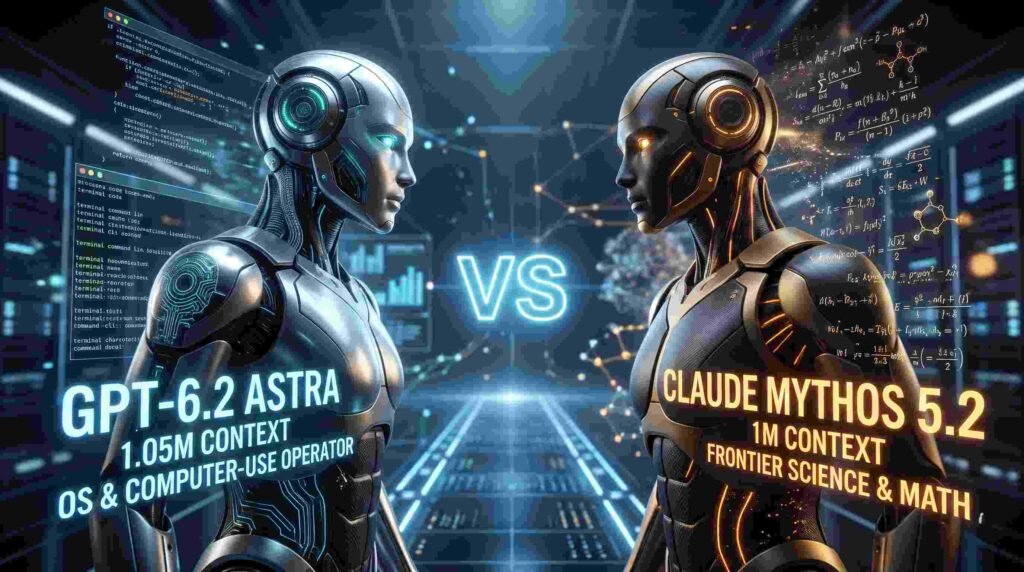
If you feel like the ground under the AI industry shifts every Tuesday, you are not imagining things. Within a span of eight days in November 2026, both Anthropic and OpenAI dropped massive upgrades that immediately rewrote the frontier leaderboard. First, Anthropic unveiled Claude Mythos 5.2 (alongside its sibling, Fable 5.2) on November 9, boasting scientific breakthroughs that sounded straight out of a sci-fi novel. Just over a week later, on November 17, OpenAI fired back with GPT-6.2 Astra, slashing API prices by 20% while pushing computer-use and terminal-based research to new highs.
For developers, researchers, and enterprise leaders, choosing between these two heavyweights is no longer about picking a slightly better chatbot. It is about deciding which autonomous reasoning engine best fits high-stakes engineering, scientific discovery, and complex multi-step workflows. Let’s break down how GPT-6.2 Astra and Claude Mythos 5.2 stack up in real-world performance, pricing, guardrails, and daily utility.
The Core Philosophy: Autonomous Worker vs. Open-Ended Research Partner
While both models sit at the absolute pinnacle of artificial intelligence—matching each other dollar-for-dollar on standard API token pricing—they are built with slightly different philosophies in mind.
OpenAI GPT-6.2 Astra: The Precision Enterprise Operator
OpenAI designed GPT-6.2 Astra to be the ultimate digital knowledge worker and terminal operator. Building on the September debut of GPT-6 Astra (and skipping a public 6.1 Astra release altogether), the 6.2 update focuses heavily on reliability, conciseness, and token efficiency.
In practical terms, GPT-6.2 Astra excels when given a complex, multi-step business or engineering assignment inside a real software environment. Whether navigating CAD and 3D simulation tools, refactoring massive legacy codebases in Codex, or generating polished presentations and spreadsheets that strictly adhere to corporate templates, Astra operates with surgical precision. Even better, OpenAI trained it to trim the fat from its responses—using roughly 22% fewer output tokens on tasks like GDPval v2 while scoring 5.2 points higher than its predecessor on Agents’ Last Exam.
Anthropic Claude Mythos 5.2: The Deep-Tech & Cyber Specialist
Anthropic’s Claude Mythos 5.2 (which shares core architecture and pricing with Claude Fable 5.2, but is specifically gated for verified organizations) is built for the most daunting, open-ended technical challenges on the planet. During pre-release testing, Anthropic revealed that the Fable/Mythos 5.2 family designed three working electronic devices from scratch, solved two open problems in black hole physics, and formalized the proof of Fermat’s Last Theorem in just 30 hours.
Rather than acting as a general everyday assistant—a role Anthropic explicitly delegates to Claude Opus 5.5 or Sonnet 5.5—Mythos 5.2 operates with “always-on” adaptive thinking set to high effort by default. It is engineered to tackle sprawling, ambiguous problems in advanced cybersecurity, theoretical mathematics, and deep systems architecture, generating outputs 30% faster than the 5.1 generation.
Head-to-Head Comparison: GPT-6.2 Astra vs. Claude Mythos 5.2
| Feature / Specification | OpenAI GPT-6.2 Astra | Anthropic Claude Mythos 5.2 |
|---|---|---|
| Release Date | November 17, 2026 | November 9, 2026 |
| Context Window | 1.05 Million tokens | 1 Million tokens |
| Max Output Tokens | 128,000 tokens | 128,000 tokens |
| Input API Pricing | $8.00 per 1M tokens | $8.00 per 1M tokens |
| Output API Pricing | $40.00 per 1M tokens | $40.00 per 1M tokens |
| Cached Input Pricing | $0.40 per 1M tokens (95% savings) | $0.20 per 1M tokens (cache read) |
| Knowledge Cutoff | May 18, 2026 | June 2026 |
| Access & Availability | ChatGPT (Plus, Pro, Enterprise, Edu), Codex, & OpenAI API | Gated API access (Requires Anthropic Verification Program) |
| Standout Strengths | Computer use (CAD/simulation), terminal science, token efficiency, office deliverables | Frontier math & physics, deep code reasoning, cybersecurity, orchestrator workflows |
Deep Dive: Where Each Model Shines
1. Coding, Terminal Workflows, and Computer Use
Both models are absolute beasts in software engineering, yet they approach it differently. GPT-6.2 Astra dominates environments where the AI must interact directly with graphical interfaces, operating system terminals, and external tools. It set a new record on Terminal-Bench-Science 0.1 and shines in workflows that require jumping between a code editor, a browser, and specialized engineering software. Furthermore, its writing style inside code documentation and reports is noticeably sharper, stripping away generic AI fluff.
Claude Mythos 5.2, on the other hand, stands out for deep architectural reasoning and multi-agent orchestration. Because its sibling model, Fable 5.2, claimed the #1 spot on the Artificial Analysis Intelligence Index (with GPT-6.2 Astra sitting right behind at #2), developers often use Mythos/Fable 5.2 as an “Advisor” or “Orchestrator”—letting it map out high-level system designs and delegating routine execution to faster models like Claude Sonnet 5.5 or Haiku 5.5.
2. Pricing and Real-World Cost Efficiency
On paper, the sticker price is identical: $8 per million input tokens and $40 per million output tokens for both models (with a 50% discount on Batch API calls for each). However, your actual monthly bill depends heavily on how you use them:
- GPT-6.2 Astra wins on output token economy. Because it solves complex tasks using roughly 20–22% fewer output tokens than earlier frontier models, you pay less per completed job. Just watch out for massive prompts: OpenAI doubles input pricing and increases output pricing by 1.5x on requests exceeding 272K tokens.
- Claude Mythos 5.2 keeps flat pricing across its entire 1M-token context window and offers an aggressive $0.20 per million tokens for cache reads (half of Astra’s $0.40 cached input rate), making it cheaper when repeatedly querying massive static repositories.
3. Cybersecurity Capabilities and Gated Guardrails
The defining story of late-2026 AI releases is capability containment. Both OpenAI and Anthropic acknowledge that models at this tier can discover and exploit zero-day software vulnerabilities autonomously.
OpenAI rates GPT-6.2 Astra as “Critical” for cybersecurity and “High” for biological, chemical, and AI self-improvement risks under its Preparedness Framework. While anyone on a paid ChatGPT tier or standard API account can access Astra, its built-in cyber guardrails are strict—occasionally blocking legitimate penetration testers unless they apply for OpenAI’s Daybreak program.
Anthropic takes an even stricter approach with Claude Mythos 5.2. Unlike Fable 5.2, Mythos 5.2 is completely restricted to organizations approved through Anthropic’s specialized verification programs, such as the Cyber Verification Program. If you are an independent developer without enterprise cyber vetting, you will be routed to Fable 5.2 or Opus 5.5 instead.
The Verdict: Which One Should You Choose?
- Choose OpenAI GPT-6.2 Astra if: You want immediate, friction-free access via ChatGPT or the OpenAI API to an autonomous agent that excels at computer use, CAD/3D workflows, terminal-based scientific analysis, and producing clean, executive-ready documents and spreadsheets with lower token overhead.
- Choose Anthropic Claude Mythos 5.2 if: You belong to a verified research or cybersecurity organization tackling open-ended scientific problems, formal mathematical proofs, or complex multi-agent orchestration where maximum raw reasoning depth is non-negotiable.
Frequently Asked Questions (FAQ)
1. What is the main difference between Claude Mythos 5.2 and Claude Fable 5.2?
Both models were released on November 9, 2026, and share identical context windows (1M tokens), output limits (128K tokens), and API pricing ($8/$40 per million tokens). However, Claude Mythos 5.2 is a specialized release restricted strictly to organizations vetted through Anthropic’s verification programs (such as the Cyber Verification Program) for high-sensitivity defensive and technical work, whereas Fable 5.2 is more broadly accessible.
2. Is GPT-6.2 Astra cheaper than the original GPT-6 Astra?
Yes. OpenAI reduced GPT-6.2 Astra’s API token prices by 20% compared to the September 2026 GPT-6 Astra release, bringing rates down to $8 per million input tokens and $40 per million output tokens. Combined with its ability to use ~22% fewer output tokens per task, real-world execution costs are significantly lower.
3. Can individual developers access both models right now?
You can access GPT-6.2 Astra immediately through a ChatGPT Plus, Pro, Enterprise, or Edu subscription, inside Codex, or via the standard OpenAI API. For Claude Mythos 5.2, individual developers cannot access it without organizational verification—though they can use Claude Fable 5.2 or Claude Opus 5.5 on the Claude API, Amazon Bedrock, Google Cloud Vertex AI, and Microsoft Foundry.
4. Which model has a larger context window?
They are virtually tied. GPT-6.2 Astra offers a 1.05 million-token context window, while Claude Mythos 5.2 provides a 1 million-token context window. Both models support a maximum output of 128,000 tokens per response.
Discover more from TechResider Submit AI Tool
Subscribe to get the latest posts sent to your email.