
CMOs today are haunted by a specific dissonance: dashboards glowing with green ROAS indicators while the bottom line remains stubbornly stagnant. This isn’t just a performance dip; it is the systemic failure of “burning budget”—a state where high click-through rates and positive-looking metrics mask a total lack of incremental growth. As we navigate the 2026 landscape, the industry is undergoing a violent correction.
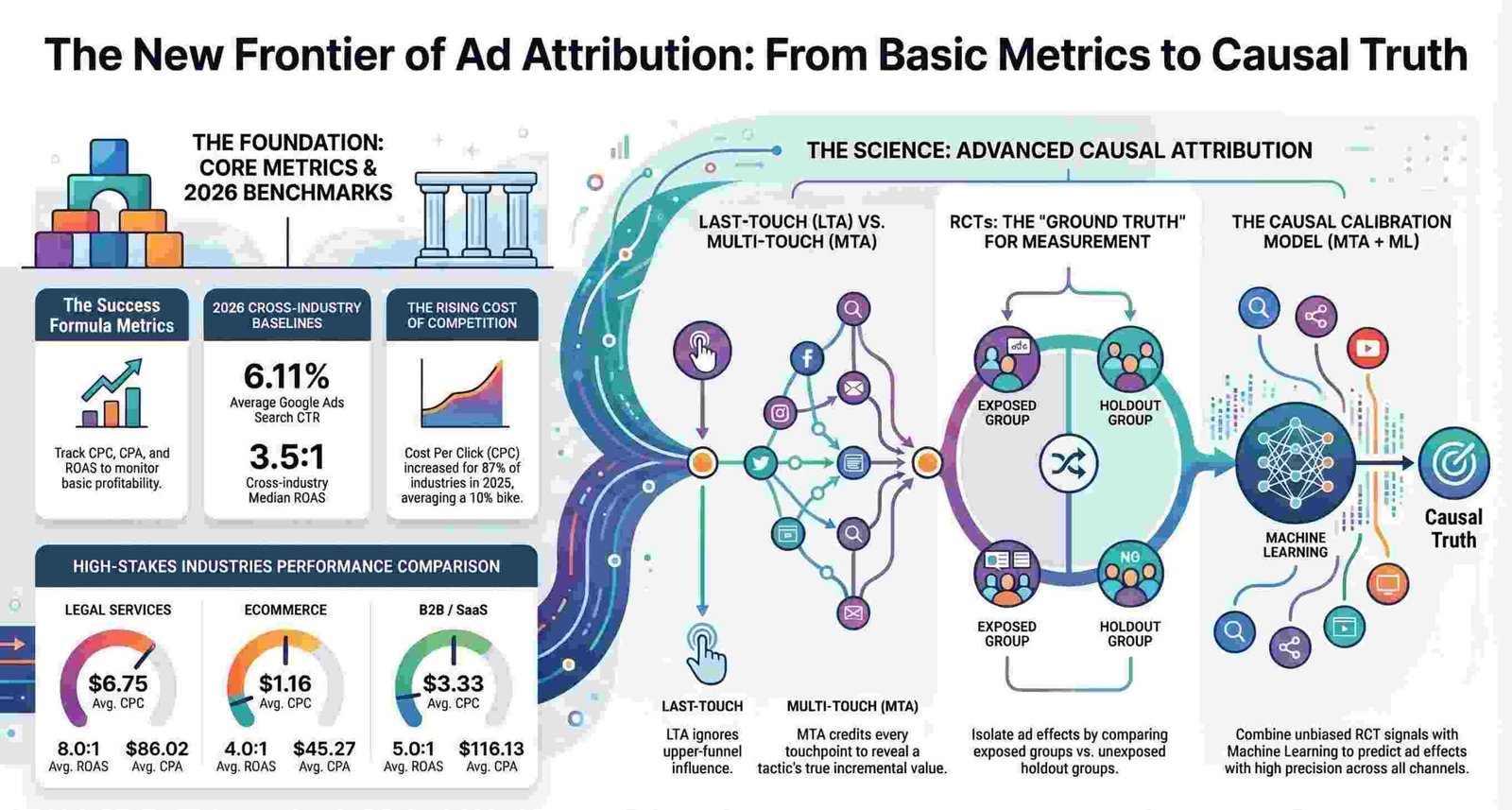
To survive, marketing must be treated as “math, not magic,” as advocated by Pulse Analytix. We are moving past the era of digital marketing as a series of lucky guesses into a paradigm where “success” is defined by causal calibration. To achieve causal clarity in a multi-channel environment, we must deconstruct five structural failures of legacy ad strategy and replace them with the rigorous logic of algorithmic game theory.
1. The Last-Touch Trap: Why Your Best Channel Might Be a “Dummy Player”
Last-Touch Attribution (LTA) is not just a simplistic metric; it is a structural liability. By assigning 100% of conversion value to the final interaction, LTA creates a feedback loop that overfunds “Dummy Players”—a concept from cooperative game theory describing channels that provide zero marginal utility to a coalition but happen to stand at the finish line. This approach leads advertisers to “undervalue and reduce investment in tactics that play a key role in conversions,” specifically those upper-funnel awareness campaigns that initiate the journey. As Amazon Ads research notes: “Last-touch attribution (LTA) credits the full value of a conversion to one ad… overlooking the impact of earlier touchpoints like awareness campaigns.”
To solve this, we must apply the Symmetry property. In game theory, Symmetry dictates that if two players contribute the same marginal value to a coalition, they must receive equal credit. In a boardroom context, this proves that an upper-funnel impression and a lower-funnel click can be mathematically equal contributors to the same conversion. LTA fails because it ignores the synergy of the full funnel, rewarding the players who were present at the end rather than those who were necessary for the start.
2. Why Second-Price Auctions are Failing Your Budget
The industry-wide transition toward First-Price auctions (recently adopted by platforms like Google AdSense) was marketed as a move toward “simplicity and transparency.” However, the underlying motivation is found in “Liquid Welfare” research: sequential second-price auctions can produce “arbitrarily bad” results for buyers operating under strict budgets.
For the strategic technologist, First-Price auctions are more “causally-defensible” because they provide a stable, predictable relationship between the bid submitted and the price paid. This efficiency is measured by the Price of Anarchy. While second-price auctions can lead to systemic welfare collapses for budgeted buyers, first-price auctions maintain a 2.41 upper bound on the Price of Anarchy for additive valuations. This bound serves as a mathematical guarantee of system efficiency, ensuring that your budget is actually converted into welfare rather than being lost to the structural inefficiencies of a second-price mechanism.
3. The “Ground Truth” Dilemma: Why ML Models Often Lie
Machine learning is the industry’s favorite sedative, but when models are trained purely on “observational data”—incidental data collected during normal operations—they don’t optimize; they hallucinate. A meta-study by Gordon et al. (2023) involving nearly 2,000 campaigns at Meta showed that sophisticated ML models using only observational data produced errors in estimated ad effects ranging from 488% to 948%.
To reach the “Ground Truth,” the industry is pivoting toward Predicted Incrementality by Experimentation (PIE). This methodology uses Randomized Controlled Trials (RCTs)—the gold standard where one group is exposed to ads and a holdout group is not—to calibrate machine learning predictions. As the Amazon Ads strategy highlights: “ML models trained purely on observational data are easy to scale… but the models might produce biased estimates of ad effects.” We must move from scale-at-all-costs to a calibrated framework where RCTs define the reality that ML models are then permitted to scale.
4. Game Theory to the Rescue: Calculating “Fair” Credit with Shapley Values
If LTA is the diagnostic failure, the Ordered Shapley Value is the mechanistic solution. This cooperative game theory approach distributes revenue among channels based on their average marginal contribution across all possible user paths. It reveals a “loyalty bias” that traditional metrics miss: high-intent users who would have converted regardless of the ad often mask the true performance of middle-funnel DSPs.
The data is striking. In standard models, Paid Search at Touchpoint 1 often appears to claim 43.76% of conversion credit. However, when using Ordered Shapley logic to filter for conversion journeys longer than two touchpoints, that credit craters to just 4.37%. This proves that search engines are often overvalued “Dummy Players” facilitating sales that were already pre-determined by earlier interventions.
| Traditional Metric | Game Theory Logic | Strategic Benefit |
| Efficiency | Total credit must exactly equal total revenue. | Eliminates “ghost” conversions and double-counting. |
| Symmetry | Equal marginal contributions earn equal credit. | Neutralizes lower-funnel bias; rewards awareness fairly. |
| Dummy Player | Channels with zero marginal utility earn zero credit. | Prunes redundant tactics that don’t drive incrementality. |
5. The Sensitivity Secret: Revenue Is Your Biggest Risk
The 2026 PPC Benchmarks signal an increasingly hostile environment: the cross-industry average CPC has reached $4.22, and 87% of industries saw costs rise last year. In this landscape, raw ROAS is a insufficient indicator of business health. Using the “Risk Radar” concept, we see that Revenue is a far more “sensitive variable” than Spend. A 15% drop in revenue can swing net profit by thousands of dollars, far outweighing the benefit of a 15% saving in ad spend.
This sensitivity bridges the gap to Break-even ROAS. In the Legal sector, a high $6.75 average CPC is sustainable because high margins and case values allow for greater sensitivity to revenue fluctuations. Conversely, in low-margin E-commerce, where CPCs average $1.16, a minor revenue dip can immediately turn ad spend toxic. Scaling spend (e.g., a 25% increase) is only a rational move if the advertiser understands their break-even thresholds based on gross margins, not just click costs. You aren’t just buying traffic; you are managing a volatility portfolio.
Conclusion: Digital Marketing as Logic, Not Luck
As the customer journey becomes non-linear and fragmented, reliance on simple metrics like CTR or CPC is a recipe for stagnation. The future of ad strategy belongs to those who utilize Causal Calibration and understand that Liquid Welfare is the only true measure of success for a budgeted advertiser.
We must move toward a logic-first framework. Are your ads generating true incrementality, or are you simply paying a premium for sales that would have happened anyway?
Final Thought: If you turned off your top-performing “last-touch” channel tomorrow, would your total revenue actually move—or have you been overvaluing a dummy player all along?
Discover more from TechResider Submit AI Tool
Subscribe to get the latest posts sent to your email.