
For years, the “mid-range” label was tech-shorthand for “compromise.” You bought these phones because you had to, not because you wanted to, accepting plastic backs and stuttering performance as the tax for financial prudence. But as we hit April 2026, the Samsung Galaxy A37 has officially arrived to blow that distinction apart. We are witnessing a revolution where flagship-grade DNA is being spliced into devices that don’t require a four-figure investment.
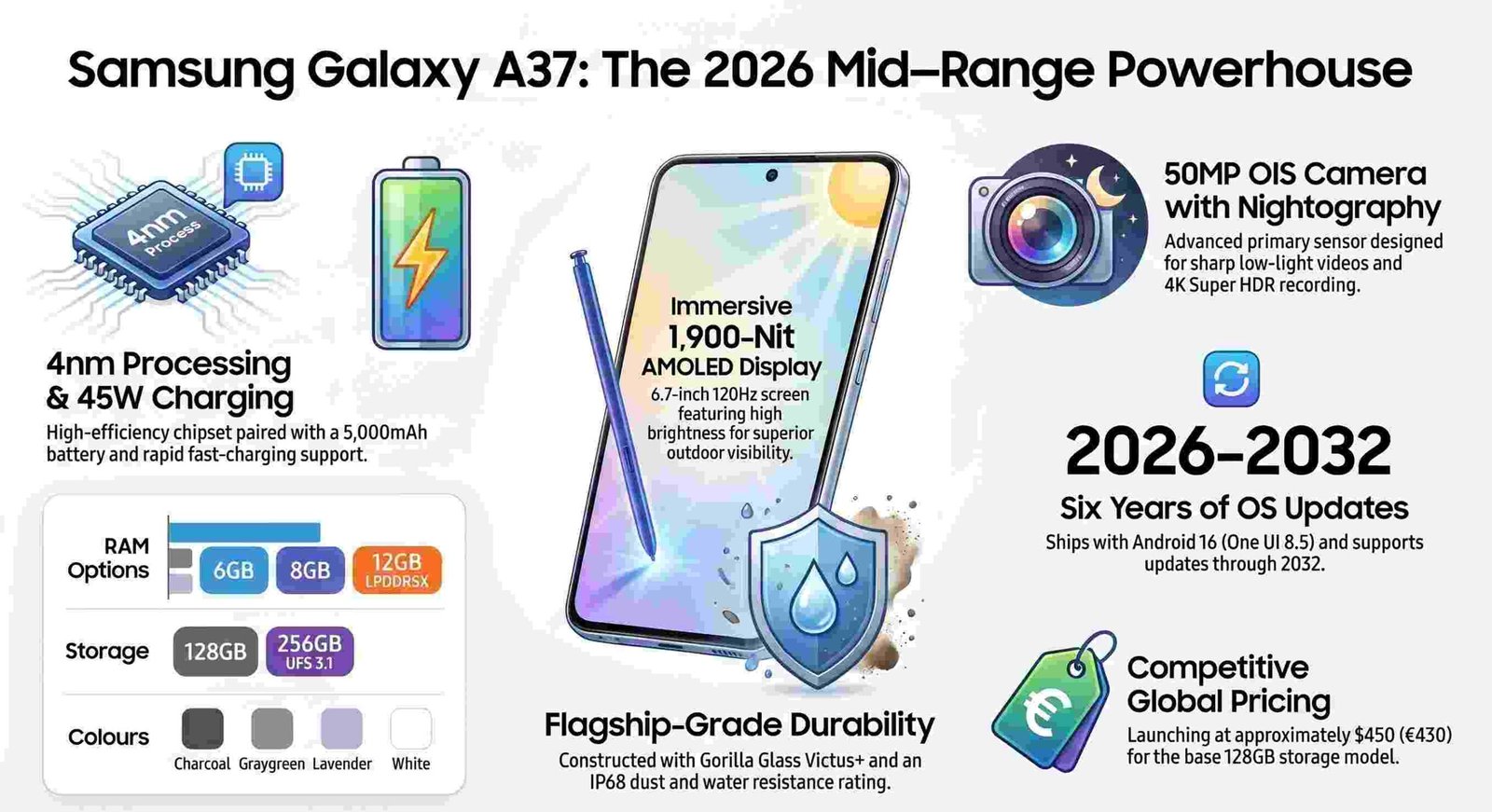
The Galaxy A37 isn’t just another iterative update; it is a direct challenge to the thousand-dollar status quo. While tech enthusiasts often fixate on the “Ultra” monikers, the real story this year is how Samsung has migrated high-end engineering—materials, longevity, and optics—downward. It is a device built for the pragmatic user who is tired of the “prestige tax” but still demands a phone that feels like a piece of premium jewelry.

If you are currently nursing a cracked screen on a three-year-old flagship or struggling with a budget phone that has run out of storage, the A37 presents the most compelling argument for an upgrade in years. Here are five reasons why this phone is redefining what $450 can buy—and one very specific reason you might want to look backward before moving forward.
1. Flagship Armor: Gorilla Glass Victus+ on Both Sides
Samsung is playing for keeps with the A37’s build quality. In a move that effectively kills off the era of “Glasstic” (Samsung’s fancy term for polycarbonate), the A37 features Gorilla Glass Victus+ on both the front and the rear. This isn’t just about aesthetics; it’s about providing an “anxiety-free” ownership experience. Victus+ was recently the gold standard for the S-series, offering significantly better drop and scratch resistance than the glass usually found in this price bracket.
The design language has also matured. The device features the new “Camera Island” design, where the frame subtly and elegantly protrudes specifically around the power and volume buttons, adding a tactile, high-end signature to the chassis. When you factor in the IP68 rating for dust and water resistance, the A37 doesn’t just feel more expensive—it’s built to survive the same accidents as a phone twice its price.
2. “Nightography” for the Rest of Us
Advanced low-light photography used to be the “Great Wall” separating the tiers of smartphones. With the A37, that wall has crumbled. Leveraging an enhanced Image Signal Processor (ISP) and a 1/1.56-inch 50MP primary sensor, Samsung has brought “Nightography” to the masses. This isn’t just marketing fluff; the new ISP reduces grain and preserves color accuracy in lighting conditions that would have turned last year’s mid-rangers into a blurry mess.
The result is what the Samsung Newsroom India team calls “noise-free videos” that remain sharp long after the sun goes down. As the official campaign puts it: “Unbox low-light videos that stay sharp every time… Because Awesome is for everyone.” With 4K 30fps support and Super HDR across both the front and rear cameras, the social media gap between mid-range and flagship content is officially closing.
3. The Six-Year Software Commitment: A Sustainable Choice
Here is the rub: the most “premium” feature a phone can have in 2026 is longevity. Launching with Android 16 and One UI 8.5, the Galaxy A37 comes with a staggering six-year commitment for operating system updates. This effectively matches the support window of flagship competitors, meaning a device purchased today for $450 will remain current and secure until 2032.
This level of support transforms the A37 from a disposable gadget into a legitimate long-term investment. For the consumer who hates the biannual upgrade cycle, the A37 offers a path to sustainability that was previously reserved for those willing to spend $1,000.
4. Flagship Brightness: 1,900 Nits and 4nm Power
The most surprising “wow” factor of the A37 is the display. While most mid-rangers struggle in direct sunlight, the A37’s 6.7-inch Super AMOLED panel can peak at 1,900 nits during HDR playback and 1,200 nits in High Brightness Mode. That is flagship-level luminosity. Whether you’re at the beach or under harsh office lights, the 120Hz refresh rate ensures the experience remains buttery smooth.
Under the hood, the 4nm Exynos 1480 processor—paired with up to 12GB of RAM—provides a snappiness that mirrors the flagship experience for daily tasks. It handles multitasking and gaming with a fluid ease that makes you wonder exactly what that extra $600 for an S-series model is actually buying you.
5. The “Free” Factor: T-Mobile’s Power Move
The value proposition changes fundamentally when the price tag hits zero. While the MSRP sits at $450, T-Mobile has disrupted the U.S. launch by offering the Galaxy A37 for free through specific carrier deals. When a device with this level of glass construction and software longevity is available with no upfront cost, it ceases to be a “budget” choice and becomes the most logical financial move on the board for the average consumer.
——————————————————————————–
Pro Tip: The 192 Alternative** However, here is a piece of market intel that might make you pause. While the Galaxy A37 is a powerhouse, its predecessor, the **Galaxy A36**, is currently seeing aggressive liquidation. Walmart is running “Flash Deals” that have dropped the A36 to a staggering **192.94.
Here’s the dilemma: The A36 also features a gorgeous 6.7-inch Super AMOLED display and is supported through 2031. You have to ask yourself: Are the A37’s upgrades—the Victus+ armor, the improved night-time ISP, and that extra year of software support—worth a $250 premium? For the average user, the A36 at under $200 might actually be the “steal of the century,” even if the A37 is the better phone.
——————————————————————————–
Conclusion: A New Era of “Awesome”
The Galaxy A37 represents the arrival of the “flagship-lite” era. By combining six years of support, premium durability, and sophisticated low-light camera tech, Samsung is making good on its promise that “Awesome is for everyone.” It is no longer about what features were cut to save money, but rather how many flagship features could be squeezed in.
As mid-range phones become increasingly indistinguishable from their premium counterparts in daily use, it raises a significant question for the modern consumer:
With mid-range phones now offering six years of support and flagship-grade glass, is the $1,000 smartphone finally becoming a luxury rather than a necessity?
Discover more from TechResider Submit AI Tool
Subscribe to get the latest posts sent to your email.