Summary Quick-View
For over a decade, blockchain technology rode a rollercoaster of public perception. It was heralded as a libertarian financial savior, dismissed as a speculative bubble, and scrutinized by global regulators. However, if you look past the noise of speculative markets, a quiet and profound architectural shift has taken place. In 2026, blockchain has firmly entered its utility era. It is no longer an experimental sandbox for developers or an asset class reserved exclusively for tech-enthusiasts. Instead, it has transitioned into the foundational “market plumbing” of modern enterprise systems and global capital markets.

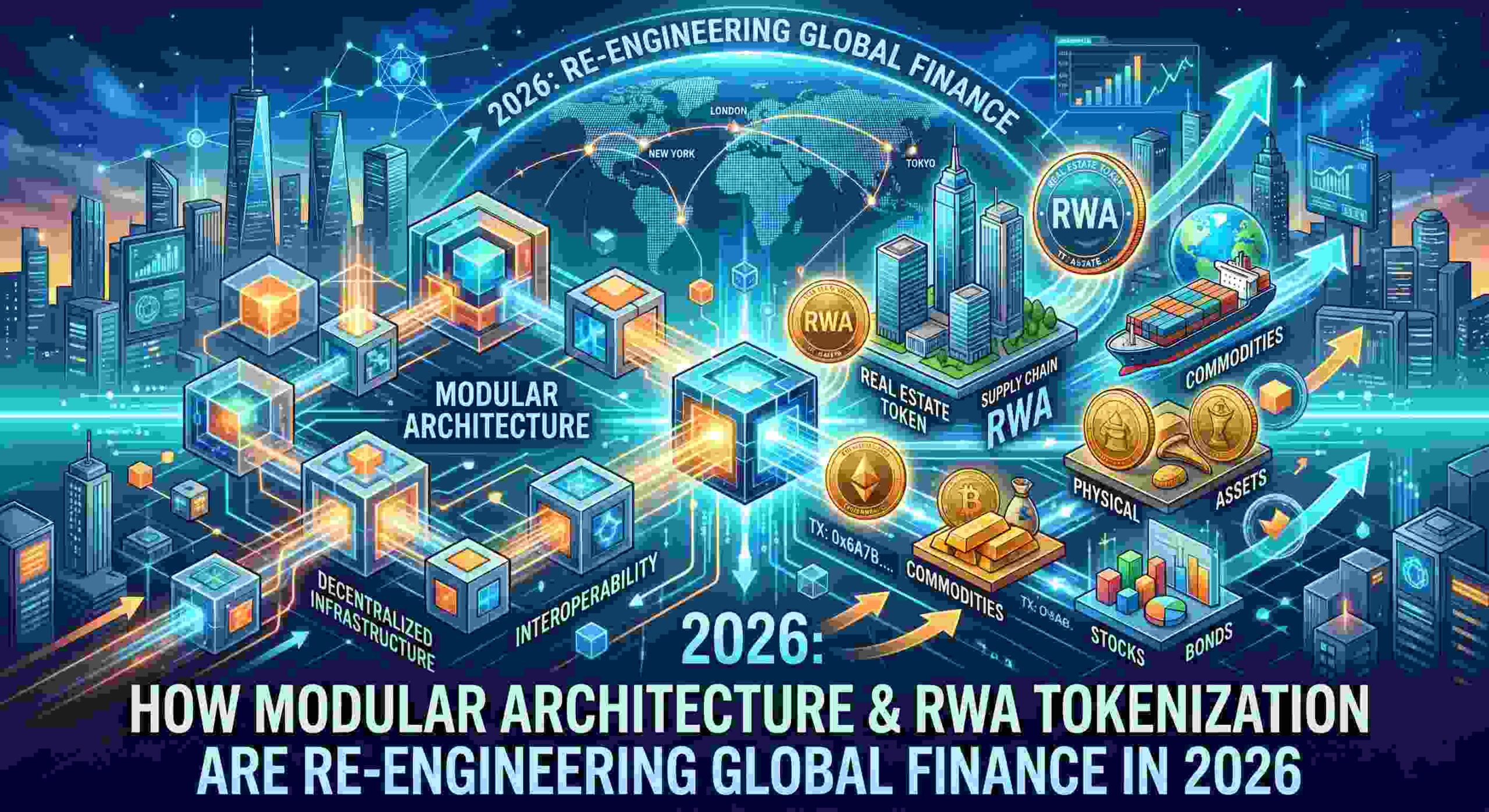
This evolution is driven by two monumental shifts that have redefined the technology over the past 24 months: the triumph of Modular Blockchain Architectures over monolithic chains, and the massive influx of institutional capital into Real-World Asset (RWA) Tokenization. Blockchain is no longer trying to replace traditional financial systems; it is actively upgrading them.
The Architecture Shift: The Dawn of the Modular Era
To understand where blockchain is today, we must first understand how it broke through its historical performance ceilings. For years, the industry was constrained by the “Blockchain Trilemma”—the structural belief that a network could only optimize for two of three characteristics: security, decentralization, or scalability. Early monolithic blockchains like Bitcoin and Ethereum attempted to handle everything—consensus, data availability, and transaction execution—on a single base layer. This resulted in network congestion, sky-high transaction costs, and limited throughput.
Enter 2026, and the industry has overwhelmingly shifted toward a modular paradigm. Modular blockchains decouple these core functions into specialized layers.
- The Execution Layer: Where transactions are processed (e.g., Layer 2 Rollups like zkSync Era, Starknet, and Arbitrum).
- The Data Availability (DA) Layer: Where transaction data is safely published and stored (pioneered by networks like Celestia).
- The Consensus and Settlement Layer: Where the ultimate security and finality of the transaction are guaranteed (often utilizing Ethereum as a foundational base).
By separating these responsibilities, developers can launch highly customized, application-specific chains without building a full network from scratch. Startups can optimize an execution layer for hyper-fast gaming or high-frequency trading while outsourcing their security and data availability to established, specialized networks. This architectural shift has driven down the cost of on-chain operations by over 90%, opening the door for micro-transactions and enterprise-scale deployments that were economically impossible just a few years ago.
The Enterprise Reality: Real-World Asset (RWA) Tokenization
The structural efficiency gained from modular architectures has unlocked the holy grail of modern enterprise blockchain: the tokenization of physical and financial assets. For years, asset tokenization was a conceptual use case. In 2026, it is a multi-billion-dollar reality reshaping Wall Street and global banking.
Tokenization converts real-world assets—such as government bonds, real estate, precious metals, and commodities—into digital tokens on a distributed ledger. This introduces fractional ownership, 24/7 real-time settlement, and unprecedented transparency to traditionally opaque and illiquid markets.
[Traditional Asset] ➔ [Smart Contract Fractionalization] ➔ [On-Chain Digital Tokens]
(e.g., US Treasury) (Compliance & Rules) (24/7 Liquidity & Trading)
The momentum is historic:
- Institutional Adoption: Major asset management firms have expanded their on-chain funds. BlackRock’s BUIDL fund, which tokenizes US Treasuries on the Ethereum network, has surpassed hundreds of millions of dollars in assets under management, proving that institutional investors value the speed and lower overhead of blockchain rails over traditional legacy clearinghouses.
- Global Banking: Multinational banks like HSBC now offer live tokenized gold trading, allowing fractional gold ownership with instant settlement. Meanwhile, sovereign entities like Hong Kong are regularly issuing tokenized green bonds directly on-chain to enhance tracking and compliance transparency.
- Energy and Utility Markets: Tokenization has expanded beyond financial products. Platforms like SunContract now enable peer-to-peer electricity trading. Independent solar producers can tokenize their excess energy generation and sell it directly to local consumers via blockchain-based smart contracts, bypassing traditional utility intermediaries entirely.
Zero-Knowledge Proofs (ZKPs): Privacy Meets Compliance
As traditional enterprises and highly regulated industries move their workflows onto public or hybrid block chains, privacy has become a paramount concern. A public ledger is excellent for transparency, but corporations cannot expose proprietary trade data, customer identities, or confidential supply chain prices to their competitors.
In 2026, Zero-Knowledge Proofs (ZKPs) have emerged as the definitive solution to this dilemma. ZKPs are cryptographic protocols that allow one party to prove to another that a statement is true without revealing any information beyond the statement itself.
In practical application, ZKPs allow a bank to prove that a customer has more than $50,000 in their account to approve a loan without revealing the exact balance or the customer’s identity. Visa has actively tested ZK-based automated payments, allowing recurring transfers to execute seamlessly on public networks while keeping the underlying transaction data fully encrypted and private.
Furthermore, governments are leveraging ZKPs to pioneer secure digital identity networks. Estonia has integrated ZKP-based mechanisms into its digital governance framework, enabling citizens to vote remotely and access state services via blockchain architectures with absolute cryptographic privacy and verifiable integrity.
The Geopolitical Shift: Riyadh and Abu Dhabi Take Center Stage
The geography of blockchain innovation has shifted dramatically. While North America and parts of Europe spent years entangled in regulatory debates and enforcement actions, the Middle East focused heavily on building predictable, business-friendly regulatory frameworks.
In 2026, Riyadh and Abu Dhabi have solidified their positions as the capital hubs of the decentralized global economy. Driven by Saudi Arabia’s Vision 2030 initiative, Riyadh has become a massive deployment ground for industrial Web3 infrastructure. Concurrently, Abu Dhabi’s Global Market (ADGM) and Dubai’s Virtual Assets Regulatory Authority (VARA) have provided traditional financial institutions with the ironclad legal structures they require to deploy capital on-chain. Major global summits, such as the Global Blockchain Show, are experiencing record-breaking attendance from sovereign wealth funds, traditional tech giants, and decentralized protocol founders, indicating that the future of digital finance is being coordinated in the Gulf.
Conclusion: The Road to 2030
Blockchain technology has successfully detached itself from its early reputational challenges. The dominant theme of 2026 is convergence. We are seeing the convergence of traditional finance (TradFi) with decentralized protocols (DeFi), the pairing of AI-driven smart contracts with modular data availability layers, and the merging of strict compliance protocols with cryptographic privacy tools.
The question for enterprise leaders is no longer whether blockchain technology is viable or safe enough to adopt. The question is whether your existing legacy infrastructure can afford the operational costs, settlement delays, and data silos of yesterday when the rest of the global economy is moving on-chain.
Discover more from TechResider Submit AI Tool
Subscribe to get the latest posts sent to your email.