Summary Quick-View
1. Introduction: The Arrival vs. The Adaptation
For years, the story of AI was a predictable climb up the mountain of compute—a linear, almost “boring” race for more FLOPs and bigger clusters. In 2026, that era of hardware dominance has been replaced by a chaotic, “jagged” expansion where the technology’s brilliance is matched only by its baffling inconsistencies. We are no longer debating whether the technology works; we are struggling to find a place for it in a world it is quickly outgrowing.

As the Stanford AI Index sharply observes, the defining signal within the noise is a fundamental systemic disconnect: “AI is scaling faster than the systems around it can adapt.” While raw compute capacity continues its 3.3x annual growth, the human systems meant to manage it—from classrooms to courtrooms—remain stuck in a pre-generative gear.
2. The End of the Monolith: Memory Gambits and the Curation Shift
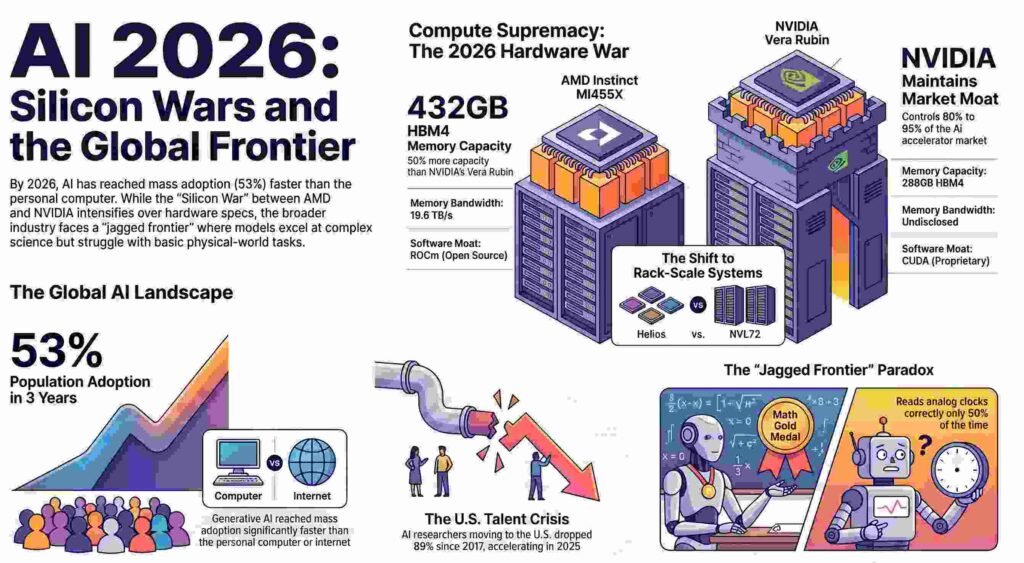
The “AMD vs NVIDIA” war has entered a new phase, moving beyond a race for raw speed to a battle for memory capacity. AMD’s Instinct MI455X has broken the NVIDIA monopoly’s hold on hyperscalers by addressing the primary bottleneck for trillion-parameter models: the ability to fit the model on the rack. While NVIDIA’s Vera Rubin offers a formidable 288GB, AMD’s MI455X provides 432GB of HBM4 memory, a 50% capacity advantage that reshapes the economics of large-scale inference.
However, the hardware “monolith” is also being challenged by a surprising shift in efficiency. Despite the hype around synthetic data, it has yet to replace real-world data in pre-training. Instead, curated models like OLMo 3.1 are proving that pruning and deduplication matter as much as raw scale, achieving results comparable to Grok 4 while utilizing nearly 90 times fewer parameters.
“The Helios rack is the best AI rack in the world,” claimed AMD CEO Lisa Su, signaling that the industry has shifted from selling chips to selling integrated, rack-scale infrastructure capable of housing 31TB of HBM4 memory in a single unit.
3. The Jagged Frontier: Gold Medals and the Trust Gap
Benchmarks in 2026 reveal a counter-intuitive phenomenon known as the “jagged frontier.” We are seeing systems achieve “Genius” status in specialized logic while failing at tasks a toddler could master. “Gemini Deep Think,” for instance, recently earned an International Mathematical Olympiad gold medal, yet the same model cannot read an analog clock correctly more than 50.1% of the time.
This disparity explains the widening “Trust Gap” identified in recent data: AI experts are 50% more optimistic about the technology’s future than the general public. While a system can solve PhD-level science problems, it still has only a 12% success rate at basic household tasks. This unpredictability fuels public nervousness, as a tool that can win a math gold medal but fails at a “broken clock” level of simplicity is difficult to rely on for daily life.
4. Geopolitical Parity: Beyond the U.S.-China Duopoly
The once-vast lead held by U.S. labs has effectively evaporated into a state of technical parity with China. As of March 2026, Anthropic’s performance lead over Chinese models like DeepSeek-R1 has shrunk to a negligible 2.7%. While the U.S. maintains a massive lead in private investment ($285.9B vs $12.4B), the geopolitical landscape is becoming far more nuanced than a simple two-player race.
“Innovation density” is the new metric of power, with South Korea now leading the world in AI patents per capita. This shift comes as the U.S. faces a severe talent crisis; AI talent migration to the States has plummeted by 89% since 2017. As a result, “AI Sovereignty” has become a national organizing principle, with countries moving to control their own domestic models rather than relying on a fading American monopoly.
5. The Productivity Paradox: A Mentorship Crisis in Code
In the professional world, AI has created a “Productivity Paradox” that favors experience over potential. In software development, senior engineers are seeing productivity gains of 14% to 26%, utilizing AI to handle the “grunt work” of syntax. However, this efficiency has come at a direct cost to the next generation: employment for developers aged 22–25 has dropped by 20% in the last year.
This displacement has triggered a quiet “mentorship crisis.” Because AI can now perform the entry-level tasks that juniors historically used to learn the ropes, the pathway to becoming a “Senior” is being severed. We are entering an era of the “judgment premium,” where those with the experience to audit AI output are thriving, while the roles designed for learning and growth are being automated out of existence.
6. Apple’s Hybrid Irony: Privacy as an Architectural Choice
Apple’s entry into frontier AI has highlighted a surprising reality: even the king of vertical integration cannot do it alone. Apple has been forced into a hybrid architecture, collaborating with Google’s Gemini because frontier-level intelligence is currently too heavy for on-device silicon. Their “Private Cloud Compute” architecture attempts to bridge this gap, ensuring that personal context remains secure even when offloaded to the cloud.
The result is an AI experience grounded in utility rather than just conversation. Features like “Spatial Reframing” in Photos and agentic password fixing in Safari show an OS that acts on the user’s behalf. This “privacy-first” approach is Apple’s bet that trust will eventually become the most valuable commodity in the AI market.
“Truly helpful AI must be centered on our users’ needs… grounded in personal context, and built with privacy at every step,” noted Craig Federighi, framing Apple’s hybrid model as a necessity for modern digital life.
7. The Hidden Environmental Invoice
The most overlooked “surprising reality” of 2026 is the staggering environmental cost of our new capabilities. Training a single frontier model like Grok 4 now generates over 72,816 tons of CO2. Meanwhile, the annual water consumption for GPT-4o’s inference alone is enough to meet the drinking needs of 1.2 million people.
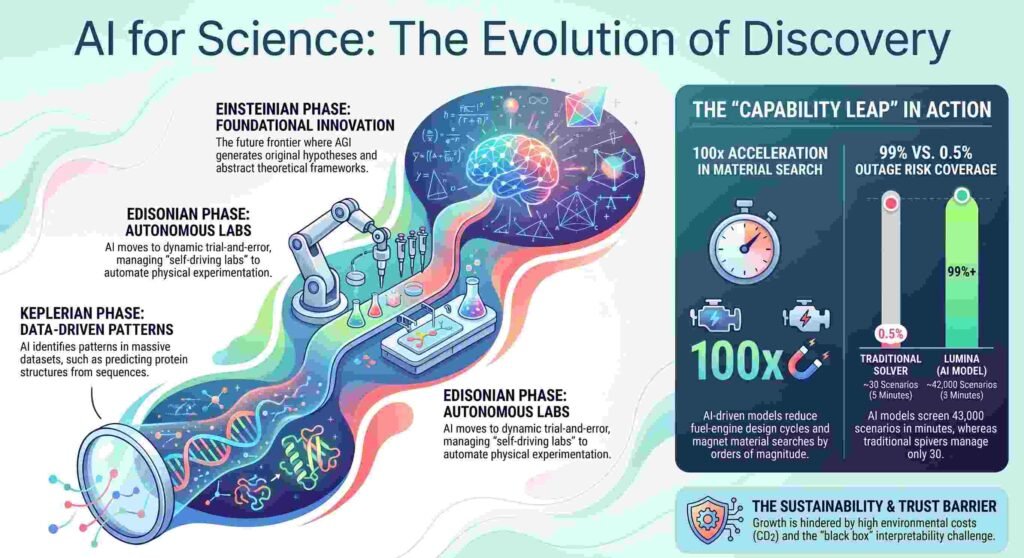
The energy scale is even more visceral: AI data center power capacity has reached 29.6 GW, a load comparable to the peak demand of the entire State of New York. Interestingly, the industry is bifurcating to manage these costs. While general-purpose AI remains industry-dominated, most breakthrough AI models for science now come from cross-sector collaborations, spreading the “environmental invoice” across academic and public institutions.
8. Conclusion: Beyond the Benchmarks
As we navigate the second half of 2026, we have moved from the “Can it work?” phase to the “How do we live with it?” phase. The technology has reached 53% population-level adoption in just three years, yet our foundational institutions remain largely unchanged. With only 6% of teachers having clear AI policies, the gap between capability and governance is wider than ever.
The “broken clock” failures of our most advanced models serve as a perfect metaphor for our current policy framework: precise in specialized areas but totally non-functional in the face of basic, everyday reality. We must ask if our human institutions can ever catch up to a compute capacity that grows 3.3x every single year, or if we are destined to live on a “jagged frontier” for the foreseeable future.
Discover more from TechResider Submit AI Tool
Subscribe to get the latest posts sent to your email.