Your smartphone screen is currently a battleground of neon banners. Between Amazon’s Great Indian Festival, Flipkart’s Big Billion Days, and a relentless barrage of push notifications from every major retailer in India, you are being bombarded with promises of “80% OFF,” flash price crashes, and time-sensitive deal timers. It is a masterclass in engineered urgency, designed to trigger the psychological panic of festive FOMO. Yet, every year, millions of Indian shoppers log off after Diwali believing they scored historic bargains, only to discover their bank balances tell a completely different story.

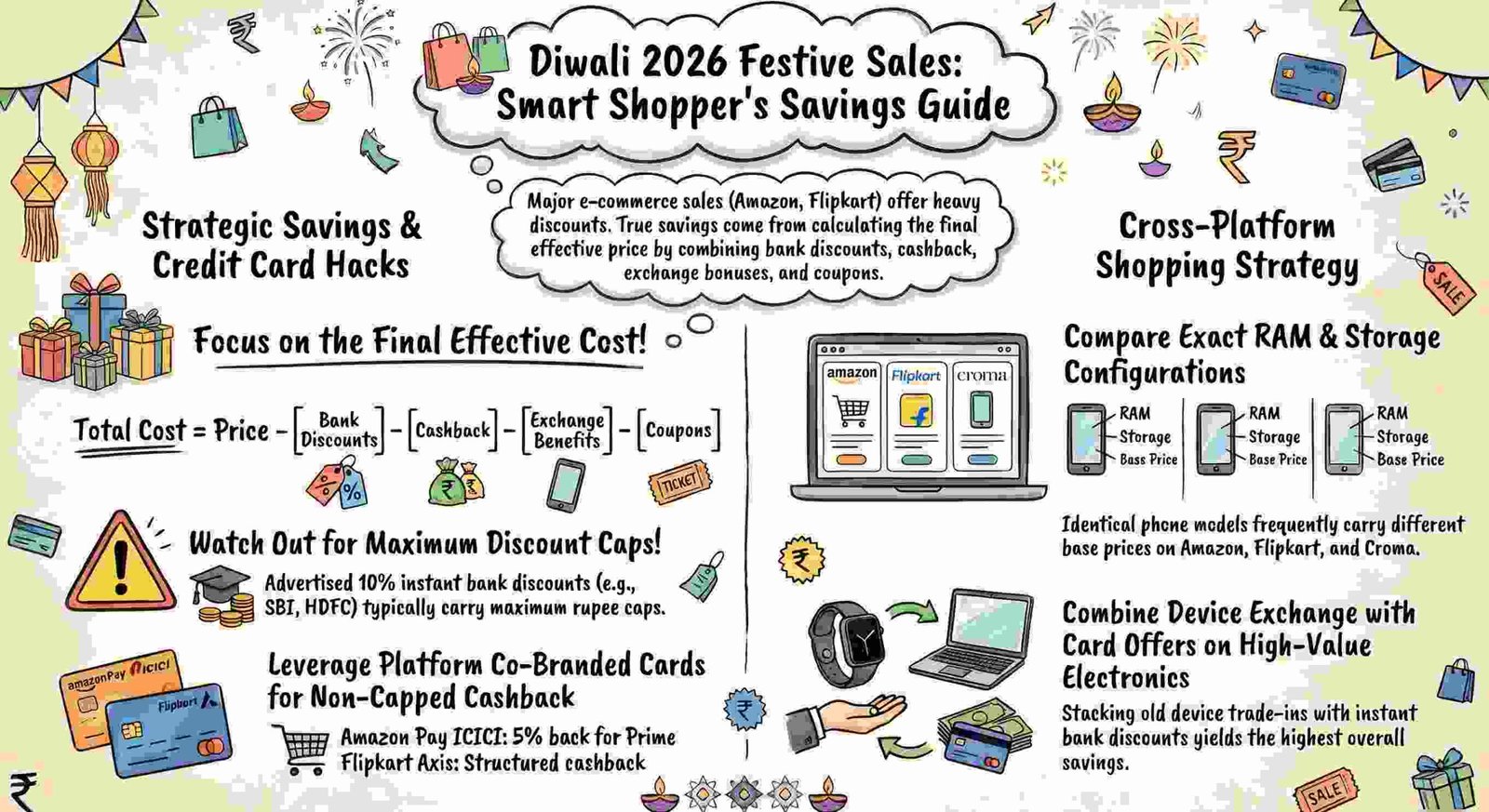
Behind the flashing graphics and marketing theater lies a cold, calculated retail economy governed by credit caps, platform turf wars, and algorithmic pricing mechanics. If you want to emerge from this year’s festive sales with actual money saved rather than a collection of impulse purchases, you need to look past the marquee discount tags. Here are five surprising, counter-intuitive realities defining the 2026 Diwali shopping frenzy—and how to navigate them like a seasoned retail insider.
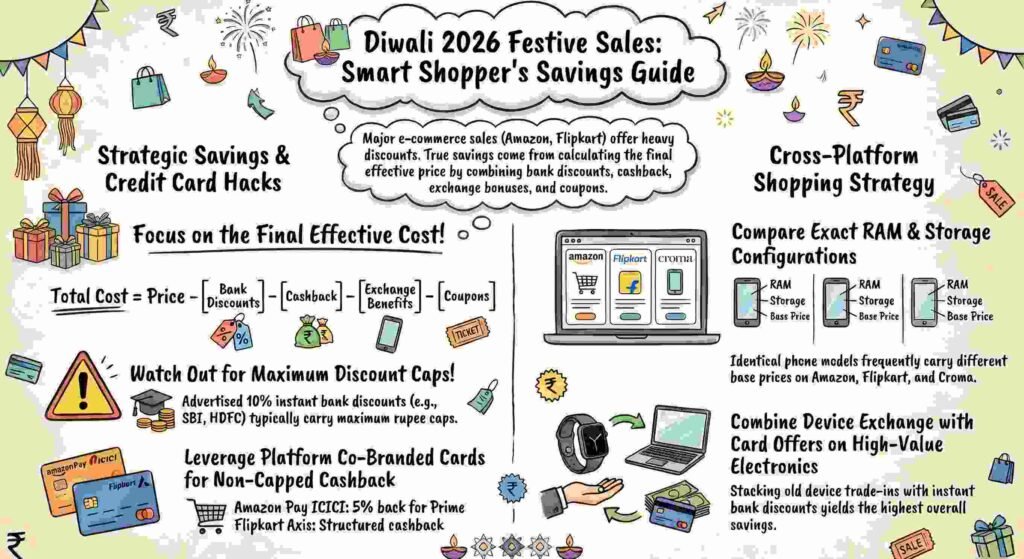
The “10% Discount” Is a Math Trap—Why Discount Caps Change Everything
Marquee bank partnerships—such as the ubiquitous “10% Instant Discount” with SBI credit cards on Amazon or HDFC Bank cards on Flipkart—are the primary psychological hook of the festive season. To a buyer eyeing a high-ticket item, a flat 10% deduction sounds like a massive windfall. But in the world of retail economics, the headline percentage is merely the bait; the fine print contains the trap.
Nearly every headline bank offer enforces a strict maximum discount cap per transaction. Consider a consumer purchasing a high-end laptop or smartphone listed at ₹50,000. Basic arithmetic suggests a 10% discount should shave ₹5,000 off the bill. However, when the bank promotion enforces a maximum cap of ₹1,500, the buyer receives an actual markdown of just ₹1,500. That reduces the real savings to a modest 3%, leaving a final payable amount of ₹48,500.
Now compare that to a card with a predictable, uncapped reward structure. A Prime member using the Amazon Pay ICICI Bank Credit Card to buy that same ₹50,000 item gets an uncapped 5% cashback credited directly as Amazon Pay balance—yielding ₹2,500 in true value.
| Advertised Bank Deal | Checkout Calculation Reality |
| 10% Instant Bank Discount | Subject to strict upper limits (e.g., a ₹1,500 cap on a ₹50,000 purchase yields an effective 3% discount, final payable: ₹48,500). |
| 5% Uncapped Cashback Card | Scales directly with purchase price (e.g., 5% on ₹50,000 delivers ₹2,500 in total value). |
Why do banks structure their promotions this way? It is a calculated liability management strategy. Financial institutions use headline “10% OFF” banners as top-of-funnel customer acquisition bait to drive high-volume, low-ticket transactions (where a ₹150 discount on a ₹1,500 item does equal 10%). Simultaneously, the cap hard-limits the bank’s financial exposure on high-ticket electronics like laptops and flagships, where applying a true 10% markdown would obliterate their promotional margins.
“The best Diwali deal is not the one with the biggest discount percentage. It’s the one that gives you the lowest genuine final price for something you actually planned to buy.”
Platform Arbitrage—The Same Phone Costs Completely Different Amounts Depending on Where You Look
If you buy all your festive tech from a single shopping app out of sheer habit, you are paying a laziness tax. E-commerce marketplaces do not price products in a vacuum; they engage in fierce model-by-model price wars, quietly subsidizing specific inventory to undermine their rivals.
Real-time price-tracking data across major platforms for identical 12GB RAM / 256GB storage configurations reveals stark pricing arbitrage:
| Smartphone Model | RAM / Storage Variant | Amazon | Flipkart | Croma | Lowest Platform Price |
| Google Pixel 10 | 12GB / 256GB | ₹67,380 | ₹74,999 | ₹74,999 | Amazon (₹67,380) |
| OnePlus 13 | 12GB / 256GB | ₹63,157 | ₹54,901 | ₹59,499 | Flipkart (₹54,901) |
| OnePlus 13s | 12GB / 256GB | ₹54,999 | ₹57,950 | ₹52,999 | Croma (₹52,999) |
A buyer who automatically checks out the Google Pixel 10 on Flipkart pays a ₹7,619 premium over Amazon’s listing. Conversely, buying the OnePlus 13 on Amazon costs an extra ₹8,256 compared to Flipkart. Meanwhile, offline giant Croma quietly undercuts both e-commerce titans on the OnePlus 13s. Marketplace algorithms constantly adjust prices based on seller inventories and platform-exclusive subsidies. Assuming any single app holds a monopoly on low prices is a guaranteed way to overpay.
Battery & Hardware Specs Are Outpacing Flagship Price Tag Premium
One of the most striking shifts in 2026 smartphone economics is the collapse of the traditional flagship value proposition during sale events. For years, shoppers waited for Diwali to snag small festive markdowns on luxury flagships like the Apple iPhone 17 Pro (listed at ₹1,34,900) or the Samsung Galaxy S25 Ultra (listed at ₹88,999). But a close look at the mechanics reveals that reaching an “affordable” price on these ultra-premium devices almost always requires liquidating your current phone via aggressive trade-ins—such as claiming a ₹57,850 exchange credit for an iPhone 16 Pro.
In 2026, mid-range performance engineering has advanced so rapidly that paying a massive flagship premium for incremental camera tweaks makes increasingly little economic sense. Instead, festive sales have highlighted a powerful new category: hyper-focused “performance and battery monsters” that deliver absurd real-world utility straight out of the box without requiring a trade-in.
Consider these high-endurance mid-range highlights from this year’s sale ecosystem:
- Realme P4 Power: Delivers an unprecedented 10,001mAh battery, a 144Hz AMOLED display, and 80W fast charging at an effective sale price of ₹29,999.
- OnePlus Nord 6: Integrates a flagship-grade Snapdragon 8s Gen 4 chipset, a 165Hz high-refresh display, and a massive 9,000mAh battery for an effective price of ₹42,999.
- OnePlus 15R: Pairs elite processing power and a vivid AMOLED screen with a 7,400mAh battery at an effective price of ₹54,999.
For mobile gamers, heavy media consumers, and remote professionals, a phone with a multi-day 10,001mAh battery or a silky 165Hz display at ₹29,999 to ₹42,999 offers vastly more practical daily utility than paying ₹1.34 lakhs for a flagship that still requires a mid-day top-up at the wall socket.
AI Tools Are Stripping Away Fake “50% OFF” Sale Pricing
The oldest trick in the retail playbook is pre-sale price inflation. Weeks before a major festive event, a retailer quietly raises an item’s list price so that dropping it back to its original retail figure during the sale allows them to slap a dramatic “50% OFF!” badge on the listing. In 2026, however, artificial intelligence is dismantling this illusion.
Shoppers now have real-time analytical tools built directly into their storefront interfaces to verify whether a discount is genuine or manufactured:
- Rufus: Amazon’s native AI shopping assistant features a integrated 30-to-90-day Price History tracker. Rufus actively monitors multi-month price trends, alerts buyers when an item hits a genuine historical low, and understands localized, natural language prompts such as “Help me find the perfect Diwali gifts under ₹2,000” or “Diwali par ghar ko sajane ke liye kya kya chahiye?”.
- Lens AI: Enables instant visual product recognition, allowing shoppers to snap a picture of an item online or in a physical store to instantly locate cross-platform pricing alternatives.
- AI Evaluation Tools: Features like AI Review Highlights, Quick Learn modules, and automated Buying Guides analyze thousands of verified customer reviews to summarize real-world product flaws before checkout.
By leveraging 90-day price trends via conversational AI, consumers can immediately identify artificial pre-sale markups, ensuring they only pull the trigger when a deal represents an authentic price drop.
E-Commerce Financing Has Expanded Far Beyond Gadgets into Mobility & High-Value Credit
Diwali sales are no longer just about picking up a discounted television or a pair of wireless earbuds. In 2026, e-commerce checkout platforms have evolved into primary financing and delivery channels for major personal mobility and credit purchases.
The infrastructure underlying festive checkouts now mirrors high-street financial services:
- Amazon Pay Shopping Loans: A high-value credit service introduced directly at checkout, providing eligible shoppers up to ₹3.5 lakhs in credit for purchases valued at ₹50,000 and above, with repayment tenures stretching up to 24 months.
- Online Vehicle Bookings: Consumers can now finance and order daily mobility vehicles straight from their shopping cart. High-volume options include the Hero MotoCorp DESTINI 125 FI ZX+ DSSC Scooter (MRP ₹92,636, reduced to an offer price of ₹82,886) and the Bajaj Chetak 3503 Electric Scooter (MRP ₹1,25,698, reduced to an offer price of ₹1,21,698).
- Rapid Logistics Integration: Ultra-fast delivery networks like Amazon Now have expanded to 120+ cities, delivering daily essentials, groceries (at up to 50% off), and instant festive supplies in minutes.
Why are e-commerce giants suddenly selling commuter scooters alongside smartphones? Because high-intent festive shopping traffic provides the ultimate low-cost acquisition vehicle for lucrative, long-term financial products like 24-month credit lines. By converting a retail transaction into a high-margin loan, platforms maximize their lifetime customer value long after the Diwali decorations come down.
CONCLUSION: Smart Shopping Checklist & Final Thought
Before you enter your card details and click “Pay Now” this festive season, run your basket through this non-negotiable checkout protocol:
- [ ] Verify Card Caps: Read the offer fine print to check the maximum rupee limit on bank discounts. Calculate the effective percentage saved on your specific transaction total.
- [ ] Check Alternative Platforms: Search for the exact same RAM, storage, and color configuration across rival marketplaces to avoid paying an single-platform laziness tax.
- [ ] Review 30-Day Price History: Use AI assistants like Rufus to check multi-month price graphs and confirm the current offer is a genuine historical drop rather than a inflated pre-sale markdown.
- [ ] Confirm Final Payable Amount vs. EMI Terms: Evaluate the absolute net rupees leaving your account. If opting for EMI financing, inspect interest rates, processing fees, and overall repayment costs rather than focusing solely on a low monthly installment figure.
When you reach the final checkout screen this Diwali, are you purchasing a product you genuinely planned to buy at its absolute lowest price, or are you simply paying for the illusion of a massive discount percentage?
Discover more from TechResider Submit AI Tool
Subscribe to get the latest posts sent to your email.