1. The Great Search Upheaval
Digital strategists and website owners across every commercial sector are confronting an unprecedented operational dilemma: their traditional organic search rankings remain firmly entrenched in top positions, yet their overall site traffic is experiencing a sharp, sustained collapse.

This widening divergence between keyword rank and web traffic is no temporary anomaly. In 2026, the foundational mechanics of online discovery have been permanently restructured by volatile search engine core updates, generative AI answer summaries embedded at the head of search result pages, and real-time automated spam enforcement.
At the center of this structural shift is the massive acceleration of zero-click search behavior. Zero-click searches have expanded to represent between 58.5% and 59.7% of total search activity. More than half of all web queries now start and end on the search engine results page (SERP) without producing a single outbound click to an external publisher.
To survive in this zero-click economy, modern search marketers must abandon legacy rank-tracking paradigms. The following seven data-backed realities reveal how visibility, content extraction, and user acquisition actually function across today’s AI-driven search ecosystem.
2. The Page-3 Paradox (Why Positions 21–50 Are Winning AI Citations)
For two decades, achieving a top-five organic ranking on traditional SERPs was the ultimate objective of search engine optimization. In the era of generative retrieval, top-tier organic rankings no longer guarantee extraction or citation inside generative answer boxes.
Large language models (LLMs) parse and retrieve web content through mechanisms fundamentally distinct from legacy crawling and index-ranking systems. While traditional organic algorithms place heavy weight on domain equity, historical link profiles, and URL-level page signals, generative answer engines prioritize semantic context, topical completeness, and structured knowledge extraction.
This algorithmic divergence has created a striking AI Citation Anomaly:
“An AI citation anomaly reveals that pages ranking in positions 21–50 exhibit a 64.7% higher likelihood of being cited in AI-generated responses than those sitting in the top five results.”
Because generative search interfaces actively seek concise, semantically dense information blocks to answer complex queries, deeply specific informational pages buried on pages three through five of traditional SERPs are routinely extracted over generalized, high-authority top-ranking URLs.
As a result, effective search strategy has shifted from basic keyword placement toward comprehensive semantic coverage and clear entity architecture.
3. The “Citation Premium”—How to Turn a 58% CTR Drop Into a Traffic Win
The widespread rollout of Google AI Overviews (AIO) has fundamentally compressed traditional click-through rate (CTR) curves across organic search results.
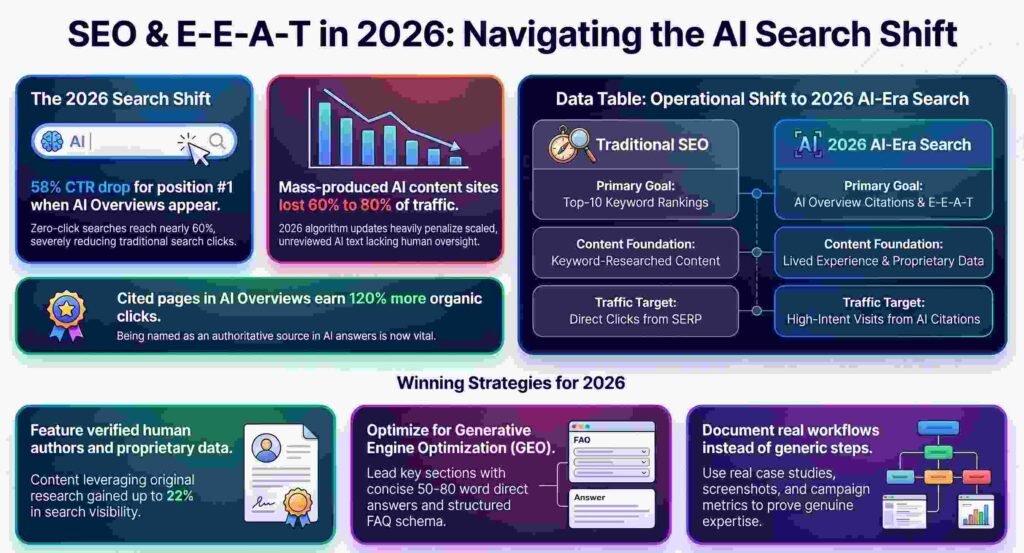
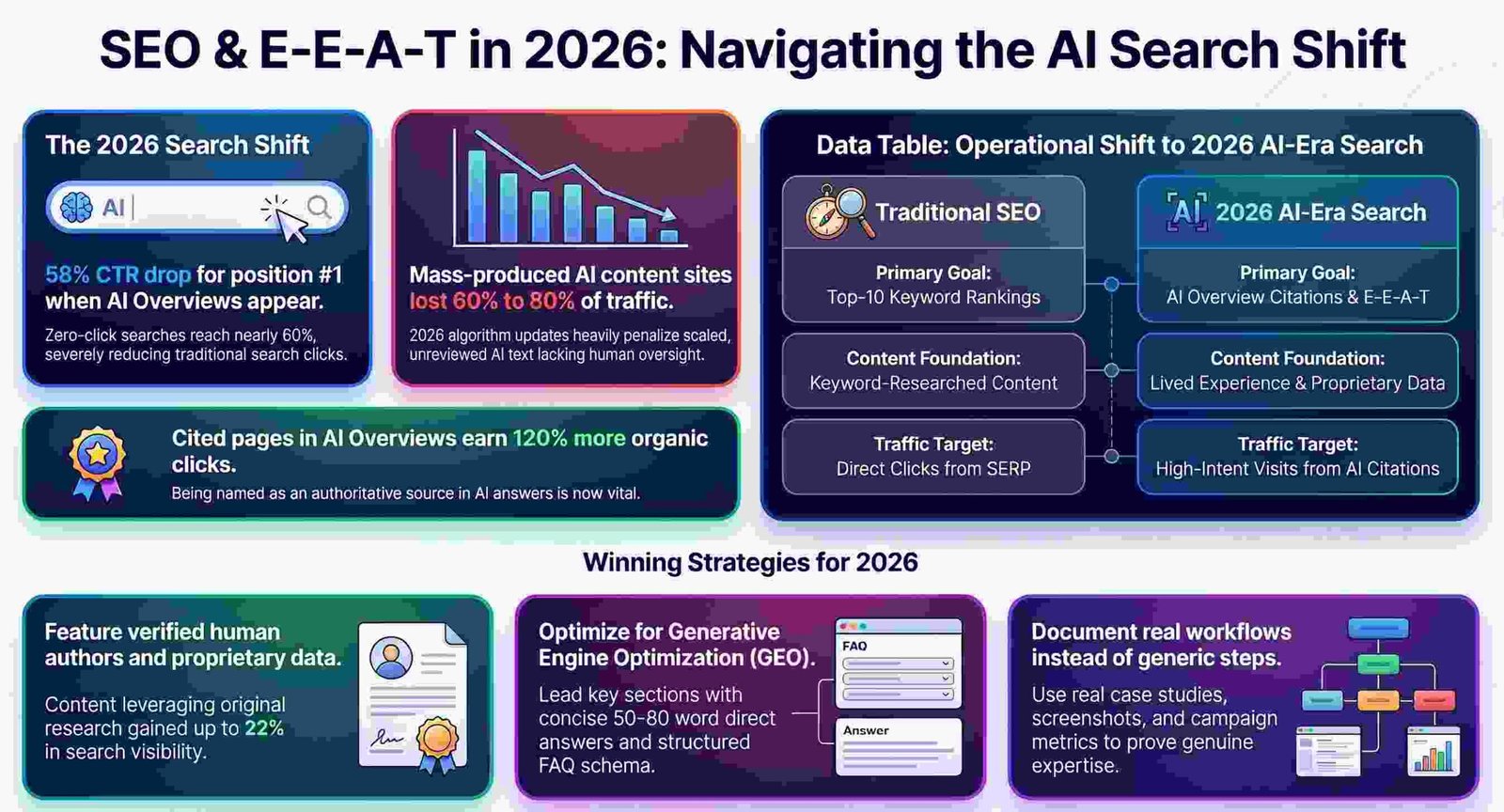
An extensive study by Ahrefs (analyzing 300,000 keywords) revealed that the presence of an AI Overview reduces the CTR for the #1 organic position by approximately 58%. Across the entire top-10 organic positions, overall click-through rates suffer a systematic degradation of 34.5% to 34.74%.
However, this traffic loss is not distributed evenly across all listings. Research from Seer Interactive (evaluating 5.47 million queries across 53 major brands) demonstrates that pages explicitly cited within an AI Overview earn a massive “citation premium,” securing 120% more organic clicks per impression than uncited pages appearing on the exact same SERP.
| Uncited Organic Results | AI Overview Cited Sources |
| CTR Impact: Suffers a ~58% CTR degradation in position #1 and a 34.5%–34.74% drop across top-10 positions (Ahrefs). | CTR Impact: Earns 120% more organic clicks per impression than uncited pages on the same SERP (Seer Interactive). |
| Impression Value: Low value; passive impressions rarely yield outbound site traffic in zero-click environments. | Impression Value: High value; commands prime visual real estate and implicit endorsement within synthesized answers. |
| Primary Goal: Defending traditional organic SERP rank positions (1–10). | Primary Goal: Winning direct content extraction and explicit source citation inside generative summaries. |
Crucially, digital strategists must account for a vital caveat highlighted in Seer Interactive’s research: even with a 120% citation premium over uncited SERP neighbors, cited pages still receive approximately 38% fewer absolute clicks compared to historical queries where no AI Overview is present. Earning citation status does not fully restore pre-AI traffic volumes, but it converts a devastating zero-click loss into an exceptionally high-intent referral stream.
4. The Multi-Engine Disconnect (Google AIO vs. ChatGPT)
A widespread strategic miscalculation among marketing teams is assuming that optimizing content for Google AI Overviews automatically secures visibility across alternative generative discovery platforms such as ChatGPT, Perplexity, or Claude.
Data from the Machine Relations Index confirms that competing AI discovery engines operate on vastly different index sets, web scrapers, and citation logic. In a cross-platform analysis of multi-engine citations:
- Only 26.7% of domains cited by Google AI Overviews were also cited by ChatGPT (840 out of 3,143 monitored domains).
- Over 73% of citations generated by ChatGPT drew from an entirely separate retrieval pool unreferenced by Google’s generative interface.
- Across 31,721 monitored domains, a tiny core of just 458 domains (1.4%) achieved citations across all six major AI engines—yet this elite tier accounted for 22.6% of all multi-engine citations.
To achieve durable visibility across the entire AI ecosystem, organizations must execute a broad cross-platform authority strategy rather than relying on single-engine, on-page SEO tweaks:
- Build Universal Entity Authority: AI models prioritize entities that are independently verified across universal knowledge bases, structured registries, and authoritative industry databases.
- Target Core Shared Publications: Securing media coverage in top-tier publications (e.g., Forbes, Gartner, TechRadar) ensures inclusion in the shared retrieval core that powers almost a quarter of all multi-engine citations.
- Adopt Machine Relations Frameworks: Modern optimization requires moving beyond traditional SEO to embrace Generative Engine Optimization (GEO) and Answer Engine Optimization (AEO)—disciplines focused on making brand authority legible to autonomous AI engines.
5. The March 2026 Core Update & The Triumph of “Information Gain”
Algorithmic volatility reached historical highs during the March 2026 Core Update, recorded as the most volatile event in search history after generating 79.5% rank movement among top-three search results.
This update codified a structural re-weighting of “Information Gain”—Google’s algorithmic metric designed to identify and reward content containing unique, first-hand data while heavily penalizing derivative, recycled summaries.
- Mass-Produced AI Content Collapse: Websites relying on unreviewed, mass-produced AI content farms suffered ranking and traffic losses ranging from 60% to 80%.
- Proprietary Data Surge: Sites featuring original research, proprietary datasets, and verified hands-on experience realized visibility gains of up to 22%.
- Mandatory Author Credentials: Verified author credentials and explicit subject-matter expertise are now present on 73% of top-ranking Your Money Your Life (YMYL) pages.
This update established a uncompromising benchmark for digital content teams:
“Google re-weighted Information Gain: if your content disappeared tomorrow, would the internet lose genuinely new knowledge, or just another rewrite of what already exists?”
6. “AI Hacking” Fails—SpamBrain 3.0 and E-E-A-T Always Win
As generative answer engines emerged, many site owners attempted to shortcut the system using “AI prompt hacking”—rewriting documents with conversational phrasing or buying bulk links to force generative extraction. Methodological research and real-time algorithmic enforcement have proven these manipulation schemes counterproductive.
The peer-reviewed C-SEO Bench study (presented at NeurIPS 2025) rigorously evaluated conversational SEO tactics, specifically testing text-rewriting schemes designed to court AI answer selection. The study demonstrated that artificial text manipulation was largely ineffective and frequently reduced a document’s overall retrieval probability. Fundamental domain authority, genuine topical relevance, and search-intent alignment remained the primary drivers of AI citations.
Simultaneously, Google’s automated enforcement systems now operate with near-instantaneous speed:
- SpamBrain 3.0 Rollout Speed: Demonstrating automated, real-time detection, the March 2026 spam update executed its entire global rollout in a record 19.5 hours.
- Targeted AI Manipulation Rules: The June 2026 spam update explicitly expanded Google’s written spam policy to cover attempts to artificially manipulate generative AI responses across both AI Overviews and AI Mode.
Attempts to trick generative search engines trigger immediate algorithmic neutralization or sitewide devaluation. Sustainable search authority remains firmly anchored in verified Experience, Expertise, Authoritativeness, and Trustworthiness (E-E-A-T).
7. The AI Conversion Paradox—Fewer Clicks, Much Higher Value
Although zero-click search environments reduce overall organic referral volumes, the user traffic that does click through from an AI citation exhibits extraordinary commercial intent compared to traditional search traffic.
Data from Adobe’s comprehensive tracking of U.S. retail web traffic (analyzing over 1 trillion visits in March 2026) highlights a profound shift in user behavior originating from generative citations:
- 42% Higher Conversion Rate: Visitors arriving via AI citations convert 42% better than traditional search traffic, proving that generative summaries act as an automated pre-qualification layer before users click.
- 48% Longer Time On-Site: Users arriving from AI recommendations spend 48% more time engaged on-site, demonstrating high context awareness and deep intent.
- 13% Increase in Page Views: AI-referred traffic navigates deeper into site architecture, viewing 13% more pages per session than standard search visitors.
- 37% Revenue Lift Per Visit: Driven by high pre-purchase confidence, AI-referred visitors generate 37% more revenue per visit than non-AI search traffic.
While AI Overviews absorb low-intent informational queries, they function as a highly efficient conversion funnel—delivering smaller cohorts of pre-educated buyers who convert at dramatically higher rates.
8. Local SEO Has Shifted From “Rankings” to “Ecosystem Inclusion”
Local discovery has evolved beyond legacy map packs into conversational AI assistants, localized summaries, and multi-platform recommendation feeds. Local visibility is no longer just a matter of keyword targeting; it is a complex challenge of data accuracy and algorithmic trust across the web.
Three critical mechanisms now govern local AI discovery:
- Real-Time “Open Now” Status: Operational status has become a direct, real-time ranking lever. Algorithms dynamically favor businesses currently open and operating at the exact moment of the user’s query.
- Review Recency and Rich Language: AI extraction systems prioritize review recency and descriptive, semantic phrases (e.g., “fast service,” “wheelchair accessible,” “great vegetarian options”) far above raw 5-star average ratings.
- Multi-Platform Ecosystem Triangulation: AI engines validate real-world business details by cross-referencing listings across major directories, social platforms, and local web mentions. These external citations act as essential “testimonials” that allow AI engines to confidently recommend a local entity.
9. The New Playbook for Search Authority
Surviving and thriving in the 2026 search landscape demands abandoning outdated playbooks focused on chasing rigid #1 keyword rankings and mass-producing generic content. As search discovery shifts toward synthesized answers, zero-click interactions, and multi-engine extraction, sustainable organic growth belongs to brands that build undeniable real-world authority. Success now requires publishing proprietary data that offers genuine Information Gain, verifying human E-E-A-T credentials, maintaining flawless ecosystem data consistency, and securing earned media across the publications that independent AI models trust.
If your strategic success is measured only by traditional rank tracking, are you accurately measuring your brand’s true visibility—or are you simply watching the rankings of a search experience that no longer exists?
Discover more from TechResider Submit AI Tool
Subscribe to get the latest posts sent to your email.