1. The Fragile Giant Behind Your Signal
Digital connectivity has become as essential and unexamined as running water or electricity. Millions of times a day, users tap screens to launch video calls, execute high-frequency financial transactions, or navigate transit routes without giving a single thought to the vast architecture carrying their packetized data. Connectivity is universally taken for granted—until the exact moment a signal drops, an API authentication call fails, or a major regional network outage brings enterprise operations to a grinding halt.

Behind these transient smartphone screens lies a global telecommunications sector undergoing its most radical, high-stakes evolution in decades. Far from acting as passive utility pipes for over-the-top content, telecom operators have transformed into software-defined battlegrounds. This tectonic shift is being driven simultaneously by hyper-volumetric cyber warfare, a commercial space race pushing cellular towers into low Earth orbit, and complex artificial intelligence integrations that promise operational efficiency while inducing vendor paralysis.
As carriers re-engineer their technical cores to support exponentially rising data traffic and defend national critical infrastructure, the operational reality of modern connectivity diverges sharply from popular belief. Here are five counter-intuitive truths reshaping the global telecommunications landscape today.
2. Public Enemy #1 — Telecom Infrastructure Faces Hyper-Volumetric DDoS Warfare
While news headlines relentlessly highlight corporate database breaches and stolen passwords, the primary cyber threat confronting global telecommunications is a direct assault on service availability. Telecom infrastructure has emerged as the premier target for hyper-volumetric Distributed Denial of Service (DDoS) campaigns designed to sever connectivity at the network layer.
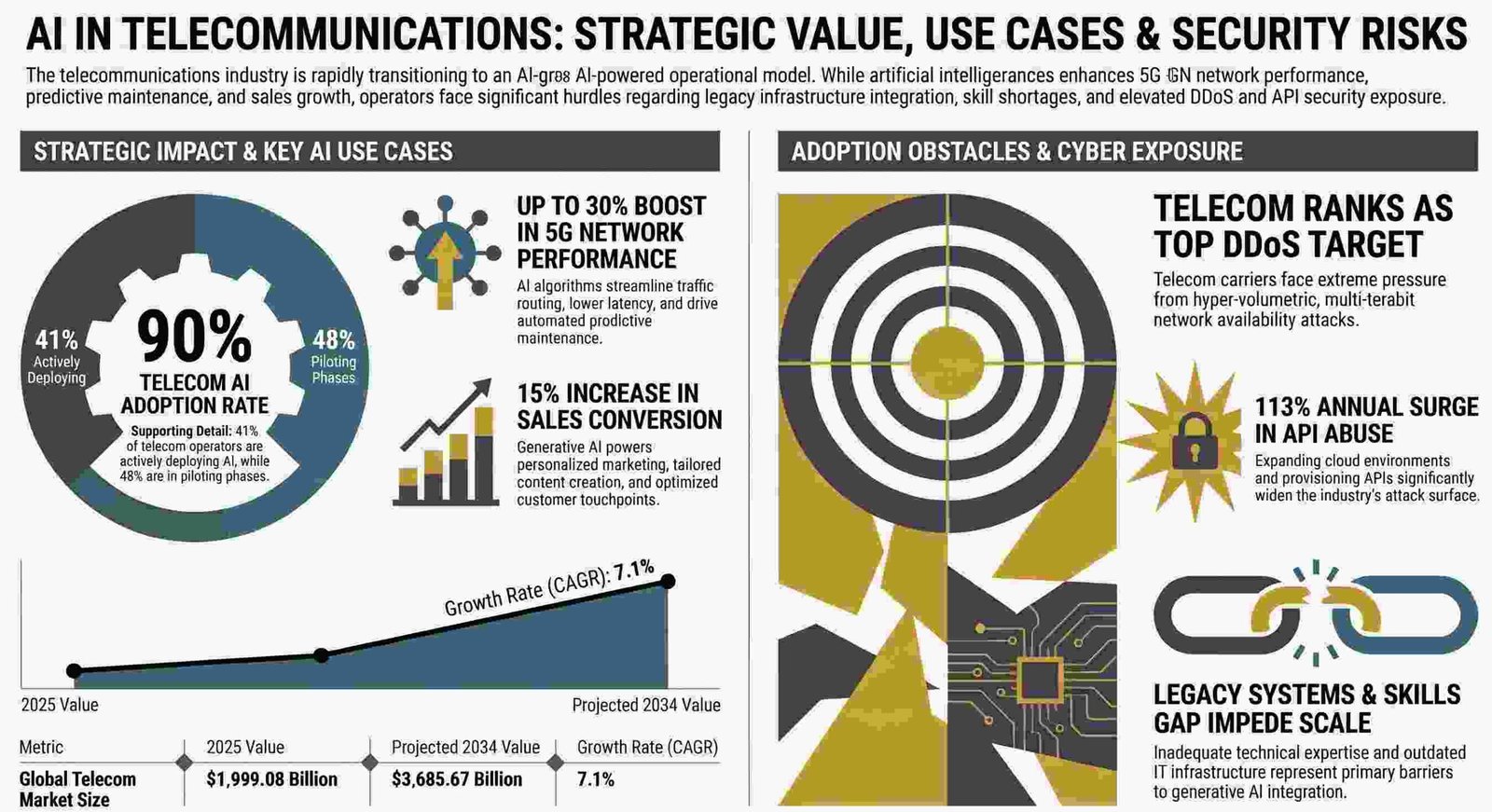
Telemetry from Cloudflare paints a stark picture of this threat shift: global DDoS attacks more than doubled to 47.1 million, with telecommunications, service providers, and carriers ranking as the single most-attacked industry sector. Threat monitoring recorded a record disclosed attack reaching an unprecedented peak of 31.4 Terabits per second (Tbps), alongside a 700% surge in hyper-volumetric attack volumes. Complementing these macro metrics, Nokia’s threat intelligence reports that terabit-scale network disruptions are occurring five times more frequently, with 37% of DDoS attacks executing in hyper-intense bursts lasting under two minutes.
“Attacks on telecommunications can serve as launchpads for attacks on other entities, transforming sector-specific disruptions into systemic risks across national infrastructure.” — Microsoft Threat Intelligence
This micro-burst strategy creates a deceptive risk profile. While a two-minute attack burst might sound negligible on a vendor dashboard, its operational legacy is massive. Multi-year reporting from ENISA reveals that while malicious cyber incidents account for a targeted percentage of total telecom disruptions, they inflict disproportionate collateral damage—accounting for 184 million user-hours lost in a single year out of a broader 743 million user-hour impact footprint across 1,930 multiannual major incidents. Because modern carrier backbones host voice networks, emergency response paths, financial identity verification, and enterprise cloud links on shared physical infrastructure, a brief multi-terabit volumetric spike instantly cascades into critical supply chains and public safety operations.
3. The 6G Bottleneck — Next-Gen Ambitions Depend on 5G Monetization
While industry marketing aggressively touts the upcoming era of 6G connectivity—with global technical standards targeted for release by late 2028—the reality is that 6G ambitions are bottlenecked by current commercial challenges. GSMA analysts issue a clear warning: the global telecommunications industry cannot fund or justify next-generation capital expenditures without first proving it can successfully monetize existing 5G Standalone (5G SA) deployments.
The technical and commercial cornerstone of this transition is “network slicing.” Enabled by 5G Standalone cores, network slicing allows operators to partition a single physical physical network into multiple, logically isolated virtual networks. Each slice delivers guaranteed service-level performance metrics tailored to mission-critical enterprise use cases in automated manufacturing, connected logistics, and remote healthcare.
+----------------------------------------------------------------------------------------------------+
| Traditional Spectrum/Network Delivery vs. 5G Standalone Network Slicing Capabilities               |
+----------------------------------------------------------------------------------------------------+
| Traditional Spectrum/Network Delivery | 5G Standalone Network Slicing Capabilities |
| Best-Effort Delivery: All subscriber traffic shares identical network paths with variable throughput and unpredictable latency during peak load spikes. | Guaranteed SLAs: Isolated virtual networks deliver dedicated bandwidth, microsecond latency, and strictly enforced performance bounds. |
| Monolithic Architecture: Fixed hardware configurations built primarily to serve generic consumer voice and mobile broadband data traffic. | Dynamic Customization: Software-defined network slices provisioned dynamically for industrial robotics, IoT fleets, or emergency priority channels. |
To unlock this value, GSMA emphasizes that regulators and governments must shift their policy frameworks. Rather than treating radio spectrum auctions as short-sighted state revenue extraction tools, governments must treat spectrum as a co-investment in the digital economy. Furthermore, operators must open their network capabilities to software developers via standardized Application Programming Interfaces (APIs). By leveraging frugal innovation templates pioneered in rapidly scaling markets like India, carriers can build reusable commercial frameworks applicable across emerging economies in the Global South and Latin America.
4. Orbits Over Towers — Direct-to-Device Satcom Bypasses Terrestrial Dead Zones
Satellite communications (satcom) have crossed a critical technological inflection point, evolving from a slow, expensive backup technology into an integrated layer of mainstream mobile architecture. Low Earth Orbit (LEO) satellite constellations are establishing direct connections with unmodified consumer smartphones, effectively transforming space into an orbital cell tower network that bypasses terrestrial infrastructure constraints.
Key regulatory, aerospace, and commercial milestones illustrate this rapid convergence:
- Regulatory Framework Modernization: Authorities such as the Telecom Regulatory Authority of India (TRAI), under Chairman Anil Kumar Lahoti, are advancing unified network authorizations under updated telecommunications legislation (“one nation, one authorisation”) while establishing spectrum assignment frameworks specifically tailored for satellite-based communications.
- Commercial Orbital Launches: Private aerospace ventures are dramatically expanding orbital deployment capacity, highlighted by Skyroot’s Vikram-1 rocket, which successfully placed multiple satellites into low Earth orbit from Indian soil.
- Cross-Border Carrier Joint Ventures: Telecom operators are actively deploying orbital coverage to eliminate geographic dead zones. Airtel Africa partnered with Starlink to commercially launch direct satellite-to-mobile connectivity in the Democratic Republic of the Congo, enabling standard smartphones to access messaging and lightweight data in remote regions. Simultaneously, U.S. giants AT&T, T-Mobile, and Verizon formed a joint venture to integrate LEO satellite connectivity directly across remote transit routes and rural coverage gaps.
By linking standard consumer smartphones directly to orbiting satellites, telecommunications providers are redefining disaster resilience, maritime transport connectivity, and remote industrial tracking without waiting for physical ground infrastructure to be constructed.
5. The AI Adoption Paradox — High Ambition vs. Operational Paralysis
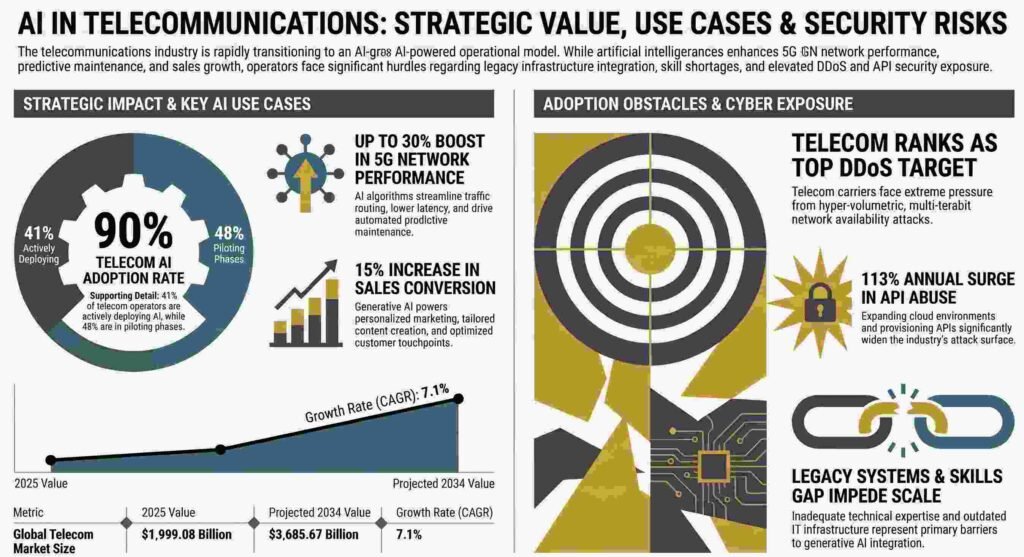
The deployment of artificial intelligence within the telecommunications sector reveals a striking operational contradiction. On one hand, top-level adoption metrics suggest near-total saturation: an Nvidia benchmark study indicates that 90% of telecom operators are actively testing or using AI (41% actively deployed, 48% running pilots). Furthermore, an IBM Institute for Business Value study revealed that 80% of telecom executives believe AI generates actionable new insights from existing data, with 53% already deploying or optimizing AI within customer service environments.
On the other hand, actual enterprise-wide transformation remains severely bottlenecked by vendor paralysis and technical debt:
“While AI enthusiasm is nearly universal across the telecom landscape, executive teams face severe execution barriers—50% struggle to select the correct generative AI partners, while legacy IT systems and internal skills shortages stall deployment.” — EY & IBM Institute for Business Value Industry Studies
Research from EY highlights that 50% of telecom leadership teams struggle to select the right Generative AI partners from a hyper-crowded vendor ecosystem. Beyond vendor selection paralysis, operators face immense friction when attempting to integrate modern neural networks into deeply entrenched, multi-decade-old legacy IT architectures and operational support systems (OSS/BSS). Compounded by a severe internal AI skills gap, these integration hurdles frequently trap ambitious, high-budget AI projects in perpetual pilot testing phases.
6. The Invisible Perimeter — Mobile Numbers and APIs Become Ground Zero for Fraud
The conventional network perimeter defined by enterprise firewalls has completely dissolved. In its place, mobile subscriber identities, onboarding workflows, and external Application Programming Interfaces (APIs) have become the primary attack vectors for sophisticated fraud and breach campaigns.
Data from Akamai underscores the velocity of this transition: average daily enterprise API attacks surged 113% year-over-year, with 61.18% of observed incidents involving unauthorized logic manipulation or abnormal workflow abuse. Telecom customer care portals, self-service provisioning apps, and partner billing APIs sit squarely in this high-exposure zone. On the employee front, Verizon’s Mobile Security Index found that 80% of surveyed organizations reported mobile phishing (smishing) attacks targeting their workforce.
Concurrently, mobile phone numbers have evolved into universal identity anchors used for multi-factor authentication (MFA), password resets, and digital banking verification. This reliance makes SIM-swap fraud and illegal number port-outs exceptionally lucrative for cybercriminals. In response to underlying protocol vulnerabilities, regulatory bodies are stepping in; the UK’s Ofcom instituted a decisive ban on the new leasing of Global Titles.
Global Titles represent legacy signaling routing addresses inside SS7 and Diameter mobile signaling networks. Banning these leased pathways eliminates a structural blind spot that malicious actors historically rented to conduct silent geo-location tracking, intercept SMS-based MFA codes, and execute stealthy call-routing fraud.
7. Navigating the Connected Era
The global telecommunications market is on an aggressive growth trajectory that mirrors its expanding role as critical software-defined infrastructure. Comprehensive market analysis from Fortune Business Insights values the global telecom services market at $1,999.08 billion in 2025. The sector is projected to expand from $2,125.02 billion in 2026 to $3,685.67 billion by 2034, registering a steady compound annual growth rate (CAGR) of 7.1%.
This valuation surge reflects a fundamental shift in how networks are engineered, commercialized, and defended. Whether through direct satellite-to-phone links, software-defined 5G network slicing, automated multi-terabit DDoS defenses, or signaling-layer security overhauls, telecommunications is no longer a passive utility pipe. It has become the central, software-driven nervous system of modern digital commerce, public safety, and national defense.
As your smartphone automatically balances connectivity across cell towers, cloud endpoints, and orbiting LEO satellites today, ask yourself: How much of your organization’s operational resilience rests on an invisible backbone you rarely think about until it fails?
Discover more from TechResider Submit AI Tool
Subscribe to get the latest posts sent to your email.