For years, web leaders and engineering managers have relied on a comfortable security baseline: turn on automatic plugin updates, put a reputable web host behind Cloudflare, and trust the infrastructure to defend itself. In 2026, that playbook is not just outdated—it actively invites catastrophic breaches.
Despite framework triumphs in WordPress 7.0 and 7.1—which delivered native AVIF support, Full Site Editing refinements, and Interactivity API v2—the nature of web attacks has fundamentally shifted. Attackers no longer deploy crude, signature-matched scripts; they exploit application logic and server memory before security teams even receive a vulnerability alert.
Securing modern web infrastructure requires looking past legacy edge defenses. To maintain operational resilience, technical executives must confront six uncomfortable realities defining the 2026 threat landscape.
1. The 5-Hour Window: Mass Exploitation Hits Before Developers Even Write a Patch
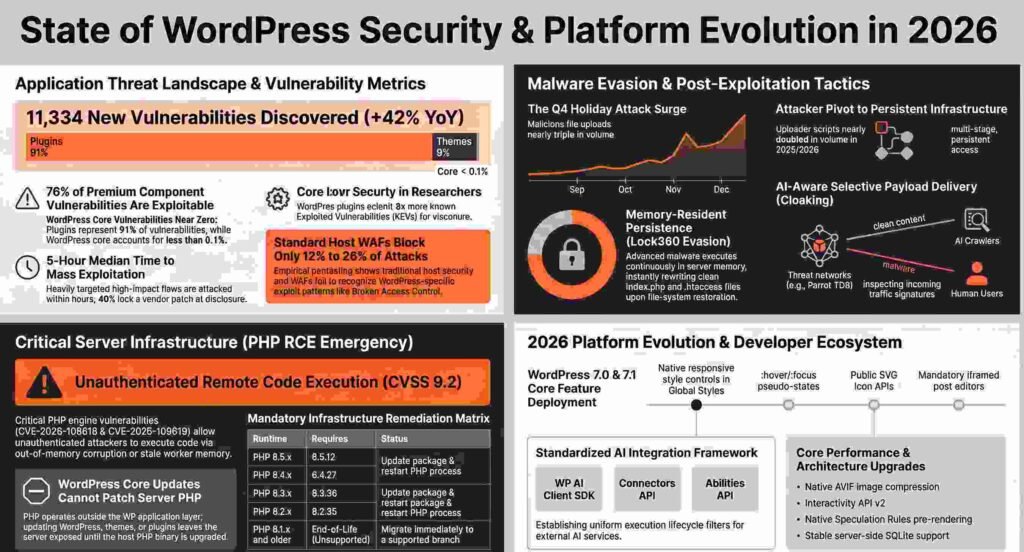
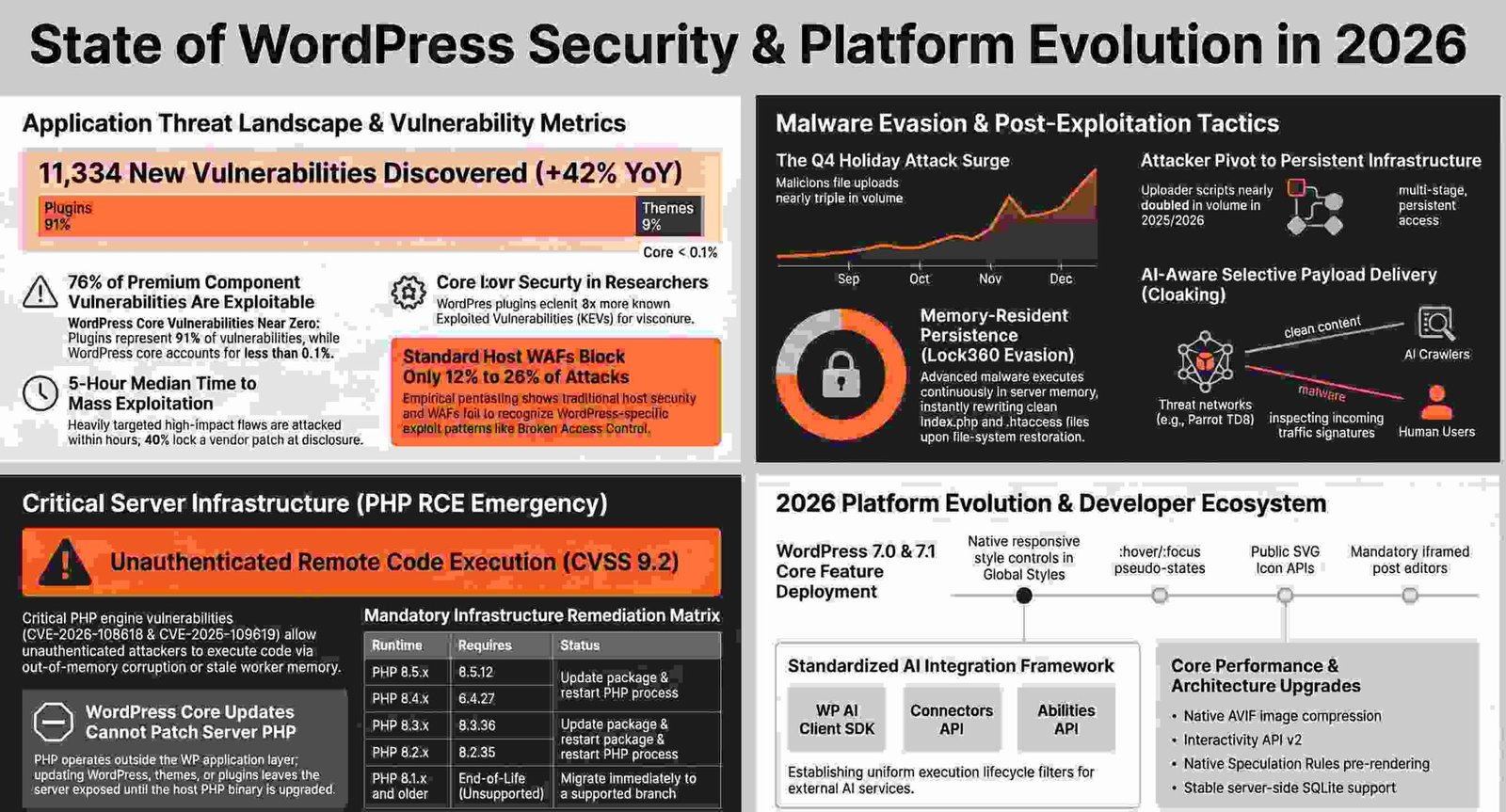
The Speed of Weaponization According to data from Patchstack’s 2026 Whitepaper, automated threat networks now weaponize vulnerabilities within hours of public disclosure. Accounting for attack volume, the weighted median time to mass exploitation for heavily targeted flaws is just 5 hours. Approximately half of all high-impact vulnerabilities face widespread exploit attempts within the first 24 hours.
The Failure of Patch-First Security Relying on vendor patch cycles as a primary defense is no longer viable. Tracking data reveals that 46% of vulnerabilities were not fixed by developers in time for public disclosure, meaning nearly half of all published flaws enter the public domain as zero-days for unpatched environments.
“Overall, this means that the first 24 hours are critical when a new exploitable vulnerability is published in the ecosystem, requiring close monitoring, fast tuning and strong response readiness.”
Why Broken Access Control Dominates Broken Access Control (BAC) has become the most widely exploited vulnerability class across WordPress architecture. In modern decoupled, headless, or REST-heavy applications, BAC flaws bypass standard authentication checks (current_user_can()) while executing legitimate HTTP requests. Because these payload calls mirror normal user traffic, legacy firewalls fail to inspect or flag them.
The Resurgence of Legacy Exploits Speed is only half the threat; legacy persistence is the other. Exploitation data reveals that threat actors continuously target unpatched legacy vulnerabilities—such as 2024 LiteSpeed Cache XSS flaws and 2023 tagDiv Composer vulnerabilities—alongside new releases. Attackers exploit the fact that site administrators routinely neglect legacy plugin code during routine updates.
2. The Premium Plugin Paradox: Paying for Software Makes You 3x More Vulnerable
The Commercial Code Blindspot The commercial software supply chain in WordPress is fundamentally broken—built on the false premise that a paid license equals vetted code. Commercial marketplaces like Envato operate behind walled access, preventing independent security researchers from auditing proprietary codebases. This lack of open community scrutiny directly results in unmonitored zero-day proliferation.
Real-World Exploitation Statistics In targeted security audits of premium software, 76% of identified vulnerabilities were fully exploitable in real-world attacks. Of these flaws, 58.6% were categorized as High risk (capable of powering automated mass takeover campaigns) and 17.0% were Medium risk (exploitable in targeted enterprise intrusions).
The Zero-Day Disparity The disparity between free open-source components and commercial plugins is stark. Patchstack’s Zero Day Bug Bounty program uncovered 33 highly critical zero-days in premium components, compared to just 12 in free WordPress.org plugins.
3x Higher Attack Volumes Real-world threat telemetry confirms that premium components contain 3 times more Known Exploited Vulnerabilities (KEVs) than free WordPress.org alternatives. Software procurement teams can no longer assume commercial licensing guarantees software safety, making managed Vulnerability Disclosure Programs (mVDP) essential for auditing commercial extensions.
3. The Hosting Security Myth: Traditional Web Host Firewalls Block Less Than 26% of Attacks
The Delusion of Edge Security Many enterprise organizations assume that hosting providers isolate applications behind bulletproof server firewalls. However, empirical pentesting studies evaluating host defense combinations—including ModSecurity, Imunify360, Cloudflare, SiteLock, and internal hosting firewalls—shatter this assumption.
Low Attack Block Rates In rigorous testing targeting known WordPress exploits, server-layer defenses blocked only 12% of WordPress-specific vulnerability attacks. When expanded to include generic web application exploits, traditional hosting environments managed to block just 26% of overall vulnerability attempts.
“In a large-scale pentest of popular web hosting companies, only 26% of all vulnerability attacks were blocked.”
The Structural Flaw of Network WAFs Generic Web Application Firewalls (WAFs) operate at Layer 7 boundary gates without execution-context awareness. They inspect raw payload strings for generic SQL injection or script syntax, but remain completely blind to internal WordPress hooks, execution filters, or user privilege states. Custom application logic passes straight through network firewalls undetected.
4. Malware Has Evolved: It Cloaks from ChatGPT and Refuses to Die in Memory
Post-Exploitation Infrastructure Telemetry from Monarx, gathered across nearly 9 trillion server file signals and 2 billion malware infections, highlights a structural shift in post-exploitation strategies. Attackers have moved away from basic defacements. Instead, uploader script volumes nearly doubled and remained elevated, proving that threat actors are building long-term, persistent server infrastructure.
AI-Aware Payload Cloaking Modern malware campaigns—including Parrot TDS, Japanese SEO, and jgalls—deploy sophisticated visitor profile cloaking. While human users encounter malicious phishing redirects and search engine bots see keyword-stuffed spam, advanced variants specifically profile AI training crawlers like ChatGPT and Google Gemini. By serving clean DOM trees to AI crawlers, malware avoids triggering LLM-driven security auditing tools.
“Uploader scripts nearly doubled in volume and maintained that elevated presence, revealing a strategic pivot from opportunistic compromises to persistent server infrastructure.”
RAM-Resident Persistence Traditional file-deletion cleanup is obsolete against campaigns like Lock360. Lock360 operates directly within server RAM process memory, actively monitoring system disk files. The exact second a support engineer restores or cleans index.php or .htaccess on disk, the memory-resident process reinfects the file instantly.
The Q4 Holiday Attack Surge Attackers strategically schedule injection campaigns around operational vulnerabilities. Server signal data shows that malicious file uploads triple during November and December. Threat actors capitalize on the Q4 window where record-high e-commerce web traffic intersects with holiday IT understaffing.
5. The Core Infrastructure Blindspot: Why Updated WordPress Sites Still Fall to PHP RCEs
Flaws Engine-Deep In October 2026, emergency security advisories exposed two critical PHP engine vulnerabilities: CVE-2026-109618 and CVE-2026-109619, each carrying a CVSS v4.0 rating of 9.2 out of 10. These vulnerabilities grant unauthenticated Remote Code Execution (RCE) at the binary process level.
Why Application Patching Fails Updating WordPress Core, themes, and plugins offers zero protection against these flaws. Because the vulnerability resides inside the underlying PHP process engine, application-level security controls are completely bypassed.
The Mechanism of Compromise CVE-2026-109618 stems from an out-of-memory buffer corruption, whereas CVE-2026-109619 relies on stale worker state persistence across HTTP requests. Because PHP-FPM reuses worker processes across stateless requests, an unauthenticated attacker can corrupt memory or poison process state before index.php even executes.
The Mandatory Sysadmin Protocol Mitigation requires upgrading underlying server packages to fixed releases (PHP 8.5.12, 8.4.27, 8.3.36, or 8.2.35). Crucially, sysadmins must explicitly execute process reloads (systemctl reload php-fpm) or rebuild container base images. Without flushing active worker processes from RAM, patched binaries remain dormant while vulnerable workers keep running.
6. The AI Security Double-Edge: OpenAI Discovers Bugs While “AI Slop” Triggers EU Regulations
Frontier Research Contributions Artificial intelligence has fundamentally altered vulnerability research. The WordPress 7.1.3 emergency release patched severe core vulnerabilities uncovered by AI research initiatives. OpenAI (working with Trail of Bits) disclosed a Stored XSS flaw on the Comments administration page, while Anthropic identified a DoS vulnerability in WP_Http::make_absolute_url() and a second-order SQL injection in WXR export.

The Automated Noise Tsunami However, LLM availability has also triggered an overwhelming flood of automated “AI slop” vulnerability reports. Open-source maintainers and plugin developers spend hundreds of hours triaging hallucinatory, low-quality submission noise generated by amateur bug hunters seeking easy payouts.
Legislative Compliance Mandates This operational friction intersects directly with regulatory deadlines. Incoming European Cyber Resilience Act (CRA) mandates require commercial software vendors selling in the EU to operate formal, compliant Vulnerability Disclosure Programs (VDPs). Vendors must deploy structured VDP pipelines to filter automated AI noise while guaranteeing real-time response to verified zero-days.
The 2026 Architecture Mandate
Web engineering in 2026 has moved rapidly toward “vibe coding,” bespoke React front-ends, and AI-generated component logic that uses WordPress as headless backend plumbing. While this stack maximizes velocity, it radically expands the application attack surface beyond traditional security perimeters.
Relying on delayed plugin updates, generic hosting firewalls, and reactive file scanning is no longer an acceptable risk strategy against 5-hour exploit windows and memory-resident malware.
Does your security stack operate “pre-boom” with real-time, execution-context mitigation—or is your organization relying on host-layer firewalls while your application layer stands completely exposed?
Discover more from TechResider Submit AI Tool
Subscribe to get the latest posts sent to your email.