Summary Quick-View
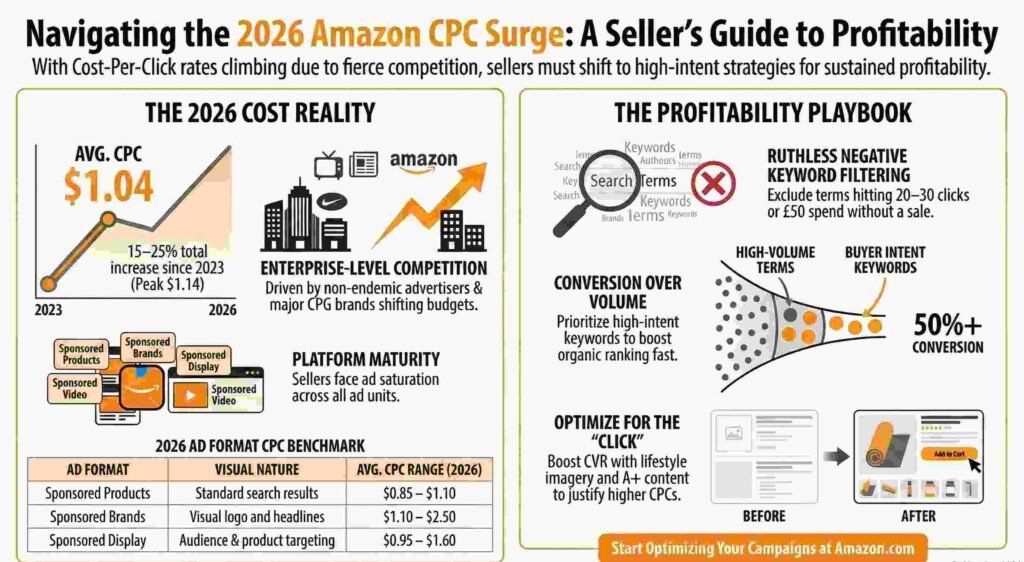
If you’ve felt a tightening grip on your margins lately, you are not imagining things. The era of “cheap” traffic on Amazon is officially over. By early 2026, the average Amazon Cost Per Click (CPC) has climbed to approximately 1.04**, with seasonal peaks during events like Prime Day or Black Friday reaching **1.14. For those utilizing visual formats like Sponsored Brands, standard costs now range between $1.10 and $2.50 per click, with hyper-competitive categories frequently exceeding the $2.00 mark.

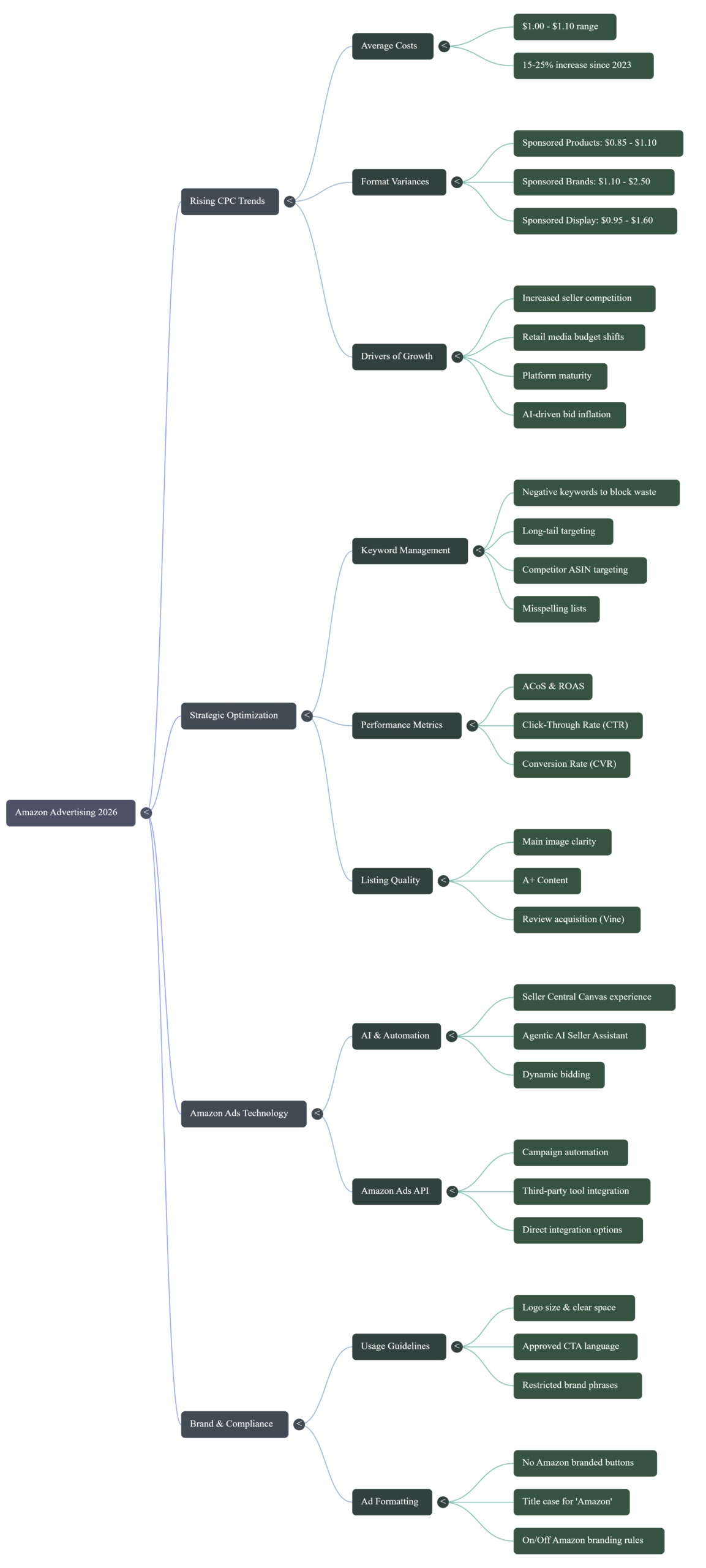
Success in this environment is no longer determined by who has the deepest pockets, but by who possesses the greatest strategic precision. To remain profitable, sellers must transition from “sloppy PPC”—where keywords are dumped into campaigns and left to the mercy of the algorithm—to “professional PPC.” This guide provides a tactical roadmap to help you manage rising costs through five high-impact strategies: prioritizing conversion over volume, surgical negative keyword application, leveraging AI-driven typos, mastering creative compliance, and breaking the “Amazon Bubble” with tracked external traffic.

1.The “High Volume” Trap — Why Sales Velocity Trumps Search Volume
Many sellers obsess over keywords with the highest search volume, assuming more eyeballs lead to growth. In 2026, this is a recipe for financial exhaustion. Amazon’s A10 algorithm does not rank listings based on search volume; it ranks them based on sales volume.
Consider the data: A generic keyword like “tent stakes” might have 50,000 monthly searches but a conversion rate (CVR) of only 6%. Conversely, a “buyer intent” keyword like “stakes for camping” may only have 300 searches but boasts a 52% CVR. Targeting the latter generates higher sales velocity with significantly less wasted spend.
A critical “insider” metric to watch here is Market Availability. This represents the percentage of total sales in a niche not captured by the top three organic sellers. If the top three sellers capture 18% of sales, the Market Availability is 82%. A high Market Availability (typically 70%+) is a massive green flag for profitability, indicating a niche where you can capture significant sales through high-conversion “side roads” rather than fighting a losing battle for the most searched terms.
“High search volume keywords might seem attractive, but they can severely hinder your organic efforts if they don’t convert. You want the Amazon search algorithm to index your listing for high conversion, as it is sales that determine your listing rank, not search volume.”
2: Your “Digital Bouncer” — The 40% Profit Leak
Negative keywords are the “bouncers” of your campaigns. Audits of underperforming accounts frequently reveal that 40% of ad spend is misallocated to irrelevant queries. By failing to use negatives, you are paying for the privilege of showing your products to bargain hunters and DIYers who have no intention of buying.
To protect your margins, you must analyze customer intent signals. Monitoring your Search Term Reports for keywords that reach 20–30 clicks without a single sale is the fastest way to identify these leaks.
Search Term Type Example Modifier Strategic Action
Low-Intent/Research “DIY,” “How to,” “Homemade” Negative Phrase: Pattern-blocking to cast a wide, controlled net.
Price-Sensitive “Free,” “Cheap,” “Used” Negative Phrase: Efficiently blocks bargain-hunting patterns.
Irrelevant Precision “Toy camera” (when selling pro gear) Negative Exact: Surgical precision to block one specific problematic term.
3: The “Misspelling” Goldmine and AI-Driven Typos
A sophisticated pro move for 2026 involves capturing unique traffic through high-intent typos. While competitors fight over expensive, correctly spelled keywords, strategic sellers find lower-cost opportunities in the common mistakes shoppers make on mobile devices.
Using AI tools like ChatGPT, you can generate a master list of common Amazon search typos by providing your core keyword list and prompting for “high-intent typos.” For a professional structure, organize your keywords into four distinct silos:
- Main Keywords: Highly relevant, primary buyer terms.
- Related Keywords: Broader terms for shoppers exploring the category.
- Misspelled Keywords: The typo-driven goldmine of low-competition traffic.
- High-Conversion Keywords: Terms with a proven sales history, regardless of search volume.
4: The Hidden Friction of Non-Compliant Creative
In a high-CPC environment, ad relevancy is king. Amazon’s Brand Usage Guidelines are often viewed as a chore, but following them is a competitive advantage. The A10 algorithm rewards compliance with better placements and lower actual CPCs.
Sellers often fail due to small technical oversights. For instance, CTAs must never exceed a 30-character limit and must be set in specific fonts: Frutiger 57 Condensed (11.5pt) for small units or Frutiger 67 Condensed (14pt) for large units. Furthermore, you must use “Shop now at Amazon.com” rather than “on Amazon.com.”
To prevent customer confusion, Amazon-branded buttons (the specific site UI buttons) are strictly prohibited in custom ads. Additionally, the Amazon logo must be at least 1 inch wide (72 pixels) and is generally only permitted for off-site (AAP) placements; its use is strongly discouraged for on-site advertisements.
The following Brand Phrases tied to Amazon functionality require express approval:
- Gold Box / Deal of the Day
- Subscribe & Save
- 1-Click
- Seller Central
- Wish List
- Today’s Deals
- Amazon Mom
- Look Inside the Book
5: Breaking the “Amazon Bubble” with External Traffic
Driving traffic from Meta, influencers, or email is a “double win.” First, it often yields a lower cost per acquisition than the top-of-search bidding wars. Second, it triggers an organic ranking boost because Amazon rewards listings that bring their own audience.
When you convert external traffic, it signals high relevancy to the A10 algorithm, improving your organic visibility and reducing your reliance on Sponsored Products. To execute this professionally:
- Use Amazon Attribution Tags: This is the only way to accurately measure the ROI of your off-Amazon spend.
- Deploy LandingCube: Use intermediate landing pages to capture emails, allowing you to maximize Customer Lifetime Value (CLV) through repeat purchases.
“Bringing your own traffic to Amazon is like showing up with your own crowd—Amazon notices and rewards you for it.”
Conclusion: Adapt or Pay the Price
The transition to the 2026 landscape marks a definitive shift. High profitability is no longer a byproduct of just “showing up”; it is a choice made through relentless optimization, surgical segmentation, and strict adherence to platform guidelines.
As you review your metrics this week, ask yourself: Is your current budget buying genuine sales velocity, or are you simply paying for the privilege to lose money on clicks that were never going to convert? The sellers who thrive in 2026 will be those who value data over search volume and precision over raw spend.
Discover more from TechResider Submit AI Tool
Subscribe to get the latest posts sent to your email.