Summary Quick-View
1. The “System 1” Problem
Modern Large Language Models (LLMs) are defined by an autoregressive token prediction architecture that excels at fluency but falters under the weight of advanced analytical reasoning. On rigorous benchmarks like MATH—comprised of competition-level problems—this “System 1” approach (rapid, intuitive, but prone to logical collapse) reaches a distinct ceiling. The autoregressive mechanism makes token-level decisions in a left-to-right fashion, leaving models ill-equipped for tasks requiring exploration, strategic lookahead, or error correction.

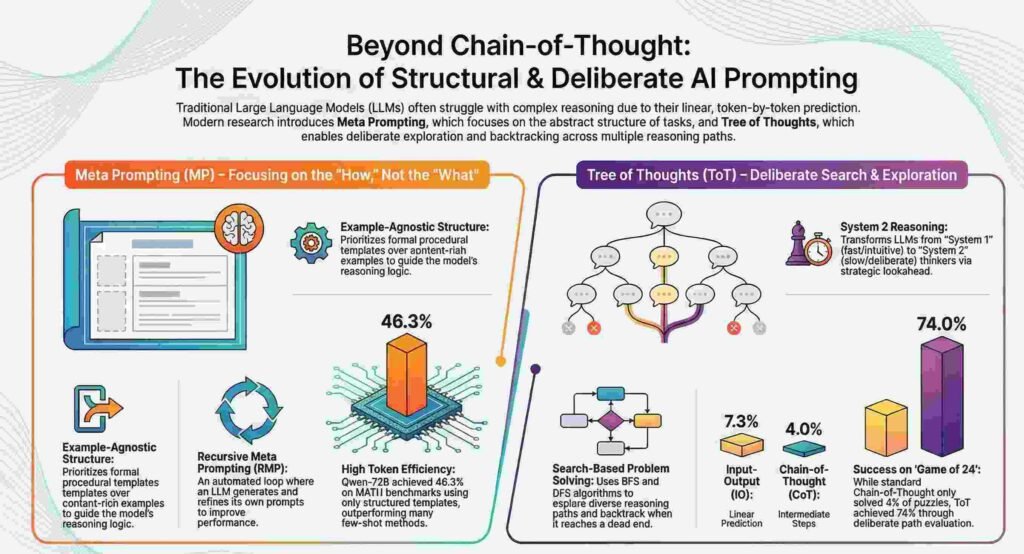
To move toward “System 2” thinking—the deliberate, systematic planning characteristic of human problem-solving—researchers are developing frameworks that transcend simple text generation. This shift is exemplified by two groundbreaking methodologies: Meta Prompting (MP), predominantly validated on the Qwen-72B base model, and the Tree of Thoughts (ToT), which has significantly extended the reasoning boundaries of GPT-4. These frameworks transition AI from a reactive predictor into a proactive, agentic reasoner.

2. Structure is Better Than Examples (The End of Few-Shotting?)
Traditional LLM interaction relies on “few-shotting,” where a model learns by analogy from content-rich examples. Meta Prompting (MP) disrupts this by shifting the focus to formal procedural guidance. Instead of showing the model what to think, MP provides a “type signature” for the reasoning process itself.
Drawing from Type Theory, MP assigns specific “types” to prompt components (e.g., ProblemStatement: string, ReasoningStep: list[string], FinalAnswer: float). By providing a syntactical template rather than content-specific data, the model follows a rigorous logic path defined by specification rather than pattern-mimicry.
——————————————————————————–
Definition 3.1 (Meta Prompt) An example-agnostic structured prompt designed to capture the reasoning structure of a specific category of tasks. It provides a scaffold that outlines the general approach to a problem, thereby enabling LLMs to fill in task-specific details as needed.
——————————————————————————–
3. Why LLMs Need a “Back Button” (The Tree of Thoughts)
Standard LLMs operate in a linear combinatorial problem space, unable to reconsider early decisions. The Tree of Thoughts (ToT) framework introduces a “back button” for AI, allowing it to maintain and explore diverse reasoning paths simultaneously. While standard GPT-4 achieves a meager 4% success rate on the “Game of 24,” ToT boosts this to 74% when tested on the hardest puzzles (indexed 901–1,000).
The “secret sauce” of ToT is the integration of global search and self-evaluation. A ToT instantiation consists of:
- Thought Decomposition: Breaking the problem into semantic units (e.g., one intermediate equation).
- Thought Generation: Proposing k potential next steps via a “propose prompt.”
- State Evaluation: Heuristically judging progress through Independent Valuation (classifying states as sure, maybe, or impossible) or Voting across different paths.
- Search Algorithm: Utilizing BFS or DFS to navigate the tree, incorporating lookahead and backtracking.
As Newell et al. observed in the 1950s:
“A genuine problem-solving process involves the repeated use of available information to initiate exploration, which discloses, in turn, more information until a way to attain the solution is finally discovered.”
4. The Recursive Engine—AI That Writes Its Own Instructions
The most potent application of this logic is Recursive Meta Prompting (RMP). RMP treats prompts as data, enabling a “self-improvement loop” that mirrors metaprogramming. The workflow typically involves a Proposer LLM, which uses a high-level “Meta-Meta-Prompt” to generate task-specific instructions, and an Executor LLM, which carries out the refined plan.
This recursive mechanism allows a model to move from a vague initial query to a highly structured, sophisticated prompt autonomously. By turning the lens of prompting inward, AI systems can iteratively refine their own “cognitive strategies,” effectively learning how to learn before attempting to solve the primary task.
5. The Surprising Math Behind Prompting (Category Theory)
Prompting is maturing from an empirical art into a formal science grounded in Category Theory. By treating Meta Prompting as a Functor—a categorical structure-preserving map—researchers can provide theoretical guarantees for modularity.
Proposition 3.4 (Compositionality) states that if a complex task can be reduced into sub-tasks f and g, the corresponding meta-prompt transformation M(g \circ f) is equivalent to the composition of the individual prompt transformations, M(g) \circ M(f). This ensures that complex reasoning chains can be built from fundamental, reusable building blocks.
To manage the self-improvement of Recursive Meta Prompting, researchers utilize the Writer Monad. This mathematical structure tracks an “edit script” (\Sigma)—a persistent refinement history—ensuring that as the model recursively optimizes its instructions, the process remains algebraically consistent and “path-independent.” The monad laws guarantee that collapsing multiple layers of meta-reasoning always yields a stable, coherent result.
6. Token Efficiency is the New Scaling Law
As we scale System 2 thinking, token efficiency becomes the critical constraint. While ToT provides deep reasoning, it can be computationally expensive due to multiple API calls per state. Meta Prompting, specifically the MP-CR (Complex Reasoning) Agent, achieves superior efficiency by changing the strategy from linguistic search to Python code generation.
The MP-CR Agent achieved a 100% success rate on 1,362 Game of 24 puzzles. It succeeded by generating a single Python program to batch-process all puzzles within one response. This allows the cost of the meta-prompt to be amortized (1/N) over the entire batch, dramatically reducing the per-puzzle expense.
| Method | API Calls | Success Rate | Cost per Case (USD) |
| IO (Input-Output) | 100 | 33% | $0.13 |
| CoT (Chain-of-Thought) | 100 | 49% | $0.47 |
| ToT (Tree of Thoughts) | 61.72 | 74% | $0.74 |
| MP (Meta Prompting) | ~1/N | 100% | $0.0003 |
Note: MP costs are amortized over N=1362 puzzles, where 1/N represents a single meta-prompt governing a massive batch.
7. Toward Agentic and Compositional Reason
The transition from simple token prediction to structured, recursive, and categorical reasoning marks the dawn of truly agentic AI. We are moving toward systems that do not merely respond to user inputs but autonomously architect their own cognitive frameworks. By utilizing functors and monads to ensure modularity and stability, we are building a “compiler view” of AI reasoning.
This leads to a final, strategic consideration: If an AI can now design its own “How to Think” manual using a logic more efficient than our own, we are no longer just building tools; we are witnessing the birth of a new, compositional form of intelligence.
Discover more from TechResider Submit AI Tool
Subscribe to get the latest posts sent to your email.