Summary Quick-View
We are witnessing the obsolescence of willpower as a standalone strategy. We have all stood at the edge of the “February Slump”—that precise moment in the second month of the year when the dopamine of New Year’s resolutions evaporates, leaving us to face the “Wall of Awful.” For decades, the personal development industry sold us the myth that grit was the only variable.

But a profound shift is underway. We are moving away from “hustle culture” apps that weaponize guilt through red notification badges and toward a sophisticated era of Agentic AI. This technology is not merely a productivity tool; it is becoming “psychological scaffolding”—a digital support system designed to manage our energy, mitigate our anxieties, and navigate our unique mental hurdles. Research now confirms that these AI-driven systems are crossing a critical threshold: they are becoming as effective as their human counterparts in helping us reach the finish line.

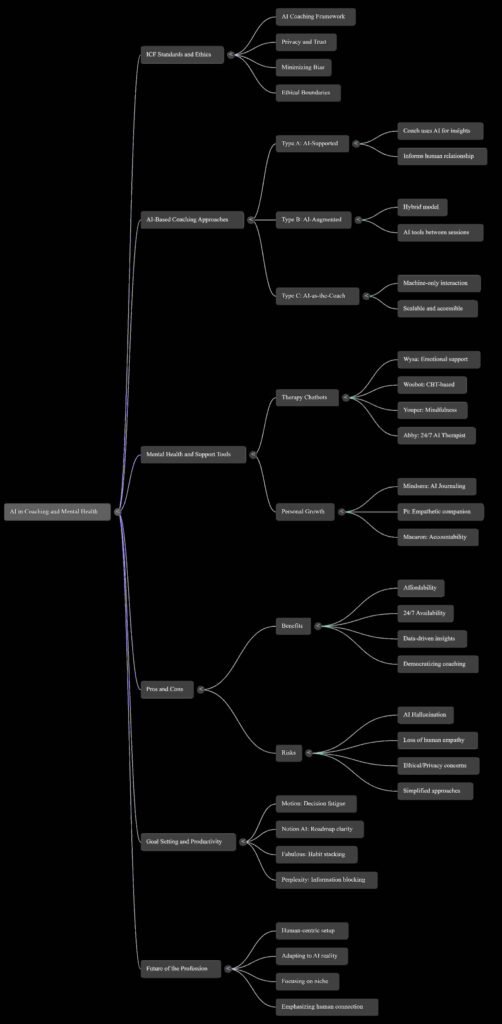
The Effectiveness Shock: AI vs. Human Coaches
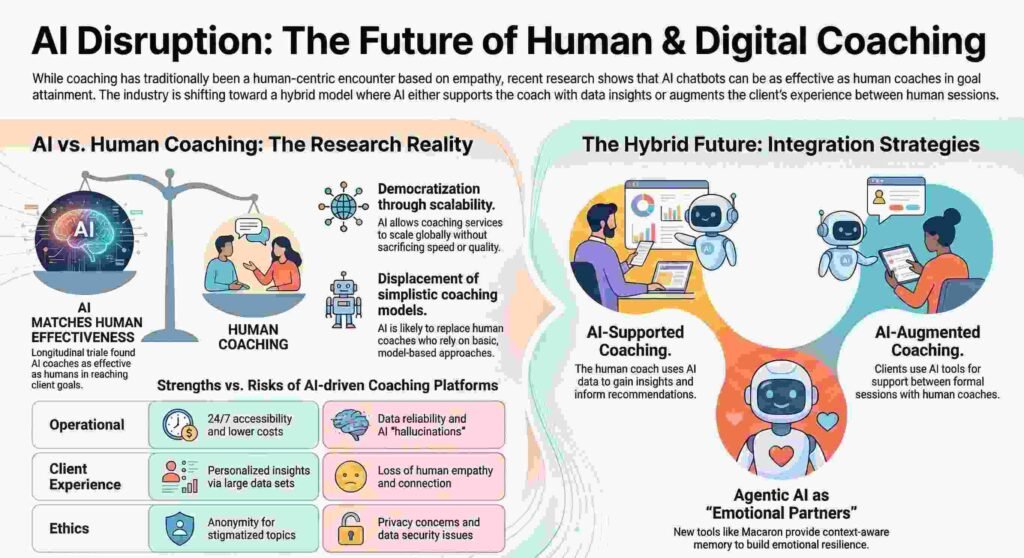
The personal growth industry is facing a disruption that many professionals are still struggling to process. A 2022 longitudinal randomized control trial measured goal attainment over a 10-month period, comparing clients working with human coaches against those using an AI chatbot coach.
The data yielded a startling and surprising revelation: the AI coach was found to be just as effective as human coaches in helping clients reach their milestones. This democratizes high-level support, removing the barriers of cost and availability that once reserved coaching for the elite. However, it also signals a strategic shift for the profession.
“AI could replace human coaches who use simplistic, model-based coaching approaches.”
Many human coaches rely on rigid, script-like models that an LLM can now execute with greater consistency and lower friction. Yet, this is not a zero-sum game. Strategically, AI acts as an entry point, handling the foundational “model-based” work and fueling a broader demand for human coaching to address deep, human-complexity issues.
From Cold Logic to “Empathetic Accountability”
Traditional productivity software functions like a calculator—logical, transactional, and ultimately cold. The new wave of “Human-Centric” AI, such as Macaron and Pi, is moving toward a “companion” model. These tools utilize “Contextual Memory” to remember your specific emotional journey. If you tell Macaron you are anxious about a presentation, it doesn’t just set a reminder; it recalls your previous successes to provide a confidence boost.
The tool Pi exemplifies this shift through “cosy” design—using soft color palettes, painterly tiles, and serif fonts to signal a supportive environment. More significantly, it bridges the “uncanny valley” through voice interactions that include natural filler words and emotional nuance, creating an experience that feels weirdly intimate—like texting a trusted friend rather than querying a database.
“My goal is to be useful, friendly and fun. Ask me for advice, for answers, or let’s talk about whatever’s on your mind.” — Pi AI
The Radical Self-Betterment Prompt: Programming Your Past
One of the most tactical hacks for the modern high-performer is what I call “Programming Your Past.” Dr. Gena Gorlin, a clinical psychologist, has pioneered a methodology that weaponizes years of personal data to solve the “blinking cursor” problem of self-reflection.
Instead of staring at a blank Google Doc for a year-end review, Gorlin feeds years of journal entries into an LLM to identify recurring blind spots and hidden patterns. The AI then co-authors a personal biography, turning a decade of disparate thoughts into a coherent narrative. This creates a “warm, free-flowing dialogue” from the very first prompt, allowing the user to step outside their own subjective experience and view their growth through an objective, longitudinal lens.
Mental Health “In Your Pocket”: The 24/7 Safety Net
In the clinical and wellness space, AI is not replacing empathy—it is amplifying it by removing the friction of “waiting times” and social stigma.
- Wysa: An AI companion trained in Cognitive Behavioral Therapy (CBT) providing a judgment-free space for emotional reflection.
- Woebot: Developed at Stanford, this agentic tool helps users recognize negative thought patterns. Remarkably, research has shown Woebot can reduce symptoms of anxiety and depression within just two weeks of regular use.
- Abby: A 24/7 AI therapist that offers instant, compassionate support for life’s challenges without the traditional barriers to entry.
“AI for mental health doesn’t replace empathy — it amplifies it, offering calm, insight, and connection when you need it most.”
Killing Decision Fatigue with Algorithmic Scheduling
High-performers often fail not because they lack motivation, but because they suffer from “Decision Fatigue”—the energy drained by choosing what to do. Tools like Motion act as the “action trigger” for the mind. By using algorithmic scheduling to arrange your calendar like a Tetris master, it removes the need to make choices.
This addresses a vital psychological principle: Action leads to motivation, not the other way around. By forcing the first step, Motion hacks the motivation loop. This has established a new “Motivation Ecosystem” for achievement:
- The Planner (Motion): Dictates when you act to preserve mental energy.
- The Architect (Notion AI): Defines what you are building and provides structural clarity.
- The Companion (Macaron): Supports who you are emotionally while you do the work.
The Risks: Hallucinations, Ethics, and the Dependency Trap
As a strategist, I must balance this optimism with a cold assessment of the “AI Realities.” To integrate these tools safely, we must acknowledge their inherent limitations:
- Hallucinations and Data Reliability: AI can generate factually incorrect content or rely on outdated datasets.
- Confidentiality and Privacy: Ensuring HIPAA compliance and the ethical treatment of personal data remains a primary concern.
- Professional Oversight: Unlike human therapists or coaches, AI currently lacks regulated professional oversight for complex clinical issues.
- The Dependency Trap: There is a latent risk of breeding long-term dependency on AI for basic emotional regulation and decision-making.
Conclusion: A Shared Journey Toward the Finish Line
The era of the “solitary grind” is over. We have entered an age where AI serves as the “psychological scaffolding” for the human mind, allowing us to outsource the maintenance of our willpower so we can focus on the essence of our work.
Technology is evolving to care for our minds, but the “work” of growth remains fundamentally ours. These tools are partners in evolution, not substitutes for agency. As you look at the goals that feel just out of reach, ask yourself:
Discover more from TechResider Submit AI Tool
Subscribe to get the latest posts sent to your email.