Summary Quick-View
We have all been there: a small notification slides into the corner of your screen, politely suggesting that a new version of Google Chrome is ready. You’re in the middle of a deadline, or perhaps you have forty research tabs open that you aren’t ready to lose. You click “remind me later,” and the cycle repeats for days.

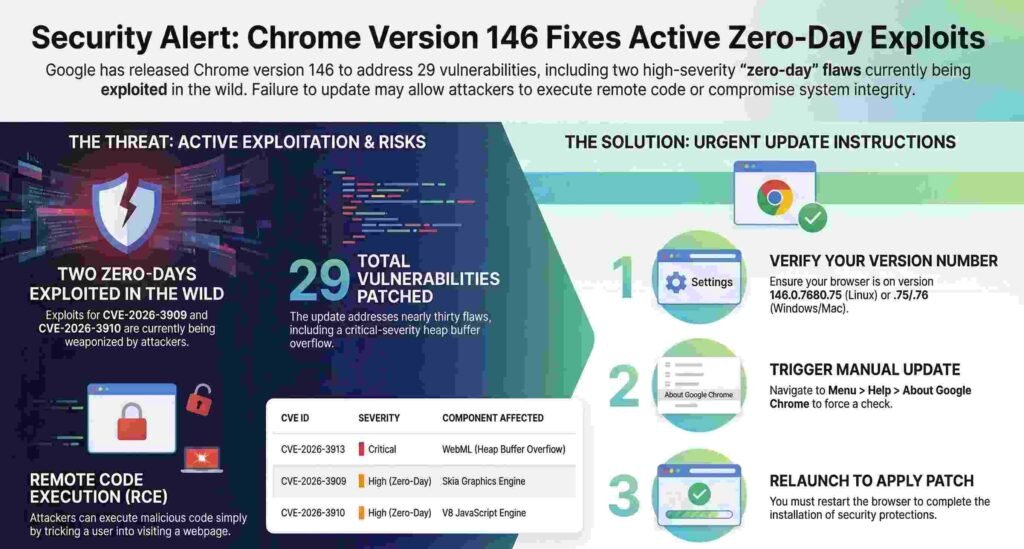
However, the update released on March 13, 2026, is a mandatory ceasefire in the war for your digital privacy. This isn’t a routine maintenance tweak; it is a massive security overhaul addressing 29 different vulnerabilities. With over $150,000 paid out in bug bounties and the confirmation of “zero-day” exploits currently being weaponized by attackers, this specific patch represents the culmination of a high-stakes, 72-hour dash between security researchers and cybercriminals.

The “Zero-Day” Reality: Exploits in the Wild
In the world of cybersecurity, a “zero-day” is the ultimate red alert. It signifies a race against a clock that has already run out—a vulnerability discovered and utilized by attackers before a fix was ever created. In this cycle, the speed of the escalation was breathtaking: the flaws were reported internally by Google’s security team on March 10 and patched by March 13.
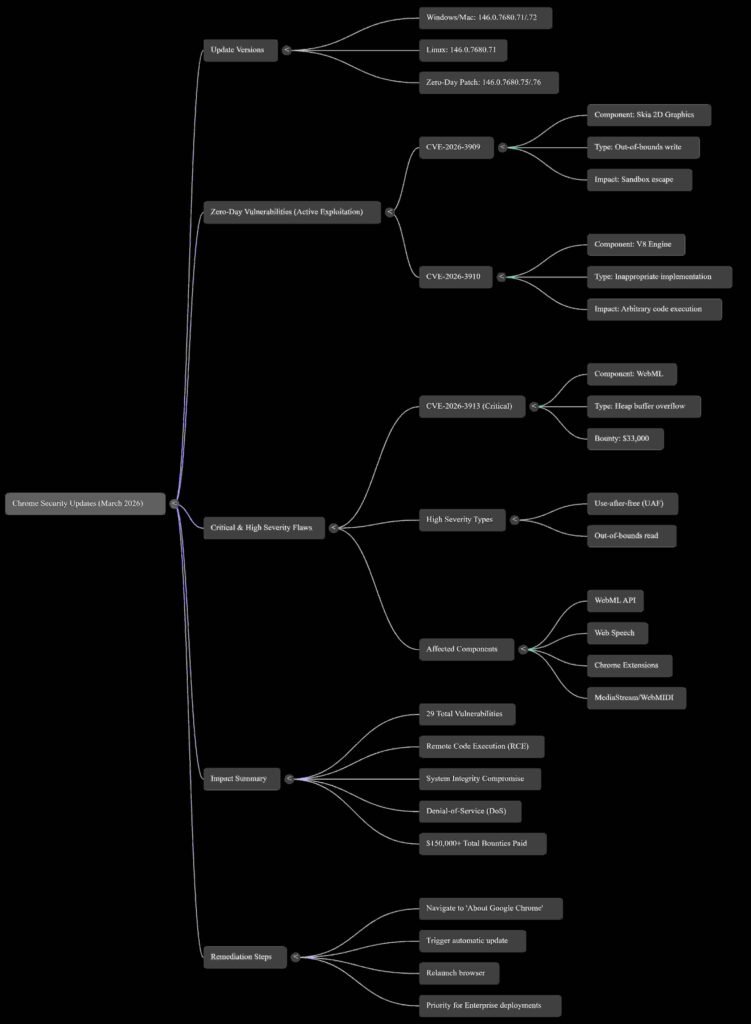
Google has confirmed that two specific flaws, CVE-2026-3909 and CVE-2026-3910, have already been weaponized. These exploits target the very heart of the browser:
- Skia (CVE-2026-3909): This involves an “out-of-bounds write” in the graphics engine. Think of an out-of-bounds write like a printer overshooting the paper and ruining the desk underneath; the program writes data past the end of the intended memory buffer, corrupting adjacent system data.
- V8 (CVE-2026-3910): This is an “inappropriate implementation” in the engine that runs JavaScript and WebAssembly.
The V8 engine is a persistent, high-value target because JavaScript executes automatically during almost every normal browsing session. By exploiting these engines, attackers can achieve a “sandbox escape.” This allows a hacker to move from the isolated environment of a single browser tab directly into your computer’s actual operating system and files.
As Google officially noted regarding these threats:
“Google is aware that exploits for both CVE-2026-3909 and CVE-2026-3910 exist in the wild.”
The $33,000 Memory Glitch: CVE-2026-3913
Among the 29 fixes, CVE-2026-3913 stands out with a “Critical” severity rating. Discovered by researcher Tobias Wienand, this flaw earned a $33,000 bounty because it provides a direct path to total system compromise.
The technical culprit is a heap buffer overflow within the WebML component. A heap buffer overflow occurs when a program attempts to cram more data into a memory folder than it was designed to hold. This “overflow” spills into adjacent memory structures, allowing an attacker to corrupt data and execute arbitrary code. For the average user, the danger is chillingly simple: a compromise can be triggered just by visiting a maliciously crafted web page.
WebML: The New Favorite Target for Hackers?
A notable trend in this update cycle is the repeated targeting of the WebML API (Web Machine Learning). Beyond the critical flaw mentioned above, Google patched two high-severity bugs (CVE-2026-3914 and CVE-2026-3915) within this component, paying out a staggering $43,000 for each.
Why is WebML suddenly under siege? As browsers take on more AI and machine learning tasks locally, the attack surface for these specific APIs is expanding rapidly. This $86,000 payout for two bugs suggests that the “AI boom” has created a new, lucrative frontier for both security researchers and threat actors.
The “Use-After-Free” Loophole
A significant portion of the high-severity patches in version 146 address “Use-after-free” (UAF) vulnerabilities. These occur when a program attempts to access a memory address after that memory has already been “freed” or released back to the system.
Attackers prize UAF bugs because they are surgical tools for bypassing browser sandboxes. In this update, UAF bugs were purged across a wide range of components:
- Agents and WebMCP (CVE-2026-3917, CVE-2026-3918)
- Chrome Extensions (CVE-2026-3919)
- MediaStream, WebMIDI, TextEncoding, and WindowDialog (CVE-2026-3921 to CVE-2026-3924)
The $150,000 Defense Strategy
The sheer scale of this update is best illustrated by its price tag. Google paid out well over $150,000 in bug bounties to independent researchers for this release alone.
This is the “bug bounty economy” in action: a proactive security model where companies pay “white hat” hackers to find flaws before “black hat” attackers can exploit them. While $43,000 for a single bug sounds steep, it is a bargain compared to the catastrophic reputational and financial damage of a widespread breach.
The Update Protocol: Three Clicks to Safety
Protecting yourself requires one manual step to ensure you are covered immediately. Do not wait for the automatic rollout.
- Open Chrome and click the three-dot menu in the top right corner.
- Navigate to Help and then select About Google Chrome.
- Ensure your browser updates to version 146.0.7680.75/76 (Windows/Mac) or 146.0.7680.75 (Linux).
Crucial Note: The update is not active until you perform a quick browser restart.
Google intentionally restricts the fine technical details of these bugs for several weeks. This strategic “blackout” prevents attackers from reverse-engineering the patch to target users who are slow to update.
Conclusion: A New Standard for “Timely Updates”
The release of Chrome version 146 marks the third time in 2026 alone that Google has been forced to patch zero-day vulnerabilities that were already being weaponized in the wild. This frequency is a stark reminder that browser-based attacks are becoming more sophisticated, more frequent, and more relentless.
In an era where your browser is the gateway to your bank accounts, personal communications, and professional identity, the “remind me later” button is a gamble you will eventually lose. Is the convenience of keeping an open tab worth the risk of a fully compromised system? Update now—your data depends on it.
Discover more from TechResider Submit AI Tool
Subscribe to get the latest posts sent to your email.