
1. Introduction: The End of the “Middleman” Era
For centuries, our financial architecture has been haunted by a singular, persistent ghost: the necessity of human trust. As Satoshi Nakamoto articulated in the 2009 Bitcoin whitepaper, the traditional “trust-based model” is inherently fragile. It relies on massive, slow-moving third parties to mediate disputes, a process that inevitably increases transaction costs and excludes the possibility of truly small, casual payments.
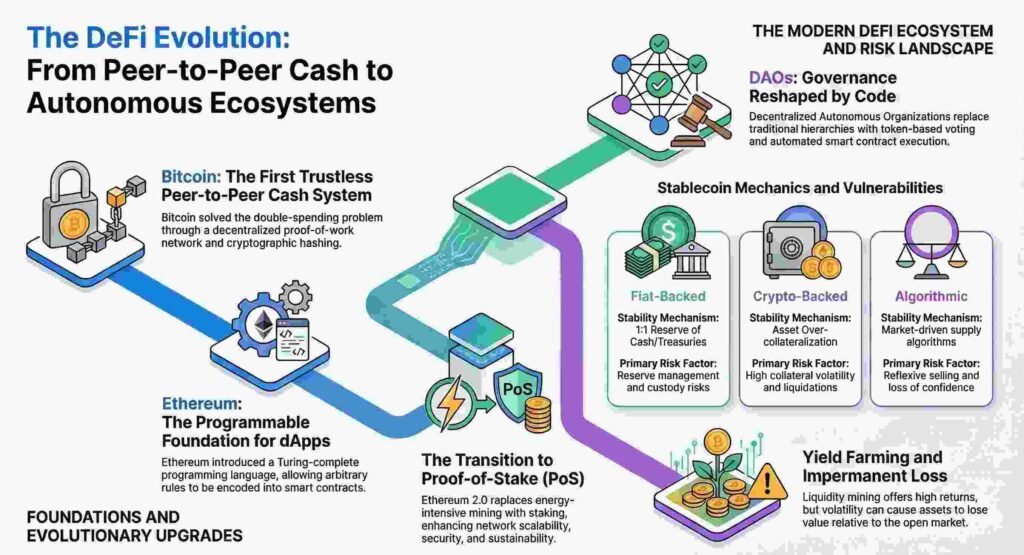
We are currently witnessing a manifesto written in silicon—a pivot from a system of human mediation to one of “cryptographic proof instead of trust.” This isn’t just a technical upgrade; it is a fundamental shift in the socio-economic fabric. We are trading the messy, reversible world of bankers and boardrooms for the cold, irreversible certainty of the machine. The “ghost” of human fallibility is being exorcised from the ledger, replaced by an autonomous architecture that doesn’t just manage finance, but executes it.
2. The Trust Paradox: Why Math is More Reliable Than Managers
The “double-spending problem” was the original sin of digital cash. Traditionally, only a central “mint”—a bank—could verify that a dollar wasn’t spent twice.
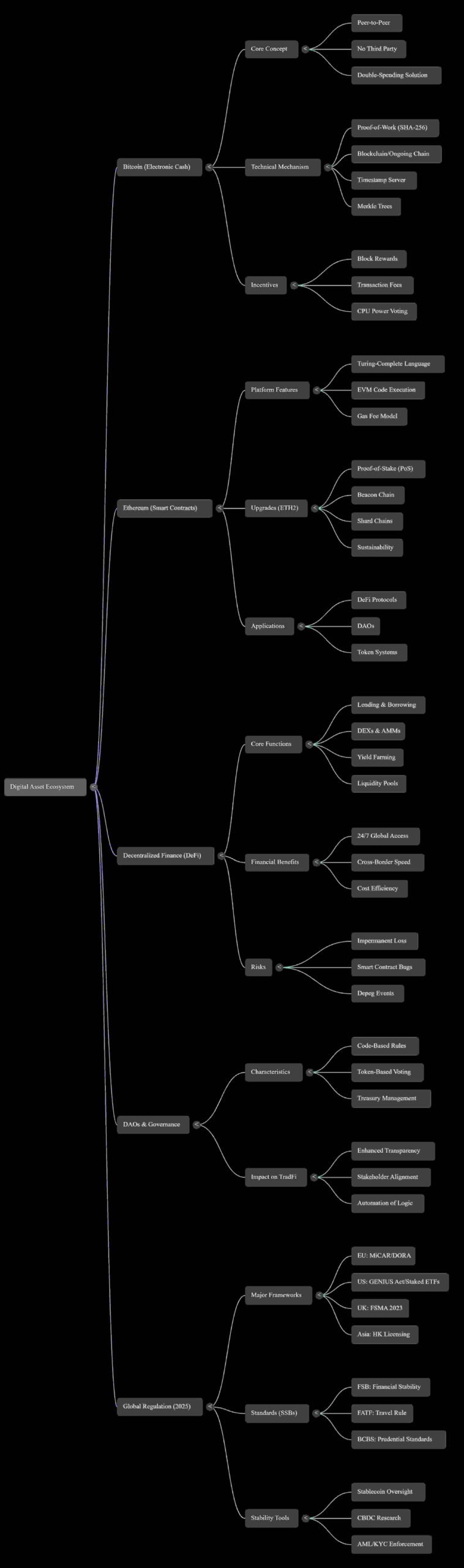
Nakamoto’s breakthrough was the distributed timestamp server. By hashing transactions into a continuous chain of proof-of-work, the network creates a chronological record that is computationally impractical to reverse.
This system operates on a “one-CPU-one-vote” protocol. It removes the need for IP-based voting, which can be easily subverted, and replaces it with the raw economic power of hardware.
The “longest chain” is the ultimate form of collective truth. It serves as an immutable witness to the sequence of events, proving that the history of the ledger came from the largest pool of CPU power.
As the whitepaper famously asserts:
“What is needed is an electronic payment system based on cryptographic proof instead of trust, allowing any two willing parties to transact directly with each other without the need for a trusted third party.”
3. The Death of the CEO: DAOs and the Rise of “Code-Based Constitutions”
Governance is undergoing its most radical evolution since the invention of the joint-stock company. Decentralized Autonomous Organizations (DAOs) are deleting the middleman’s ability to deviate from the group’s will. In these structures, the traditional human hierarchy—CEOs, VPs, and boards—is replaced by “code-based constitutions” executed by smart contracts.
In a traditional firm, we battle the “Agency Problem,” where managers (agents) act in their own self-interest rather than that of the shareholders (principals). DAOs minimize this by automating execution; once the community pokes the autonomous agent with a transaction, the code executes without human interference. However, the visionary promise faces a stark “Off-Chain Reality.” Many DAOs remain autonomous in name only, still tethered to Discord for discussion and human coordination for preliminary decisions.
Furthermore, we are seeing the rise of a digital plutocracy. “Whale Concentration”—where a few large token holders control the majority of the voting power—often leads to a new form of “Governance Paralysis.” Complex strategic decisions that require nuance can stall in a decentralized environment, proving that while code can replace the CEO, it cannot yet replace the collective wisdom—or the internal politics—of the crowd.
4. The Hidden Math of Yield Farming: It’s Not as “Passive” as You Think
Yield farming is often marketed as the “High-Yield Savings Account” of the future, but for the uninitiated, the reality is a high-octane surprise. At the heart of this ecosystem are Automated Market Makers (AMMs) like Uniswap, which rely on the
Constant Product Formula:
x \times y = k
Here, x and y represent the quantities of two tokens in a liquidity pool, and k is a fixed constant. To maintain this equilibrium, the AMM algorithmically adjusts price ratios. The surprise for most investors? Their “passive” yield is actually a high-risk payment for bearing the volatility of the entire protocol.
If you are seeking 100% APY, you are essentially acting as the insurer of last resort against three primary ghosts:
- Impermanent Loss: When the value of tokens in a pool diverges from the open market, your “balanced” portfolio can actually lose value compared to simply holding the assets.
- Rug Pulling: The most common crime in the space, where developers promote a project to attract liquidity and then abruptly vanish with the underlying assets.
- The Death Spiral: A catastrophic feedback loop seen in algorithmic stablecoins like TerraUSD (UST), where a loss of market confidence triggers reflexive selling that the code cannot stabilize, leading to a total collapse.
5. Sustainability as a Feature: Ethereum’s Great Migration
The Ethereum network recently completed a high-altitude engine swap in mid-flight. By migrating from Proof-of-Work (PoW) to Proof-of-Stake (PoS) in “The Merge,” the network resolved its two greatest evolutionary challenges: energy consumption and scalability. This transition positions ETH not just as a currency, but as a “value-integrated digital asset.”
The architecture is now coordinated by the Beacon Chain, which manages the PoS consensus. While currently active, the network is preparing for Shard Chains—a future scalability solution that will act as parallel blockchains to distribute the network load. This move reduces the need for every node to store the entire history, drastically increasing capacity.
The industry defines these eth2 upgrades as a:
“Set of interconnected upgrades designed to make Ethereum more scalable, more secure, and more sustainable.”
6. The Fragility of “Stable” Value: When $1 is No Longer $1
Stablecoins are the bridge between the volatility of crypto and the perceived safety of fiat, but “stability” is often an illusion. Risks in this sector are no longer just economic; they are deeply technical. Beyond simple “Depeg Events,” we now face the “ghosts” of Reentrancy Attacks (where malicious contracts repeatedly drain funds before a transaction completes) and Access Control Flaws (where unauthorized actors gain the ability to mint tokens or trigger emergency functions).
The regulatory landscape is finally responding to this complexity. In the United States, the GENIUS Act is creating a bifurcated path: insured depository institutions fall under their primary financial regulators, while nonbank stablecoin issuers are brought under the oversight of the OCC. Meanwhile, the EU’s MiCA (Markets in Crypto-Assets) regulation is setting a global standard for reserve management and governance. These frameworks aim to prevent the “Oracle Manipulation” that often plagues crypto-backed stablecoins, where false price data is fed to a contract to trigger unfair liquidations.
7. Conclusion: The Hybrid Horizon
The future of finance is not a total replacement of the old guard, but a Hybrid Model of Governance. We are moving toward a horizon where traditional institutions adopt DAO principles for internal treasury management, seeking the transparency of the blockchain while retaining the safety rails of the legacy system.
As we move forward, we must confront a heavy philosophical choice: are we truly ready to trade the “safety” of a reversible bank transaction—and the human mediation that comes with it—for the absolute “freedom” of irreversible code? In this new era, where the ghost of trust has been replaced by the machine, the code is the law. But remember: in a world governed by code, your only true protection is your own due diligence.
Discover more from TechResider Submit AI Tool
Subscribe to get the latest posts sent to your email.
