
Summary Quick-View
The Hook: The Smartphone Paradox
We are currently trapped in the “Smartphone Paradox.” Our primary tools for global connection have become our most profound sources of isolation and distraction, burying us under a relentless grid of notification-hungry apps. The modern flagship is no longer a tool; it is an attention-harvesting machine.

Enter the iKKO MindOne Pro. Born from a radical Kickstarter vision, this device is a defiant “smartphone that’s not a smartphone.” It doesn’t want your attention; it wants your intention. By stripping away the digital noise in favor of an AI-first, always-connected architecture, it offers a glimpse into how we will interact with technology by 2027. It is one small step toward a future where we stop scrolling and start living.

A Defiantly Small Form Factor
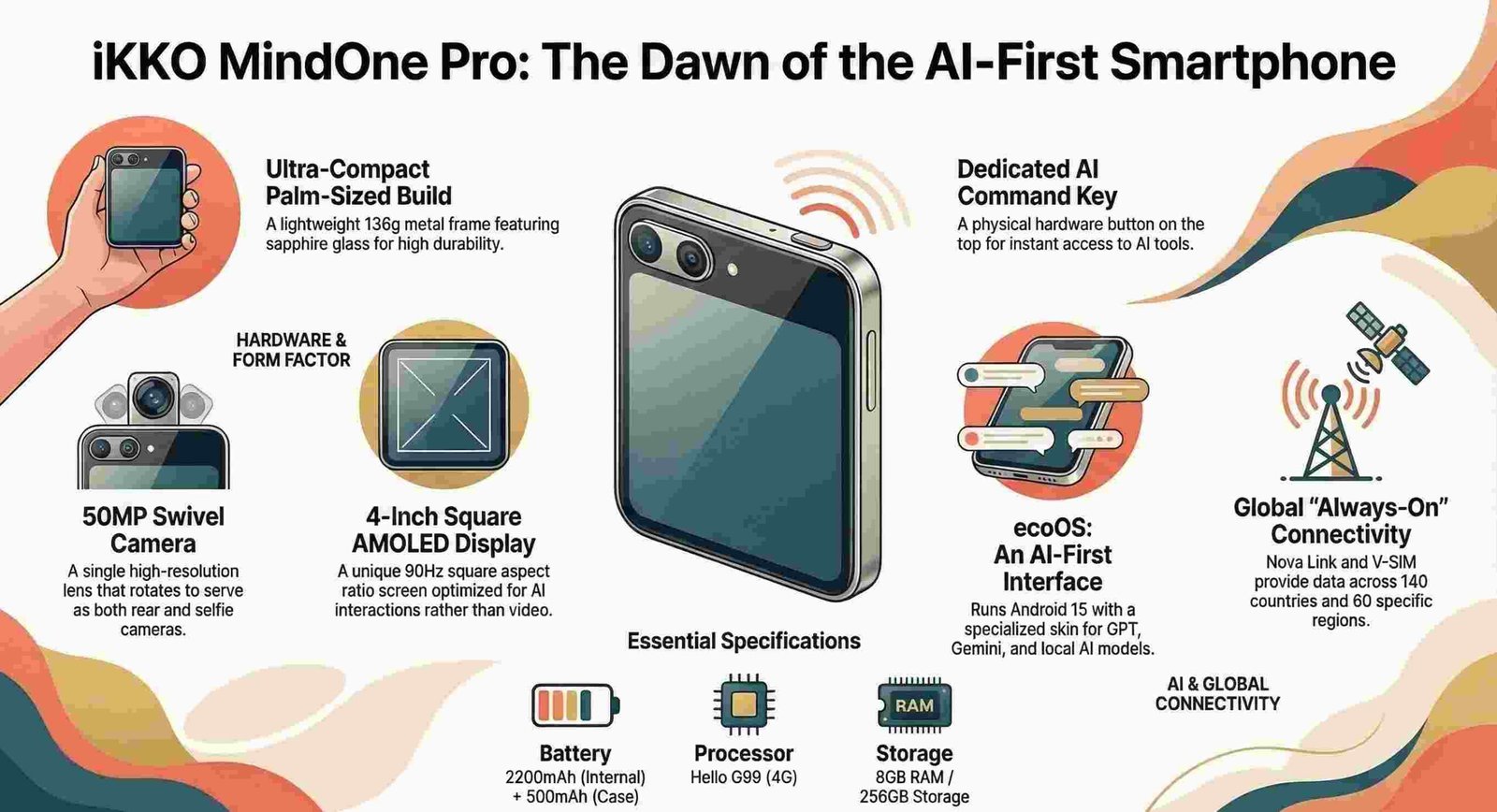
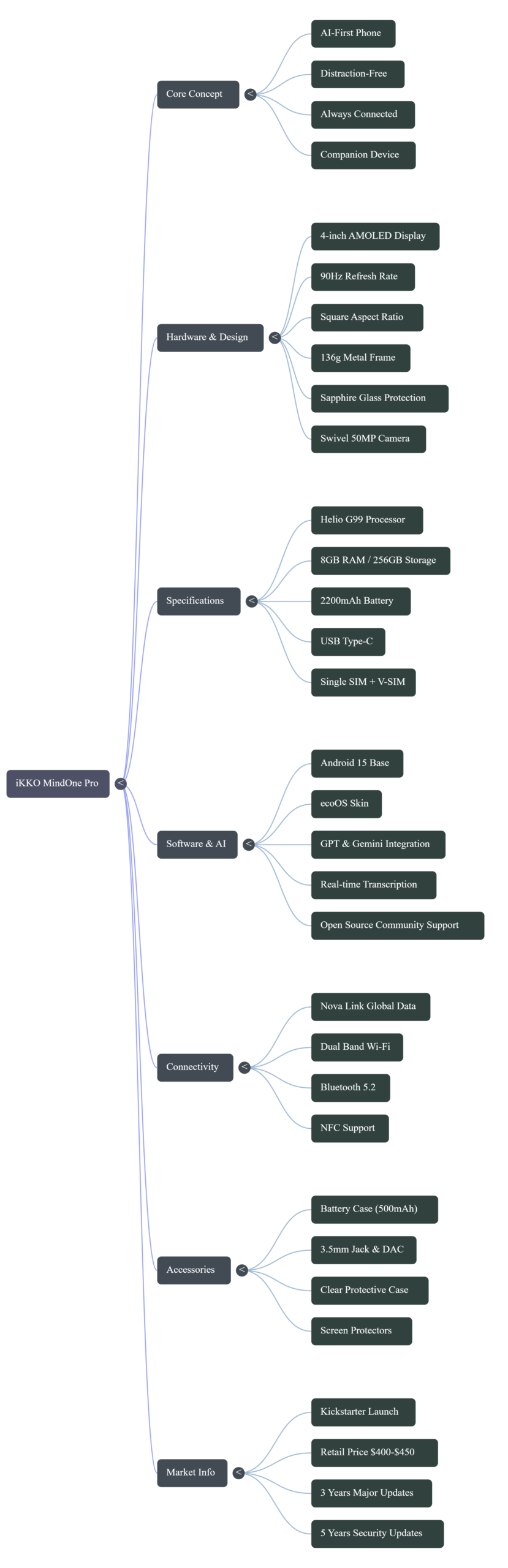
The MindOne Pro is a physical manifesto against the trend of “bigger is better.” In an era of pocket-stretching phablets, iKKO has delivered a 4-inch square AMOLED display that supports a buttery-smooth 90Hz refresh rate. But the specs only tell half the story. At 136.2g, this device recalibrates your physical relationship with technology. It is designed to fit perfectly in a single palm, resting there with an intentionality that modern glass slabs lack.
The build quality suggests a tool meant for the real world, not just a desk. Encased in a sturdy metal frame with sapphire glass protection, the device is rugged enough to survive the occasional drop—and unique enough that it can literally stand upright on its own. As noted during the first unboxing: “I’ve been unboxing for so many years, but this is different.” This isn’t just a “small phone”; it’s a reimagining of the mobile object.
The “Always-On” Global Connection (Nova Link)
For a futurist, a device is only as powerful as its connectivity. The MindOne Pro introduces Nova Link, a V-SIM technology that treats connectivity as a fundamental utility rather than a subscription service. Operating in 60 to 140 countries, the Pro variant utilizes Nova Link data specifically to power its AI tools, bypassing traditional SIM restrictions.
This isn’t just about “data”—it is about “AI as Oxygen.” The device’s core intelligence requires a constant heartbeat of connectivity to process complex tasks. By baking this global link directly into the hardware, iKKO ensures that whether you are in a boardroom in Tokyo or a cafe in Berlin, your AI companion is functional. It transforms the device from a local handset into a globally persistent node of your digital life.
The One-Camera Swivel Solution
In a pursuit of minimalist engineering, iKKO has eschewed the “camera bump” arms race. Instead, they’ve implemented a 50MP swivel camera. A single high-resolution lens rotates to serve as both the primary rear-facing sensor and the selfie camera.
From a journalistic perspective, let’s be blunt: this is a conceptual win rather than a photographic one. While it shoots “decent” photos in good lighting, the 50MP spec is largely for the “name sake.” It is a pragmatic trade-off. By utilizing a swivel mechanism, the MindOne Pro saves internal space and reduces complexity, prioritizing the device’s compact silhouette over flagship-level optics. It’s a camera for capturing information and moments, not for professional cinematography.
Beyond the Grid—Living in an AI-First ecoOS
The most radical shift is found in the software. Running on ecoOS (built on Android 15), the MindOne Pro presents a future that is entirely icon-free. There is no grid of colorful buttons vying for your dopamine. Instead, the interface is task-based and generative.
This is the “Voice-to-Generative-UI” workflow: you talk, the AI processes, and the screen generates only what you need—whether that’s transcribing a document, summarizing a podcast, or searching for information.
- A Commitment to Longevity: Unlike many experimental “Kickstarter toys,” iKKO is promising 3 years of major OS updates and 5 years of security updates.
- Open Source Philosophy: The OS is open-sourced, inviting a community of developers to build upon this “distraction-free” foundation.
The AI isn’t just a feature hidden inside an app; the AI is the interface. It shifts the user from “app-hunting” to “intent-based” interaction.
The Modular Power of the DAC Case
iKKO acknowledges the physical limitations of a device this small. With a mono speaker and a 2200mAh battery, it is clearly not designed for a weekend Netflix binge—the square screen and mono audio make it a utility tool, not a multimedia powerhouse.
To bridge this gap for power users, iKKO developed a unique modular DAC case. This accessory adds:
- A 500mAh battery boost.
- A 3.5mm headphone jack.
- High-fidelity DAC support for audiophiles.
This modularity allows the MindOne Pro to remain a minimalist AI tool by day and a high-end audio player by night, addressing internal hardware trade-offs without compromising the core device’s portability.
A Glimpse of 2027?
The iKKO MindOne Pro is not a mass-market smartphone replacement. With a retail price between $400 and $450 and a 4G-capable Helio G99 processor, it is a high-end “companion device” for those looking to decouple from the attention economy.
It represents a small but significant step toward a world where the interface disappears and only the task remains. It asks us to consider if our lives would be better if our phones did less, but did it more intelligently. Are you ready to trade your grid of distracting icons for a square, intent-driven interface? The future is calling, and it’s smaller than you think.
Discover more from TechResider Submit AI Tool
Subscribe to get the latest posts sent to your email.