For years, the promise of “cutting-edge AI” has come with a hidden tax: your digital sovereignty. To access high-level reasoning, users have been forced to choose between two evils—handing over sensitive data to third-party cloud servers or tethering themselves to the “metered anxiety” of monthly subscriptions and API credits.

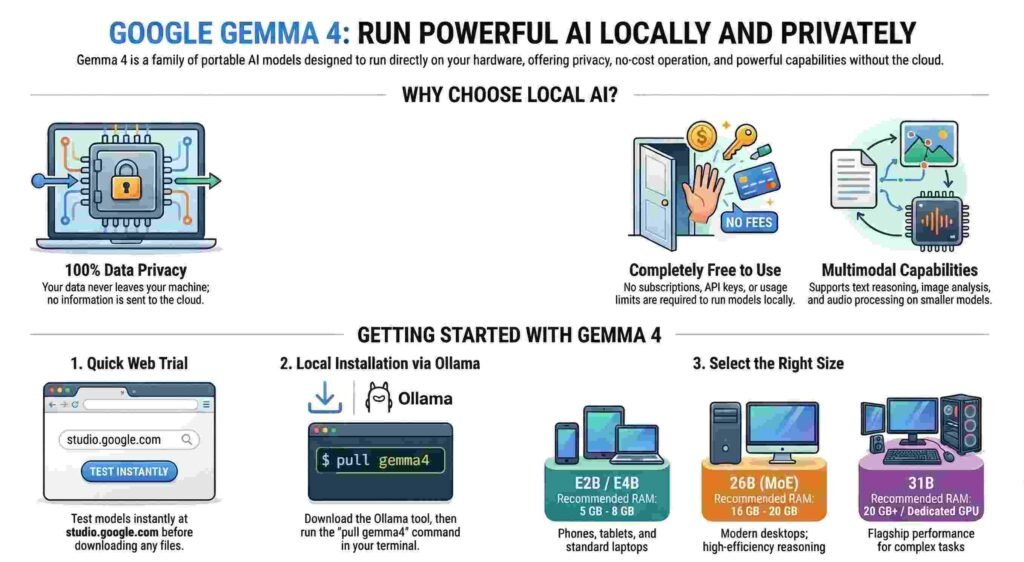
Google’s Gemma 4 has officially broken that cycle. This family of open models offers a pro-grade AI experience that is completely free, requires zero internet connection, and ensures no byte of data ever leaves your hardware. It is a paradigm shift from AI-as-a-service to AI-as-a-utility.

1. The Privacy Revolution: Your Data Stays at Home
In the current era of aggressive data harvesting, “local execution” is more than a technical feature—it is a defensive necessity. When you use cloud-based models like ChatGPT or Gemini, your prompts are processed on remote servers, often utilized to further train models or profile users.
Gemma 4 lives entirely on your machine. As the latest benchmarks and tutorials demonstrate, the privacy implications are immediate:
“With Gemma 4 running locally, everything stays on your machine. Nothing gets sent anywhere. That’s a big deal for privacy.”
This changes the landscape for professionals handling sensitive legal documents, proprietary code, or private medical notes. By removing the cloud from the equation, you eliminate the risk of data leaks or unauthorized harvesting. Your private thoughts remain truly private.
2. Breaking the Subscription Cycle
The modern software economy is designed to keep you on a financial treadmill. Access to high-tier AI is typically gated behind $20-per-month subscriptions or complex, metered API keys that penalize heavy usage.
Gemma 4 disrupts this “Software as a Service” (SaaS) model. There are no subscriptions and no usage limits. You download the model once and use it infinitely.
This is particularly vital for those working in low-connectivity environments or travelers who cannot rely on a stable 5G connection. It transforms AI from a rented luxury into a permanent asset on your hard drive.
3. Hardware Democratization: From Raspberry Pi to Flagship Power
The most impressive feat of the Gemma 4 family is its hardware spectrum. You no longer need a $10,000 enterprise server to run sophisticated intelligence.
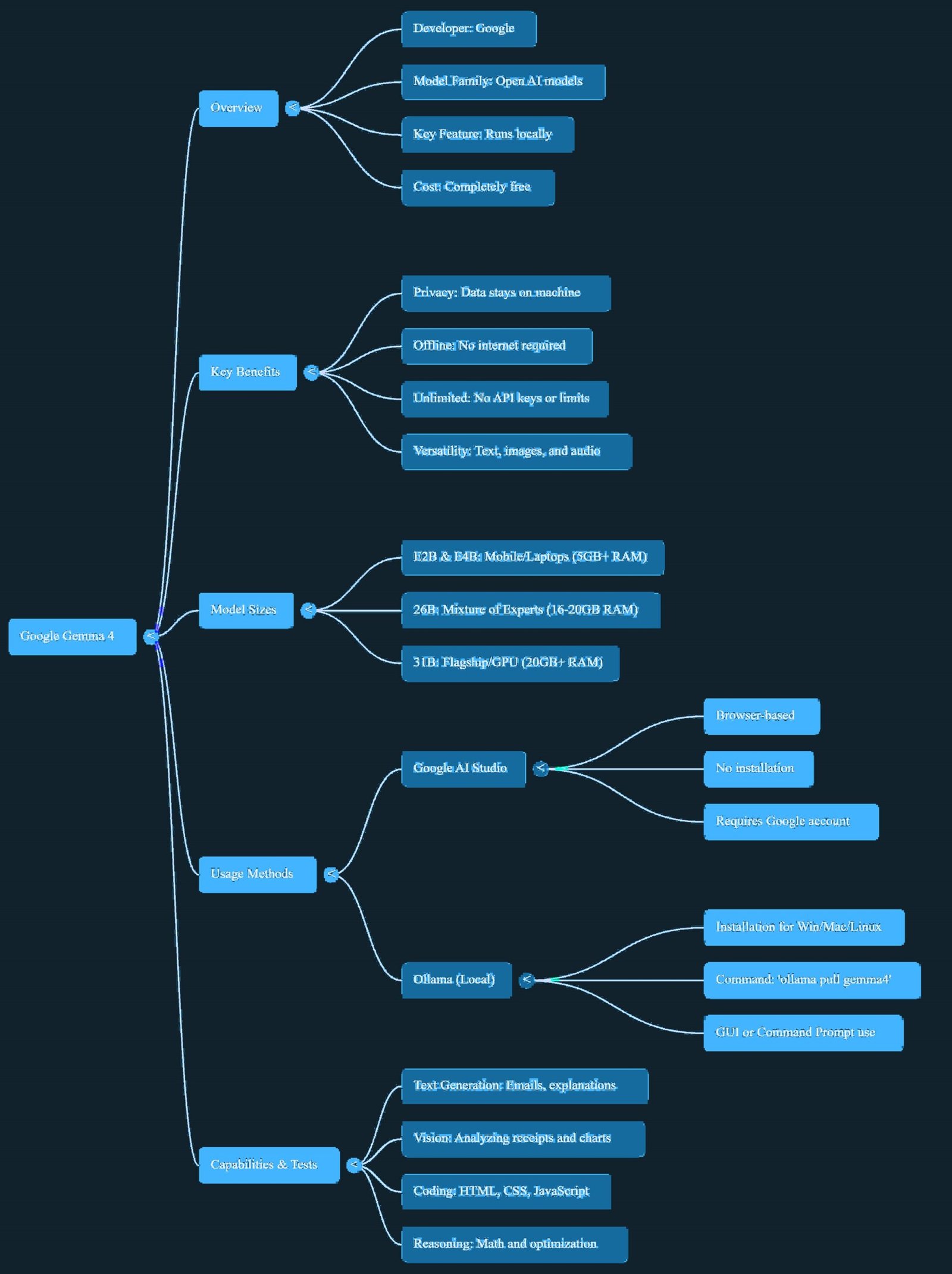
- The Entry Level (E2B & E4B): These models are designed for the “edge”—phones, tablets, and even a Raspberry Pi. The E2B variant can run on as little as 5 GB of RAM, making AI accessible on a standard student laptop.
- The Mid-Range (26B): A powerhouse for users with 16GB to 20GB of RAM, offering a sweet spot between speed and reasoning.
- The Flagship (31B): This is the top-tier model for those seeking maximum performance. To run the 31B flagship locally, you’ll want a machine with at least 20 GB of RAM or a dedicated GPU (like an RTX 40-series).
By lowering the hardware floor, Google has effectively democratized AI, ensuring that high-level intelligence isn’t just for those with the deepest pockets.
4. Multimodal Capabilities: Reasoning, Not Just Reading
Gemma 4 is a multimodal powerhouse, meaning it “sees” and “hears” rather than just processing text. However, there is a strategic distinction in capabilities across the family.
While all models handle text and vision, the smaller E2B and E4B models are specifically optimized to process audio, expanding the utility of local AI into voice transcription and sound analysis.
The vision capabilities are equally transformative. This isn’t just basic Optical Character Recognition (OCR); it is reasoning over visual data. In testing, the model can analyze a cluttered receipt and intelligently identify the business name, individual transaction details, and even calculate whether a tip was appropriate. It interprets charts, explains handwritten notes, and analyzes screenshots with the nuance of a human assistant.
“Gemma 4 is not just a text model. It can also understand images… This works with charts, screenshots, handwritten notes, and documents.”
5. The “Mixture of Experts” Efficiency
The 26B model utilizes a sophisticated architecture known as “Mixture of Experts” (MoE). This is the secret sauce that allows consumer-grade hardware to perform like enterprise workstations.
Instead of activating its entire neural network for every simple “Hello,” the model intelligently activates only the specific portion of itself needed for the task at hand. This efficiency allows the model to “punch way above its weight,” delivering complex math optimization and high-quality writing without causing your laptop to overheat. It is the reason a $1,000 modern laptop can now outperform what required a massive server rack just twelve months ago.
6. The “No-Code” Quick Start Guide
Hosting your own AI used to require a computer science degree. Today, tools like Ollama have reduced the process to a few clicks.
Quick Start Steps:
- Download: Visit Ollama’s website and download the installer for Windows, Mac, or Linux.
- Install: Run the executable and follow the standard “Next, Next, Finish” prompts.
- Launch: Open the Ollama app to see a clean, chat-like interface.
Troubleshooting Tip: If the GUI (Graphical User Interface) appears to hang during the model download, don’t panic. Open your Command Prompt (Windows) or Terminal (Mac) and type: pull gemma 4 This forces the download via the command line and provides a progress bar, ensuring the model is correctly installed on your machine.
The Future of Offline Intelligence
The release of Gemma 4 marks a pivotal moment in the movement toward digital sovereignty. We are witnessing the transition of “intelligence” from a remote, rented service to a local, personal utility.
This technology empowers you to work in private, save on monthly overhead, and maintain access to your tools regardless of your internet connection. As we move forward, every user must ask themselves: Do you want your AI to be a tether to a corporation, or a tool that belongs to you?
The era of the “Cloud Dilemma” is over. Download Gemma 4 today and take back control of your data.
Discover more from TechResider Submit AI Tool
Subscribe to get the latest posts sent to your email.