In our collective imagination, humanoid robots are sleek, agile paragons of movement. Yet, the reality within robotics laboratories remains a humbling contrast. While a high-end humanoid might execute a choreographed backflip, most struggle with the pedestrian task of standing up from a sofa or recovering from a clumsy fall. This “I’ve fallen and I can’t get up” dilemma has long been the glass ceiling preventing robots from migrating out of sanitized labs and into the unstructured messiness of homes and clinics.
Today, we are witnessing a profound convergence between two previously disparate worlds: the cognitive and the physical. On one side, the HOST (Humanoid Standing-up Control) framework is providing rigid humanoids with the posture-adaptive autonomy required to master complex transitions. On the other, the field of Soft Robotics is discarding “rigid boxes” in favor of biomimetic compliance. Together, these breakthroughs represent a fundamental shift in how we build—and teach—the machines of the future.
1. Robots are Learning to Stand Just Like Human Infants
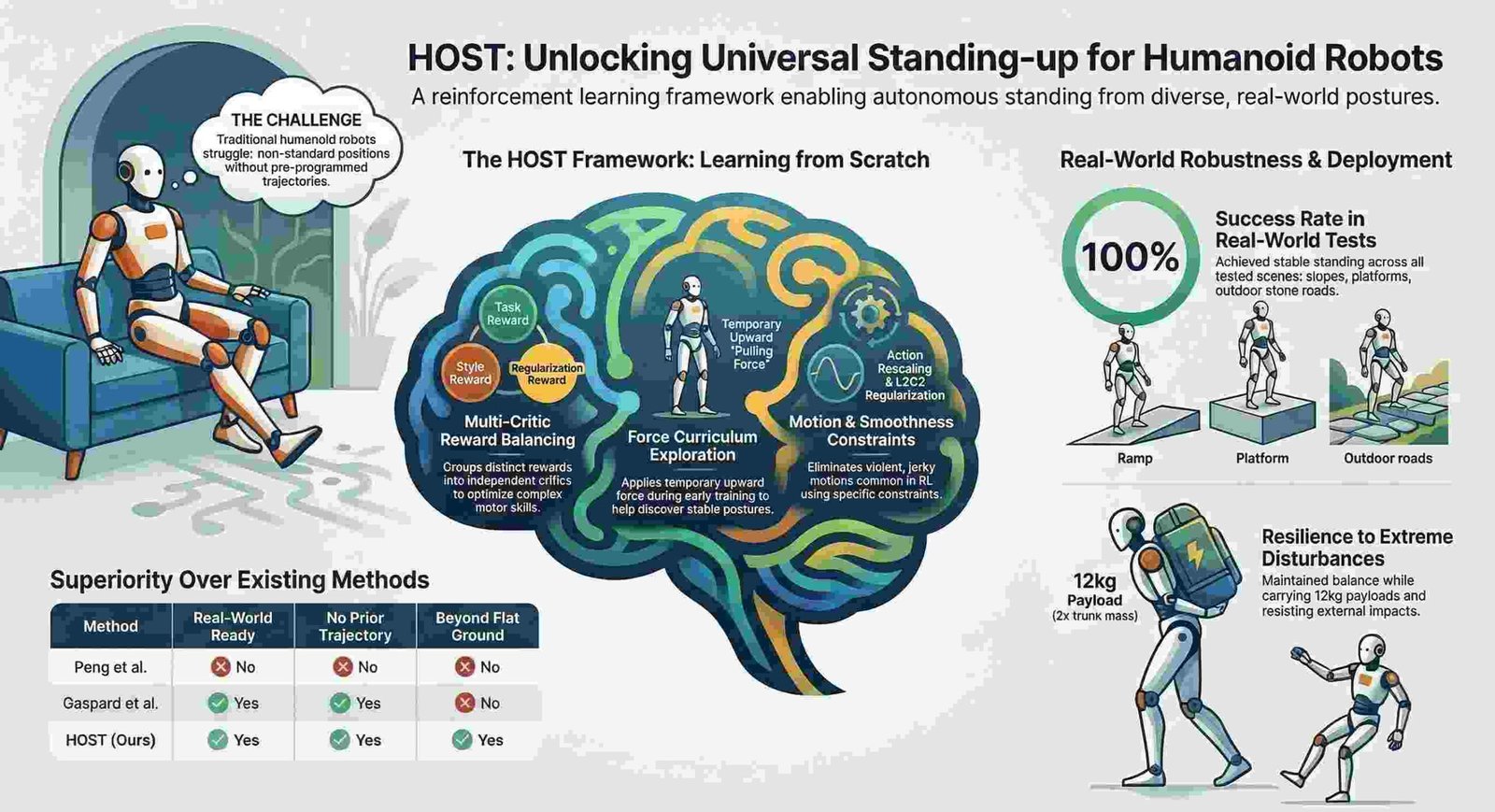
Traditional robotic control relies on “handcrafted” trajectories—painstakingly programmed joint movements that often fail the moment a single variable changes. The HOST framework abandons this rigidity, utilizing reinforcement learning to let robots discover the mechanics of standing “from scratch.” To manage the immense complexity of a machine with 23 degrees of freedom (DoF), researchers implemented a curriculum-based training strategy inspired by human ontogeny.
This strategy employs a “vertical pulling force” that mimics a parent holding an infant’s hands. Critically, this force is not constant; it only takes effect when the robot’s trunk reaches a near-vertical orientation, providing stability only when the robot has already demonstrated the intent to rise. As the robot gains balance and strength, this assistance is gradually phased out. This “learning from scratch” approach is inherently more robust than traditional planning because it allows the robot to explore its physical limits without being crushed by the initial difficulty of gravity.
“The fundamental capability—standing-up control—remains underexplored. Most existing systems assume the robots start from a pre-standing posture, limiting their applicability to many scenes.”
2. The End of “Jittery” Robots via Multi-Critic AI
Early reinforcement learning models were notorious for producing “jerky” or “violent” movements—the result of an AI trying to solve too many problems with a single, overwhelmed evaluation system. To achieve the fluidity required for real-world interaction, the HOST framework utilizes the PPO (Proximal Policy Optimization) algorithm within a sophisticated Multi-Critic RL architecture.
Instead of a single “critic” judging the robot’s performance, the system employs multiple critics that independently balance specific reward groups:
- Task rewards: High-level success in standing up.
- Style rewards: Ensuring the motion appears natural and human-like.
- Regularization rewards: Using L2C2 regularization to penalize oscillation and ensure motor efficiency.
- Post-task rewards: Maintaining stability once the upright position is achieved.
By separating these objectives, the AI can optimize for “softness” and “strength” simultaneously. This technical elegance eliminates the violent ground-hitting and rapid bouncing seen in earlier models, resulting in a motion that is safe for the robot’s expensive physical hardware.
3. “Squishy” is the New Strong—The Rise of Smart Materials
Even the most sophisticated AI “brain” cannot overcome the physical limitations of a rigid metal body when navigating the delicate environment of a clinic. This is where the convergence of mind and matter becomes essential. We are moving away from the “rigid box” paradigm toward platforms built from materials that offer biomimetic compliance.
This evolution is powered by three classes of smart materials:
- Hydrogels: Water-filled polymeric networks that are highly biocompatible and mimic the mechanical response of biological tissue.
- Liquid Crystal Elastomers (LCEs): Materials that offer programmable, anisotropic responsiveness to heat or light, enabling complex, lifelike deformations.
- Shape-Memory Polymers (SMPs): “Intelligent” plastics that return to a predefined form when triggered, allowing for sequential, programmed movements.
These materials allow robots to interact safely with human skin and internal organs, moving the needle from machines that operate near us to systems that are fundamentally bio-integrated.
4. Wireless Robots Guided by Light and Magnets
For robotics to truly revolutionize the clinic, they must become untethered. Standard motors and bulky external compressors are being replaced by Magnetic and Light-Responsive Actuators. These technologies allow for remote, wireless control of soft structures, which is a significant leap for the future of surgery.
In the “deep, tortuous locations” of the human body—such as the intricate pathways of the brain or the chambers of the heart—rigid tools are a liability. Soft, wireless micro-robots can navigate these sensitive areas during neurosurgery or cardiac interventions with minimal tissue damage. Because these actuators respond to external magnetic fields or light patterns, they can achieve high-dexterity maneuvers in constricted anatomical settings that were previously unreachable.
5. The “Sim-to-Real” Breakthrough: Robots in the Wild
The final frontier for any robot is the “sim-to-real” gap. Researchers bridge this by using Domain Randomization, intentionally injecting noise—variations in friction, mass, and center of gravity—into the simulation so the robot is prepared for the unpredictability of reality.
The Unitree G1 humanoid has recently proven that these aren’t just lab experiments. In real-world deployment, the HOST-controlled robot demonstrated a remarkable ability to maintain posture-adaptive autonomy across diverse, unseen environments.
Real-World Robustness Challenges Overcome by HOST:
- 12kg Payload: Successfully standing up while wearing a weighted backpack.
- External Disruptions: Maintaining balance despite being pushed or kicked.
- Unseen Outdoor Terrains: Successfully navigating grassland, wooden platforms, and stone roads.
- Stumbling Blocks: Overcoming physical obstacles placed in its path during the standing maneuver.
These tests prove that the transition from simulation to the “wild” is no longer a theoretical hurdle. By preparing for the worst-case scenarios in a digital environment, these robots have developed a level of real-world stability that rivals biological systems.
Conclusion: The Convergence of Mind and Matter
The future of robotics is being written at the intersection of sophisticated AI control and multifunctional smart materials. The marriage of frameworks like HOST with biomimetic materials is creating a new category of “bio-integrated” systems. We are no longer just building tools; we are creating collaborators that can safely assist, augment, and even inhabit the human body.
As we move from rigid machines to graceful, posture-adaptive partners, the ultimate question shifts: Is our goal to perfectly imitate the elegance of biology, or have we finally found the path to surpassing it?
Discover more from TechResider Submit AI Tool
Subscribe to get the latest posts sent to your email.