1. Introduction
As late 2026 unfolds, market participants find themselves navigating a profound macroeconomic paradox. On one side, broader monetary conditions have shown signs of stabilizing: the U.S. Federal Reserve has paused its benchmark interest rate hikes, signaling a potential peak in monetary tightening. On the other side, digital asset markets continue to display sharp price dislocations, defensive sentiment, and heightened selective volatility.

Yet, focusing strictly on daily candle charts misses the broader structural evolution occurring across the crypto landscape. Behind surface-level market choppiness lies an unprecedented maturation in defensive security architectures, institutional integration, protocol financial engineering, and foundational Layer 1 performance. The digital asset industry of late 2026 is no longer defined merely by speculative asset cycles, but by a deepening rift between short-term market sentiment and long-term technical infrastructure. Below, we examine five surprising trends that reveal how the crypto ecosystem is being fundamentally reshaped beneath the surface.
2. The Altcoin Bloodbath Occurred Despite a Less-Hawkish Federal Reserve
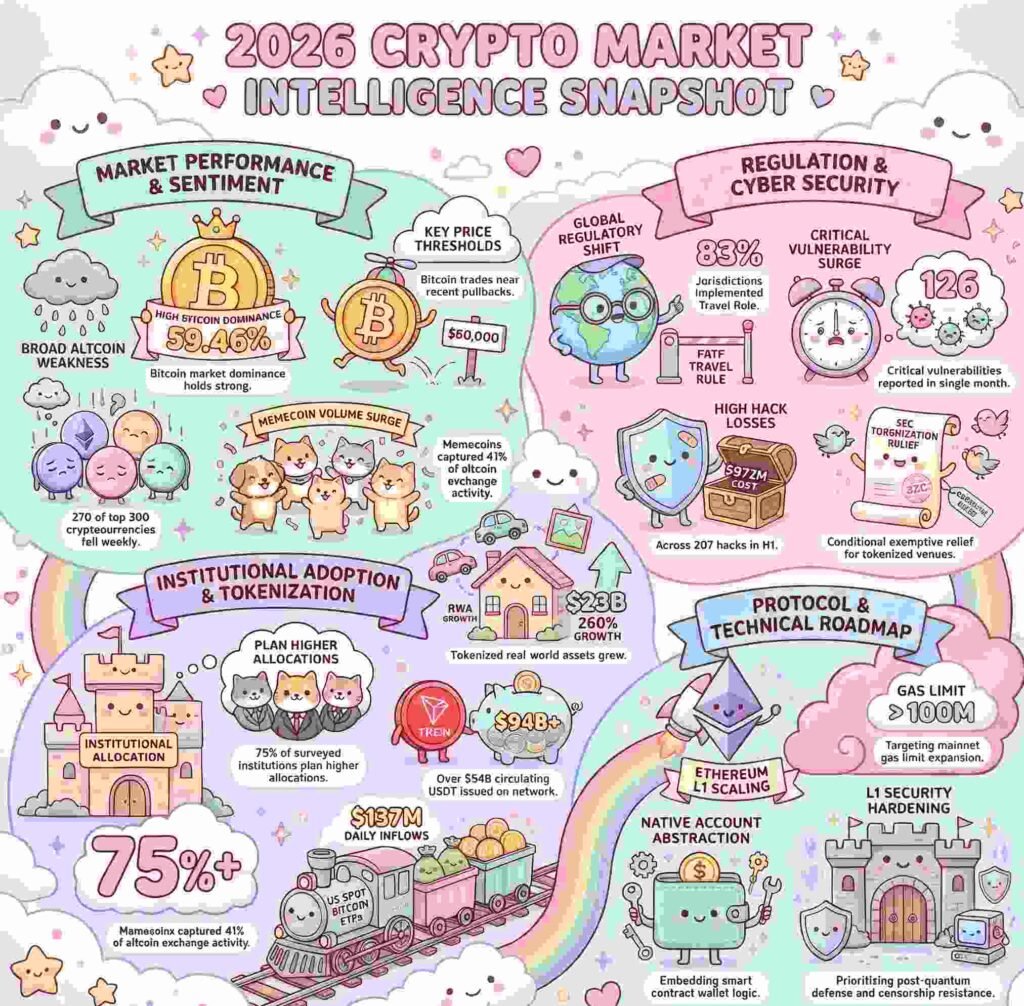
Despite the Federal Reserve adopting a less-hawkish stance at its October Federal Open Market Committee (FOMC) meeting by holding benchmark interest rates steady, the altcoin market has failed to mount a sustained recovery. In late October 2026, market intelligence reported that roughly 270 out of the top 300 cryptocurrencies by market capitalization suffered losses over a single week. The simple average weekly drop across the asset class was approximately -7%, demonstrating a broad sell-off that spared few sectors regardless of market capitalization.
The downturn was accentuated by token supply unlocks and insider distribution. Worldcoin (WLD) plummeted 24.1% over a single week following supply unlocks and wallet transfers linked to the team. Aerodrome Finance (AERO) fell 16.2% following news of BitMEX co-founder Arthur Hayes selling his holdings, while LayerZero (ZRO) dropped 13.8% after an October 20 unlock released roughly 5.9% of its circulating supply. Mid-cap and low-cap tokens experienced even harsher volatility: QuarkAI (Q) collapsed 61.1% in a week—tumbling more than 70% in a single day after a suspected wash-traded 260% surge—while Starknet (STRK) dropped 15% as its ecosystem total value locked (TVL) shrank by 74%.
This disconnect between a paused Federal Reserve and suppressed altcoin valuations stems from persistent macro headwinds and regulatory delays. High oil prices have reignited inflation fears surrounding the Personal Consumption Expenditures (PCE) price index, threatening higher long-term Treasury yields. Simultaneously, uncertainty surrounding the Nov. 3 U.S. midterm elections and legislative stalling of the U.S. CLARITY Act have kept capital locked in defensive postures.
“Altcoins have fallen more than twice as much as Bitcoin in the latest pullback… even if a rebound emerges, Bitcoin is likely to rise first and altcoins may follow later.” — Bitfinex Weekly Report
According to Bitfinex analysis, altcoins have absorbed more than double the drawdown experienced by Bitcoin. With Bitcoin market dominance reaching 59.46%, analysts emphasize that Bitcoin dominance must reverse or BTC must decisively reclaim the $82,500 level before a structural altcoin recovery can begin.
3. Crypto Hacks Hit a 2026 High—Even as White-Hat Vulnerability Findings Surged 9x
The security landscape in 2026 presents a striking paradox: defensive security mechanisms and white-hat bug bounty participation are operating at historic performance levels, yet actual protocol exploitation has reached record highs. Data from security platform Immunefi revealed that in August 2026, security researchers successfully closed 424 valid vulnerability reports across bug bounties and audit competitions—a dramatic rise from the 154 reports closed in August 2025.
Even more significant was the surge in severe code flaws: confirmed critical vulnerabilities reached 126 critical findings in August 2026, representing a 9-fold increase compared to the 14 critical findings logged in August 2025. However, this record-breaking bug discovery rate coincided with the busiest period for exploits. In the first half of 2026 alone, Immunefi recorded 207 total hacks resulting in approximately $972 million in losses, marking the highest six-month incident count on record.
This dynamic illustrates that while white-hat incentives are expanding—Immunefi paid $802,000 to 126 researchers in August 2026 alone, pushing cumulative platform payouts to $143.2 million—the attack surface of decentralized applications is expanding faster. The core driver behind this gap is the compounding complexity of dApp composability. As total capital locked on-chain grows and financial protocols integrate across multiple smart contracts, unmapped interaction vectors and systemic dependency risks multiply faster than pre-deployment audits and bug bounties can eliminate them.
4. Institutional Adoption Pivoted from Speculation to Tokenized Infrastructure and Real-World Assets (RWAs)
Between 2024 and 2026, institutional participation in digital assets underwent a structural pivot. Market participants moved decisively away from unhedged spot trading and speculative allocation, shifting instead toward regulated access vehicles, real-world asset (RWA) tokenization, and stablecoin-based settlement infrastructure. Institutional survey data from EY-Parthenon and Coinbase reveals that 62% of institutions now prefer registered or regulated investment vehicles over direct spot holdings, with 67% maintaining active digital asset allocations. Crucially, 94% express long-term belief in the structural value of blockchain technology.
The primary gateway for this capital shift has been regulated investment wrappers. U.S. Spot Bitcoin ETFs established a mature market foundation, crossing 100 billion+ in assets**. Concurrently, institutional demand drove exponential expansion in tokenized real-world assets. The market valuation for tokenized RWAs expanded by more than **260% in H1 2025 to ~23 billion, propelled by private credit vehicles and tokenized U.S. Treasuries—which experienced single-month asset surges as high as $2.3 billion, led by institutional products like BlackRock and Securitize’s BUIDL fund.
This institutional shift has been enabled by global regulatory frameworks transitioning from policy drafting to strict implementation:
- Europe: The Markets in Crypto-Assets (MiCA) transitional arrangements officially concluded on July 1, 2026, establishing standard authorization standards across EU member states.
- Global Enforcement: The Financial Action Task Force (FATF) reported that global Travel Rule compliance reached 83% among surveyed jurisdictions.
- United States: While the CLARITY Act faced legislative delays in Congress, the SEC issued temporary conditional exemptive relief for Tokenized Securities Venues in September 2026, granting a defined legal legal pathway for secondary trading of tokenized national market system (NMS) stocks.
5. Protocol Fundamentals and Token Prices Have Officially Decoupled
A prominent trend in late 2026 is the growing financial decoupling between protocol usage metrics and secondary market token valuations. Mature decentralized protocols are displaying fundamental financial performance that diverges completely from speculative market price action.
A prime example is decentralized lending platform Aave. While the AAVE token price has held above its 2024 cyclical lows, its Fully Diluted Valuation to Annualized Revenue (FDV/ann. Revenue) ratio collapsed below 20x. This historical compression indicates that the protocol is generating vastly higher fee revenue relative to its market capitalization than it did during the speculative market peaks of 2025. The market is effectively applying a heavy valuation discount to Aave’s core cash generation, pricing in governance and execution risks following the narrow March passage of the “Aave Will Win” proposal and the exit of core development team BGD Labs.
Conversely, Solana-based ORE Protocol demonstrated how direct protocol-revenue mechanisms can support token valuations. ORE’s weekly protocol revenue rebounded from an April low of $319,000 to $818,000, propelling its token price from $39 to $111 over the same period, supported by continuous revenue-funded token buybacks.
Meanwhile, secondary market volume metrics show speculative capital concentrating heavily in non-utility assets. In early 2026, memecoin trading volume surged to command 41% of altcoin activity on centralized exchanges (up from 12.9% in late 2025), directly cannibalizing volume share from utility-focused sectors such as privacy coins, which dropped from a 61% market share peak down to 14%.
6. Ethereum’s Technical Roadmap Quietly Executed Its Most Ambitious Engineering Upgrades
While broader crypto market prices traded sideways throughout late 2025 and 2026, core developers executed some of the most complex architectural upgrades in blockchain history. The Ethereum network delivered two landmark hard forks in 2025:
- The Pectra Upgrade (May 2025): Deployed EIP-7702 to allow Externally Owned Accounts (EOAs) to temporarily function as smart contract wallets—enabling gas sponsorship, batch transactions, and social recovery. Pectra also doubled blob throughput via EIP-7691 and raised the maximum effective validator balance from 32 ETH to 2,048 ETH via EIP-7251.
- The Fusaka Upgrade (December 2025): Integrated Peer Data Availability Sampling (PeerDAS via EIP-7594), allowing validators to sample blob data rather than downloading full blocks. PeerDAS unlocked an 8x increase in theoretical blob capacity, supported by Blob Parameter Only (BPO) forks.
Alongside these protocol hard forks, the Ethereum community achieved a major milestone in Layer 1 execution throughput by raising the mainnet gas limit from 30 million to 60 million—its first major capacity increase since 2021. Node storage requirements were simultaneously mitigated by history expiry implementations, which purged pre-Merge historical data and saved full node operators hundreds of gigabytes of disk space.
Looking through 2026, the Ethereum Foundation restructured its core engineering focus into three unified tracks: Scale, Improve UX, and Harden the L1. Under this strategy, developers are executing toward target mainnet gas limits exceeding 100M using Block-level Access Lists (EIP-7928) while advancing the Glamsterdam (H1 2026) and Hegotá (Late 2026) upgrades. These upgrades incorporate enshrined Proposer-Builder Separation (ePBS via EIP-7732) and censorship resistance via Inclusion Lists (FOCIL via EIP-7805).
Crucially, the roadmap directly bridges user experience with long-term network security through native Account Abstraction proposals like Frame Transactions (EIP-8141). By embedding smart contract wallet logic natively into the protocol rather than relying on external relayers, EIP-8141 creates a seamless, built-in migration path away from legacy ECDSA cryptography toward post-quantum signature verification algorithms within the EVM.
7. Conclusion & Forward-Looking Thought
The market dynamics of late 2026 illustrate a clear divergence within the digital asset ecosystem. Short-term price weakness, altcoin drawdowns, and macroeconomic uncertainty dominate headlines and retail sentiment. However, evaluating the sector solely through secondary market valuations obscures an era of profound structural maturation. Across institutional regulatory compliance, real-world asset integration, protocol fee generation, and Layer 1 engineering, the technological foundation has expanded dramatically. As infrastructure capacity grows and institutional frameworks solidify, the digital asset ecosystem is quietly separating fundamental execution from speculative momentum.
As protocol cash flows and network throughput continue to decouple from secondary market prices, will token valuations eventually realign with underlying protocol revenue and execution metrics, or has the market permanently entered an era where utility and asset price operate on completely independent tracks?
Discover more from TechResider Submit AI Tool
Subscribe to get the latest posts sent to your email.