1. The Illusion is Fading: Architecture Over Artifice
For decades, game design relied on “smoke and mirrors”—rigid, pre-baked scripts designed to simulate a living world. By 2026, the strings are finally being cut as AI transitions from a cosmetic additive to the industry’s architectural backbone. This shift is creating an intergenerational narrative moat, with a projected market value exceeding $501.91 billion by 2034.
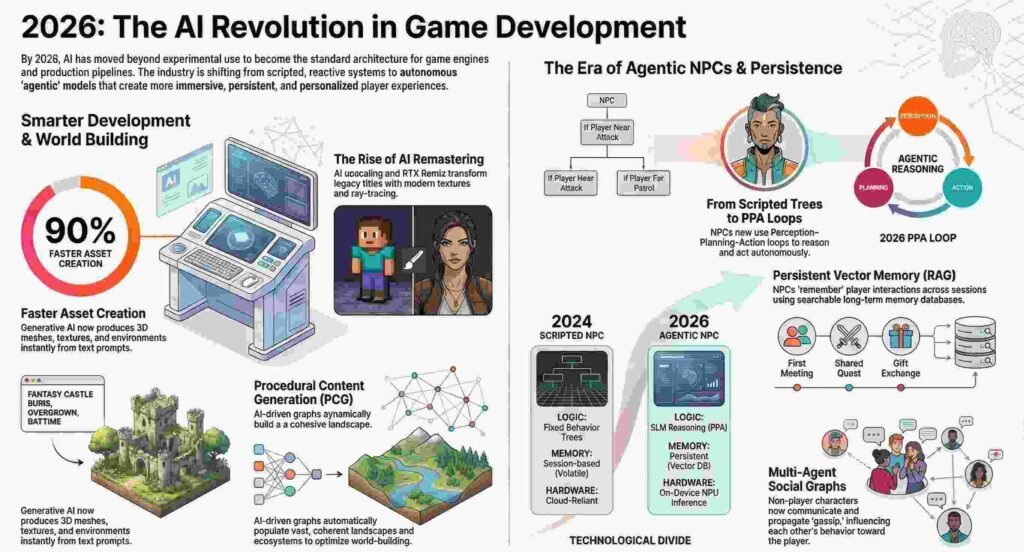
Strategic insights from the BCG Global Gaming Survey reveal that parents are now introducing children to gaming as early as age five through platforms like Roblox and Minecraft. These “AI-native” Gen Alpha players expect worlds to be inherently malleable and socially complex. For developers, the challenge has shifted from creating a game to architecting a persistent ecosystem that thrives even when the player is offline.
2. From Chatbots to Actors: The Rise of Agentic PPA Loops
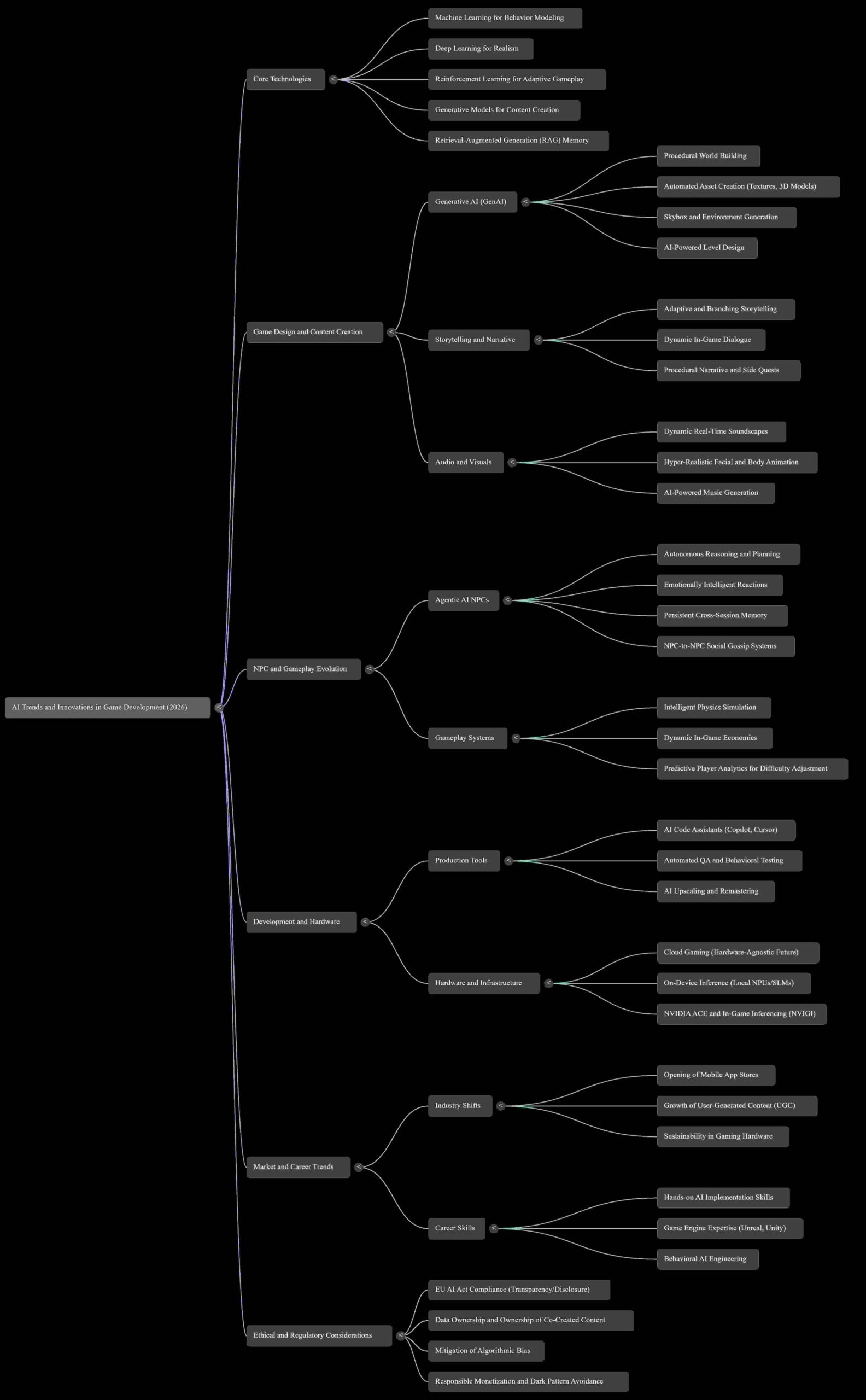
The traditional “Behavior Tree” is effectively dead, replaced by the Perception–Planning–Action (PPA) loop. In 2026, NPCs no longer wait for a specific “If/Then” trigger to respond to player behavior. Instead, they function as autonomous actors, utilizing Quantized Small Language Models (SLMs) to reason through non-deterministic decisions in real-time.
This technical evolution transforms characters from static puppets into reasoning entities that perceive the world state and execute original plans. By moving away from deterministic logic, developers can finally offer the depth of interaction once reserved for Tabletop RPGs. As the industry moves toward these agentic systems, the fundamental nature of the digital character changes.
“The era of scripted illusion is ending. The era of autonomous digital actors has begun.”
3. The “Gossip Protocol”: NPCs are Talking Behind Your Back
Modern NPCs are no longer isolated data silos; they are nodes within a Multi-Agent Social Graph. Through the “Gossip Protocol,” a character’s opinion of a player is influenced by transitive influence from other NPCs. This creates emergent social retention loops that significantly boost Player Lifetime Value (LTV) by making social standing a high-stakes, dynamic mechanic.
To manage these decentralized narrative ecosystems, lead developers use a Social Graph Weighting formula to determine behavioral shifts:
Score = W_direct + sum(W_trust * W_opinion) * 0.5
This ensures that if you offend a town’s blacksmith, a merchant who trusts that blacksmith will preemptively raise prices or refuse service. These living rumor systems create a world that evolves socially and politically without a single line of hard-coded script.
4. Persistent Vector Memory: They Don’t Forget the “Feeling”
We have officially moved past “Legacy JSON logs,” which suffered from shallow context and “Context Window Fatigue.” NPCs now utilize Persistent Vector Memory powered by Retrieval-Augmented Generation (RAG). This architecture allows the character to treat the player’s history as a searchable, mathematical database.
The 2026 memory stack operates through a high-speed, three-stage retrieval loop:
- Vector Embedding: Interactions are converted into coordinates representing factual and emotional context.
- Semantic Retrieval: The system scans a Local Vector Database to find the “nearest neighbors” to the current situation.
- Context Augmentation: The NPC retrieves the feeling of past sessions, allowing for narrative permanence that can span across different titles or sequels via cloud-synced profiles.
5. The Hardware Revolution: The NPU in Your Pocket
To sustain these reasoning loops without breaking immersion, the industry has abandoned cloud-reliant models in favor of On-Device Inference. While 2024 demos were plagued by high latency and recurring token costs, 2026 hardware-optimized stacks utilize local Neural Processing Units (NPUs). This shift achieves sub-100ms latency, critical for maintaining the “illusion of life” in real-time.
Developers now use INT8 Quantization on embedding models to run 1,536-dimension vector searches directly on the NPU. This keeps the main GPU cores free for high-fidelity rendering while reducing the VRAM footprint. Furthermore, TMR (Tunnel Magnetoresistance) Sensors have permanently ended controller drift. Precise input is now mandatory, as drift acts as “data corruption” in an AI character’s Perception loop, potentially breaking the non-deterministic reasoning chain.
6. The Lesson of the “Gameslop”: AI as a Foundation, Not a Replacement
The rise of Generative AI has proven to be a “Double-Edged Sword.” While it accelerates production, an over-reliance on uncurated automation leads to “gameslop”—visual errors and misspelled gibberish that destroy a studio’s reputation. The industry has learned that AI-native tools must complement, rather than replace, human artistic vision.
| Model | Success Case | Outcome |
| Pure Automation | GTA Trilogy – Definitive Edition | “Wax-like” faces, texture gibberish, and broken immersion. |
| Human-AI Hybrid | Mass Effect Legendary Edition | AI-upscaled textures refined by artists to preserve original intent. |
Visionary studios now utilize specialized Gen AI tools such as Blockade Labs for skyboxes, GET3D by NVIDIA for meshes, and Meshy.AI for high-quality PBR textures. This hybrid approach ensures that the world is built at a 2026 scale while maintaining the handcrafted “soul” that players demand.
“A prudent approach involves balancing Gen AI-generated content with human intervention for refinement and personalization. While Gen AI holds immense promise, it should complement, not replace, human creativity.”
7. Regulatory Reality: The “Right to Be Forgotten” in a Virtual World
Autonomous virtual worlds have introduced unprecedented ethical and regulatory challenges, specifically under the EU AI Act (Art. 50/52). Developers are now legally bound to a Disclosure of Synthetic Origins, ensuring players know when they are interacting with an AI persona. This is no longer just a legal hurdle; it is a core component of building player trust.
There is a growing tension between “Sensing for Toxicity” (to ensure safe gaming spaces) and “User Privacy.” To comply with the “right to be forgotten,” developers are pioneering Machine Unlearning. This technical process allows specific player data to be removed from a trained model without the prohibitive cost of retraining the entire neural architecture from scratch.
8. Conclusion: The Architecture Decides Everything
In the 2026 landscape, the divide is no longer between those who use AI and those who do not. The true separation exists between “Reactive” worlds and “Persistent” ones. Studios clinging to traditional scripting will find themselves unable to compete with the social and economic depth offered by agentic loops and vectorized memory.
This technological leap is establishing a new standard for intergenerational engagement and long-term player investment. We have transcended the era of the chatbot; we are now building digital societies. Are you prepared to step into a world that continues to evolve, trade, and remember—even when you aren’t there to watch it?
Discover more from TechResider Submit AI Tool
Subscribe to get the latest posts sent to your email.