There is a subtle, unspoken magic happening right now in laboratories, warehouses, and living rooms across the globe. For decades, the word “robot” conjured images of cold, metallic arms welding car chassis behind safety cages, or hyper-intellectual, dystopian metallic figures operating on pure, unfeeling logic. But if you look closely at the latest generation of machines stepping into the spotlight, you will notice something profoundly different. They aren’t just getting smarter; they are getting softer. They are learning to navigate our world not by forcing us to adapt to them, but by learning what it means to be human.
We are currently living through a quiet revolution in robotics—a transition from industrial automation to companionate, collaborative presence. The latest trending robots are no longer confined to fixed coordinates. They walk among us, look us in the eye, decipher our emotional cues, and carry out tasks that require a delicate touch. This isn’t just a leap in mechanics; it is a profound shift in philosophy. Designers and engineers are looking through a humanized lens, crafting machines meant to seamlessly blend into our daily landscapes.
1. The Humanoid Renaissance: Empathy in Motion
Perhaps the most visually stunning trend is the meteoric rise of advanced humanoid robots. Leading the charge is the latest iteration of Figure AI’s flagship model, Figure 02, alongside Tesla’s highly refined Optimus Gen 3. Watching these machines operate is no longer an exercise in uncanny valley shudders. Instead, it feels strangely natural.
What makes these humanoids fundamentally different from their ancestors is their integration of advanced neural networks with expressive physical form. They don’t just execute code; they observe human behavior and mirror it. If you hand a tool to Figure 02, it doesn’t grab it with the sudden, jarring motion of a factory clamp. It gauges the weight, anticipates your release, and grips it with a fluid, organic grace that feels safe. This humanized physical interaction reduces the psychological friction of sharing a workspace with a machine, turning a potential threat into a trusted teammate.
2. Companionship and Care: The Soft Side of Silicon
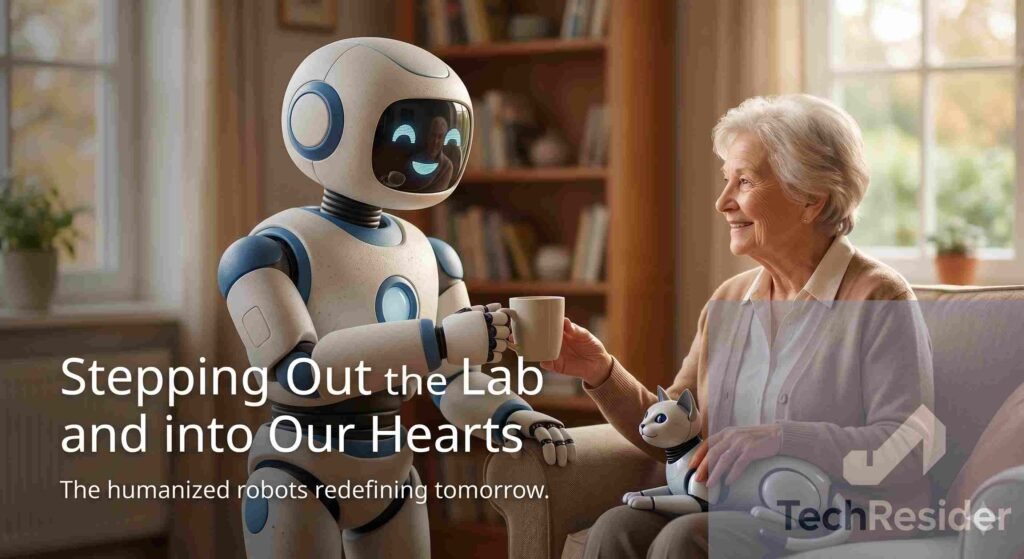
Away from the bustling fulfillment centers, a softer, quieter class of robotics is making waves in our homes and healthcare systems. Robots like Moxie and newly evolved eldercare companions are rewriting the rules of human-machine relationships. These are not tools for productivity; they are containers for connection.
In pediatric wards and elderly care facilities, loneliness and emotional isolation are genuine health crises. Humanized social robots are stepping into this void, equipped with large language models that allow for genuine, flowing dialogue and generative emotional responses. They remember your favorite stories, pick up on the subtle sadness in your tone of voice, and offer gentle encouragement. Critics once worried that substituting human care with silicon would alienate us further, but the reality on the ground has shown the opposite: these machines often act as social catalysts, breaking the ice and opening pathways for people to reconnect with the world around them.
3. Collaborative Co-Workers: Changing the Nature of Work
In the commercial sector, the narrative surrounding robotics has long been one of displacement—the fear that machines will arrive to take our jobs. However, the current trend paints a far more collaborative picture through “Cobots” (collaborative robots) like Agility Robotics’ Digit.
Digit is designed specifically to work alongside humans in logistics spaces built for people. It navigates stairs, avoids obstacles dynamically, and handles repetitive, backbreaking lifting. By shifting the dull, dirty, and dangerous work to a robotic counterpart, human workers are elevated to supervisory, creative, and problem-solving roles. This collaborative framework changes the workplace dynamic entirely. The robot becomes an extension of human capability, a tireless assistant that allows us to focus on what we do best: innovate, strategize, and connect.
4. The Hidden Intelligence: Embodied AI
To understand why today’s robots feel so astonishingly human, we have to look beneath the chassis at the concept of Embodied AI. For years, artificial intelligence lived behind screens—a disembodied brain handling text and images. By giving AI a physical body, we have fundamentally altered how it learns.
When a robot bumps its foot against a rug, misjudges the slipperiness of a glass, or feels the warmth of a human hand, it receives tactile, real-world feedback. This physical existence forces the AI to develop a rudimentary understanding of common sense and intuitive physics. This continuous feedback loop creates behavior that feels remarkably intuitive. They don’t just follow a static script; they improvise and adapt to the messy, unpredictable reality of human life.
Looking Ahead: Walking Hand-in-Hand into the Future
As we stand on the threshold of this new era, it is clear that the future of robotics is not about creating artificial replacements for humanity, but about creating tools that celebrate and enhance our humanity. The latest trending robots are reflection points, showing us that our technology can be as compassionate, adaptable, and collaborative as we choose to build it.
The journey ahead will undoubtedly bring complex ethical questions and logistical hurdles. But if the current wave of human-centered design is any indication, we are moving toward a world where technology doesn’t isolate us behind screens, but steps out into the physical world to help us build a brighter, more connected tomorrow.
Discover more from TechResider Submit AI Tool
Subscribe to get the latest posts sent to your email.