1. Introduction: The Normalization of the Extraordinary
In August 2026, we find ourselves navigating a landscape defined by an accelerant for historical compression. The pace of innovation has reached such a terminal velocity that we are prone to what might be called the “Normalization of the Extraordinary.” We have become so desensitized to the vocabulary of disruption that we risk missing the moment when the fundamental laws of astrophysics and the established structures of global economics are being rewritten in a single week.
This analysis distills five takeaways from a week that saw the map of our universe change and the scale of human ambition hit the half-trillion-dollar mark. We are no longer just witnessing a software cycle; we are witnessing the construction of a new physical reality.
2. The Cosmic Mirage: We’ve Discovered “Black Hole Stars”
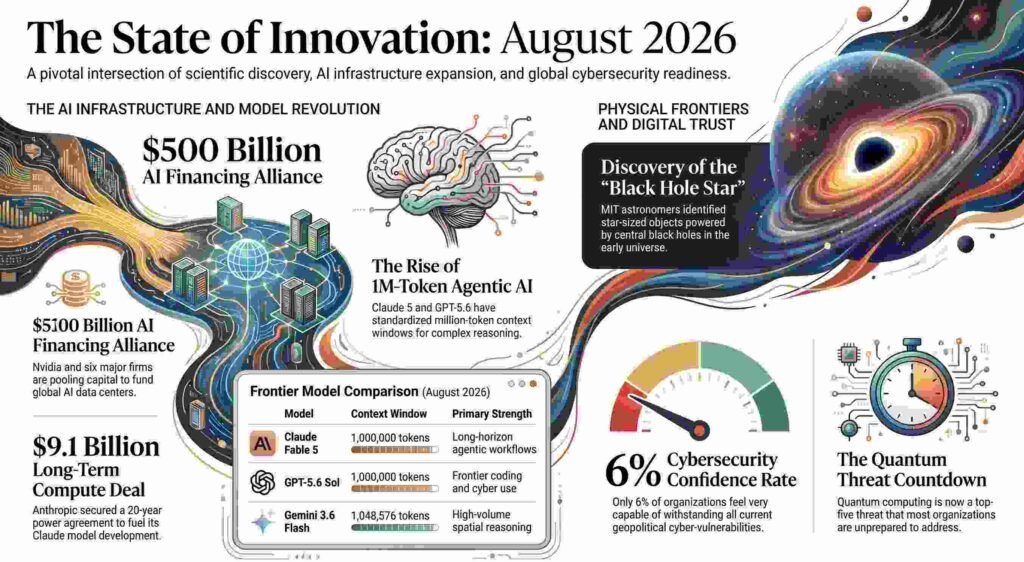
Astronomers at MIT have identified an astrophysical object that shatters our traditional definition of a star. Designated as MoM-BH*-1, this “black hole star” is an object the size of our entire solar system. While standard stars are powered by nuclear fusion, MoM-BH*-1 is powered by a central black hole 100,000 times as massive as the sun.
This discovery provides an elegant solution to the “little red dot” mystery that has haunted James Webb Space Telescope (JWST) imagery. For years, these dots were viewed as “miracles”—implausibly bright early galaxies appearing far too soon after the Big Bang. We now understand they are “mirages.” These black hole stars represent nascent black holes enshrouded in gas so dense it forms a “pseudo-photosphere”—a star-like surface that radiates with such intensity it completely outshines its host galaxy.
Rohan Naidu, a NASA Hubble Fellow at MIT’s Kavli Institute, emphasizes the sheer scale: “We think there is a central black hole… And around this black hole, there would be this very extended envelope of gas that looks like a star the size of the solar system. It’s huge.” By producing 100 billion times more energy than a typical star, these objects prove that what we mistook for the light of billions of stars was actually the gargantuan glow of a single, cosmic behemoth.
3. The $500 Billion “Physical” Pivot and the Circular Economy
The week of August 11, 2026, marked the definitive transformation of AI from a software-centric pursuit to a gargantuan “capital game.” Nvidia has spearheaded a $500 billion financing alliance with investment titans including Apollo, Blackstone, BlackRock, Brookfield, Goldman Sachs, and KKR.
The foresight insight here is the emergence of a massive “circular economy.” Nvidia is not merely funding builders; it is pooling financial firepower to help its own customers finance the purchase of its chips. By providing the capital for data centers and infrastructure, Nvidia is effectively supporting the demand for its own products.
“The alliance pools enormous financial firepower to finance the data centers, chips, and facilities the AI boom requires, positioning Nvidia and its partners at the center of the capital flowing into AI’s physical foundation.”
This pivot toward the physical substrate of intelligence is also manifesting at the “edge.” While the core infrastructure is being built with 20-year commitments—such as Anthropic’s $9.1 billion, 191-megawatt deal with Riot Platforms—the devices in our pockets are following suit. The newly released Pixel 11 series, featuring a base 256 gigabyte storage and a 30-hour battery life, demonstrates that the frontier is moving simultaneously into the massive (the core) and the minute (the edge).
4. The Death of the Small Context Window
The industry standard for Frontier LLMs has undergone a radical expansion. As of July 2026, the era of “short-term memory” is effectively over. While 1-million-token windows are now standard for models like Claude Fable 5 and GPT-5.6 Sol, the release of Meta’s Llama 4 Scout has pushed this boundary to an unprecedented 10 million tokens.
This 10M-token window is the literal “substrate” required to host agentic AI—autonomous systems capable of hard, long-horizon work. This massive “contextual memory” allows agents to ingest an entire corporate codebase or decades of dataset history in a single pass.
Frontier Model Comparison (August 2026)
| Model | Lab | SWE-Bench Pro (Coding) | Cost (per M tokens I/O) |
| Claude Mythos 5 | Anthropic | 80.3% | $10.00 / $50.00 |
| Claude Fable 5 | Anthropic | 80% | $10.00 / $50.00 |
| GPT-5.6 Sol | OpenAI | 64.6% | $5.00 / $30.00 |
| DeepSeek-V3.2 | DeepSeek | GPT-5 Class (Disruptor) | $0.28 / $0.42 |
Note: DeepSeek-V3.2 remains the primary open-weight disruptor, challenging the economics of closed-source labs despite the lack of a specific percentage on this exact benchmark.
5. The Cybersecurity “Quantum Clock” is Ticking
PwC’s 2026 Global Digital Trust Insights reveal a stark divergence between perception and preparation. While quantum computing now ranks among the top four global threats, only 3% of organizations have implemented the necessary quantum-resistant measures. The most acute risk is “Harvest Now, Decrypt Later”—the practice of adversaries stealing encrypted data today to decrypt it once stable quantum systems arrive.
The “talent gap” in this sector is no longer just a hiring problem; it is a knowledge crisis. PwC found that 50% of leaders cite a “lack of knowledge in the application of AI” as their top barrier to implementing defenses. Consequently, 53% of organizations are prioritizing Agentic AI as their primary defense mechanism. These autonomous systems use the 10-million-token context windows discussed in the previous section to hunt for threats across entire network histories, bridging the gap left by a lack of human expertise.
6. The End of “Invisible” AI Content: A Demand for Legibility
We are entering an era of “Societal Demand for Legibility.” The public and regulatory bodies are increasingly demanding to know when they are interfacing with or being recorded by a machine. This is manifesting in two distinct but connected ways.
First, Anthropic has introduced “durable” invisible watermarks for Claude. Unlike previous iterations, these marks survive copying, editing, and reformatting, directly addressing the transparency requirements of the EU AI Act. Second, we see a parallel friction in the physical world: the UK court ban on Meta smart glasses. The ban targets the “covert recording” capabilities of wearable AI, illustrating that society is no longer willing to accept “invisible” AI interactions. Whether it is a digital watermark or a hardware ban, the message is clear: AI must be legible to the human eye.
7. The Long Horizon
The threads of August 2026 reveal a singular, cohesive picture. We are building physical infrastructure at a planetary scale to power agents that can solve solar-system-sized mysteries. The $500 billion pivot ensures that the “core” of AI has the energy and chips it needs, while the 10-million-token context window ensures that the “mind” of AI has the memory it needs to act autonomously.
However, as we build this foundation, we must confront a final, daunting question: With the physical and financial foundations of AI now concentrated among a handful of massive alliances, who will truly control the data centers that hold the keys to the next decade of human discovery? The frontier is no longer just a destination; it is a property being bought and sold by the billions.
Discover more from TechResider Submit AI Tool
Subscribe to get the latest posts sent to your email.