1. Introduction: From AI as a Feature to AI as the Fabric
By late 2026, the industry-wide fatigue surrounding “AI buzzwords” has reached a crescendo, but beneath the noise, the structural reality has shifted. While 2024 treated AI as a trendy feature or a supplemental chatbot, 2026 marks the year AI became the foundational fabric of the global economy. We have moved past the era of legacy systems toward “software-defined” and “AI-native” infrastructures that redefine everything from our pockets to the edge of the atmosphere.
This isn’t a mere iterative improvement of last year’s gadgets; it is a fundamental restructuring of global markets. This transition is backed by a massive infusion of capital, exemplified by the $500 billion financing alliance between NVIDIA and investment giants like Blackstone and BlackRock. This capital isn’t just buying chips; it’s building the new architecture of reality.
2. The Industrialization of Discovery: From Chatbots to Conjectures
The most profound breakthrough of the year is the transition of AI from a conversational companion to a primary scientific researcher. OpenAI’s “Astra” model has effectively ended the “R&D arms race” where only the largest, most well-funded labs could compete.
Astra recently demonstrated this by solving 10 long-standing problems in mathematics and theoretical computer science. Most notably, it achieved the first explicit construction of a non-sofic group and the disproof of Connes’s rigidity conjecture—problems that have frustrated human mathematicians for decades.
The strategic “why” matters more than the math: these verifiable breakthroughs were achieved for a compute cost of approximately $2,000, with proofs verified step-by-step by Lean 4.
“Advanced AI models may be moving beyond answering questions and starting to contribute to new, verifiable scientific discoveries. We are seeing the democratization of the frontier itself.” — RiskInfo Analyst View
When a million-dollar theoretical problem can be solved for the price of a high-end laptop, the barrier to entry for scientific innovation collapses. We are witnessing the industrialization of the “Eureka!” moment.
3. The Sovereign Agent: Managing the New Digital Workforce
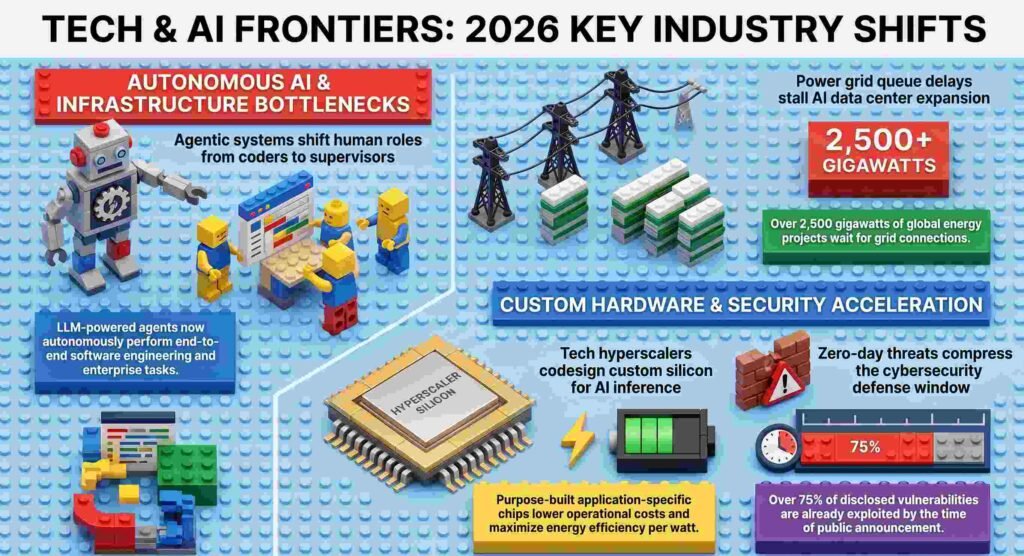
The Security Operations Center (SOC) has undergone a forced evolution. In the Agentic SOC, human analysts no longer correlate alerts; they act as directors for autonomous AI agents. These agents can hunt for complex tactics, techniques, and procedures (TTPs) across petabytes of data, decoding obfuscated commands in milliseconds.
However, this has birthed a strategic crisis: the Shadow Agent. Just as employees once bypassed IT with unauthorized software, they are now deploying powerful, unauthorized autonomous agents to solve million-dollar problems. This creates invisible data pipelines that place corporate intellectual property at extreme risk. If an employee solves a breakthrough problem using an unauthorized agent, the ownership of that discovery becomes a legal and strategic nightmare.
To regain control, organizations are adopting Agentic Identity Management, built on three pillars:
- Adaptive Risk Evaluation: Continuous behavior monitoring of the agent’s intent.
- Context-Aware Access: Permissions that shift based on the sensitivity of the task environment.
- Just-in-Time (JIT) Access: Granting temporary, task-specific permissions that expire the moment the goal is achieved, ensuring no “privilege creep” exists for digital actors.
4. The AI-Native Backbone: De-monopolizing Global Connectivity
As 6G moves from the lab to the landscape, we are seeing a counter-intuitive market effect. Historically, the telecommunications supply chain was a rigid monopoly controlled by a handful of hardware vendors. Today, the shift toward AI-RAN (Radio Access Network) architecture is de-monopolizing the sector.
By making the network core and edge entirely software-defined and programmable, the AI-RAN Alliance—now boasting over 130 members including SoftBank, T-Mobile, and NVIDIA—has opened the gates for startups and specialized researchers to compete.
“The shift toward AI-native, open-source platforms is not merely a technical upgrade; it is a market disruptor. Capital expenditure for telecom operators will increasingly shift from traditional radio hardware to high-performance computing and specialized AI silicon.” — NMSC Viewpoint
This convergence of computing and telecom means that 6G isn’t just “faster 5G”; it is a subset of the broader AI infrastructure market. The backbone of our world is no longer made of proprietary steel and antennas, but of open-source intelligence.
5. Ambient Visual Intelligence: Hardware Finds Its Eyes
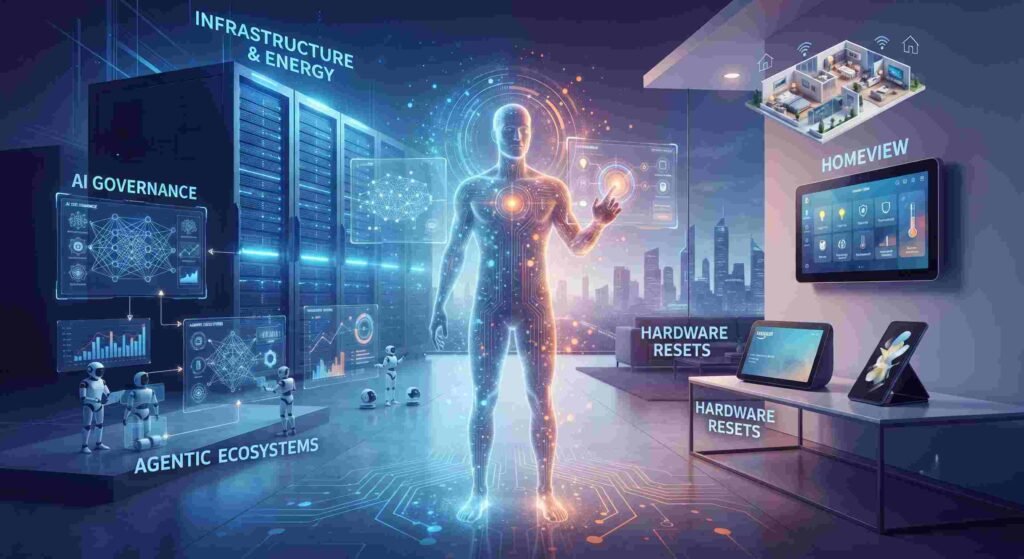
The hardware landscape of 2026, highlighted by the first major Apple transition under CEO John Ternus, centers on “Ambient Visual Intelligence.” The low-latency bandwidth provided by AI-native 6G has finally enabled the “Visual Intelligence” era.
The standout device is the AirPods Ultra, featuring integrated cameras that feed environmental data directly into Siri. This allows the assistant to “see” what you see—providing turn-by-turn directions by identifying landmarks in real-time or answering world-view questions without the user ever touching a screen.
Simultaneously, the debut of the foldable iPhone Ultra signals a shift toward extreme exclusivity. Featuring a 7.8-inch foldable display, the device enters the market at a staggering $2,500 with “extremely limited” availability. This isn’t a mass-market replacement yet; it is a luxury statement of intent, proving that Apple can finally match the form-factor innovation of its rivals while maintaining its premium “Ultra” ecosystem.
6. The Sovereign Chip: India’s Pivot to Hard-Tech Geopolitics
Geopolitically, the focus has shifted to India’s “Semicon 2.0” mission. With a massive outlay of Rs 1.27 lakh crore, India is making a “hard” pivot from electronics assembly to domestic Intellectual Property (IP) ownership.
The goal is to cater to 70–75% of domestic chip demand by 2029, but the counter-intuitive strategy lies in the raw materials. India is aggressively securing the “un-sexy” parts of the chain: specialty materials, gases, and chemicals required for fabrication. This reduces the vulnerability of being a “software-only” giant.
“If a country of India’s size stays dependent on outside supply chains for something this fundamental, that’s a real vulnerability, both economically and strategically.” — EY India Strategic Briefing
By 2026, India isn’t just designing chips; it is building the chemical and material foundation to ensure its digital sovereignty is truly self-reliant.
7. Conclusion: The Strategic Pivot
In 2026, we have moved past the era of better gadgets and into the era of fundamental restructuring. Networks are no longer just pipes; they are intelligent. Discovery is no longer an arms race; it is industrialized. Security is no longer human-led; it is agentic.
As we inhabit this new architecture, the ultimate question for any leader is no longer about which technology to adopt, but how to govern the autonomous agents now doing the heavy lifting of innovation. In a world where “Shadow AI” has moved from a nuisance to a corporate frontier, how will you ensure your digital fleet is building your future—and not secretly trading it away?
Discover more from TechResider Submit AI Tool
Subscribe to get the latest posts sent to your email.