Modern science is trapped in a productivity paradox. Over the last half-century, the number of researchers in the United States has surged seven-fold, yet the rate of transformative, “breakthrough” discovery is stalling. We have more hands on deck than ever before, but the sheer complexity of our greatest challenges—mutating rare diseases, the logistics of a decarbonized grid, the search for rare-earth-free magnets—has created a wall that human intellect alone can no longer scale.
We have reached a ceiling of specialization. To break through, we are moving beyond AI as a digital assistant for organizing spreadsheets and toward the “Co-Scientist”—an autonomous collaborator capable of managing the hyper-complexity of the 21st century.
Beyond Big Data: The Rise of the Einsteinian Theorist
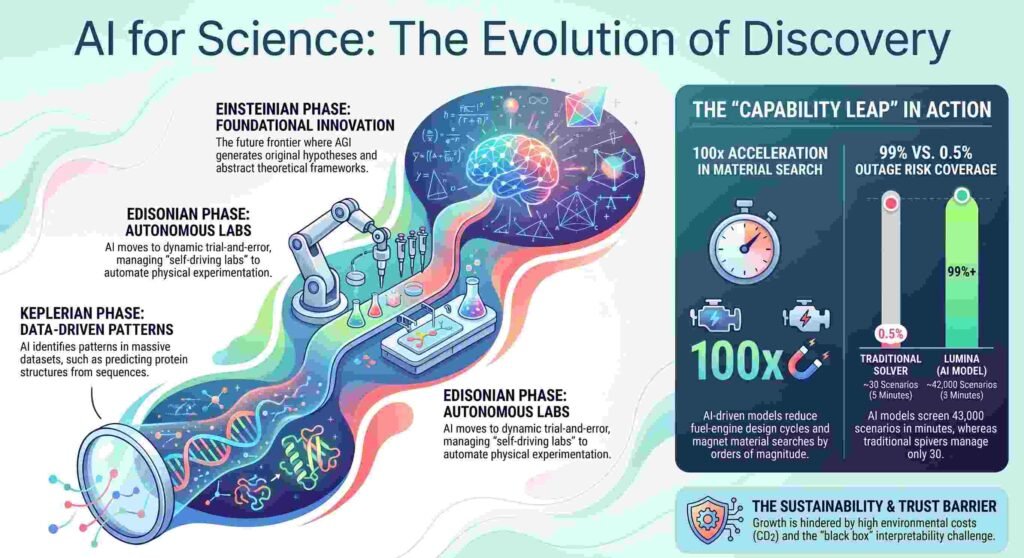
The evolution of this partnership is best understood through the “Three-Phase Framework” developed by researcher Valerie Fu. This roadmap tracks AI’s journey from a sophisticated calculator to a creative peer:
- The Keplerian Phase: This is our status quo. Like Johannes Kepler synthesizing astronomical observations into laws, AI excels at pattern recognition, sifting through petabytes of data to find hidden correlations that human eyes would miss.
- The Edisonian Phase: Named for Thomas Edison’s relentless trial-and-error, this phase introduces autonomous experimentation. Here, AI doesn’t just watch; it acts, optimizing experiments in real-time through reinforcement learning.
- The Einsteinian Phase: This is the ultimate frontier of Artificial General Intelligence (AGI) in science. Unlike current “data-hungry” models, the Einsteinian phase is characterized by independent reasoning and “thought experiments.”
Just as Albert Einstein used minimal data to imagine himself inside a falling elevator to derive the equivalence principle, Einsteinian AI moves beyond summarization. It uses deep logic to dream up foundational theories and groundbreaking hypotheses where data is scarce. As DeepMind CEO Demis Hassabis suggests, science is a “tree of knowledge”; by using AI to solve “root node problems” like protein folding, we can unlock entirely new branches of research that were previously invisible to us.
AISAC: Orchestrating the End of the Information Silo
The primary obstacle to this “Einsteinian” future is the “burden of knowledge”—the fact that a physicist might hold the solution to a biological problem but never find the relevant paper in the millions published annually. To solve this, researchers are deploying the AISAC (AI Scientific Assistant Core), a hierarchical multi-agent architecture that acts as the orchestration engine for discovery.
AISAC doesn’t just summarize; it synthesizes. Using Large Language Models and specialized platforms like MAG-GPT, it can bridge transdisciplinary silos in record time. In the search for rare-earth-free permanent magnets, for instance, this architecture enables a “Query to Discovery in Seconds” workflow. Researchers can move from a natural language query to a synthesized response—optimizing impurities and dopants across fourteen different databases and 238,000 materials—in the time it takes to brew a cup of coffee.
Programming Life: The Age of the Rxn Rover
In the Edisonian Phase, the laboratory itself becomes a participant. By merging AISAC-level orchestration with robotics, we have created “Self-Driving Labs” (SDLs). Systems like the Rxn Rover are transforming biology and chemistry from observational “studies” into systematic engineering disciplines.
As NVIDIA CEO Jensen Huang famously noted, we are entering the era of “Digital Biology.” When biology is treated as an engineering discipline, improvements become exponential rather than incremental. The speed gains are no longer theoretical; they are industrial:
- 100x speed-up in targeted material searches.
- 40% reduction in experimental human effort.
- 180 automated screenings completed in a mere 48 hours.
Silicon Reflexes: Navigating Crisis at 1,400x Speed
The “Co-Scientist” is most vital when human reaction time is the bottleneck. In high-stakes environments like a power grid failing during a hurricane, traditional physics-based solvers are too slow to be useful, typically evaluating only 30 scenarios in five minutes—a measly 0.5% coverage of the total outage risk.
Enter LUMINA and GridMind. These models utilize “foundation-style pretraining” and surrogate models—fast, AI-driven approximations of complex physics—to achieve a 1,400x leap in capability. While a human operator struggles with a handful of possibilities, LUMINA can evaluate 43,000 scenarios in that same five-minute window, providing 99% risk coverage. This “speed of thought” allows AI agents to suggest prioritized, traceable actions before a blackout even begins.
The Hidden Tax: From Carbon Clouds to Orbital Data Centers
This revolution carries a heavy price. The “carbon tax” of discovery is staggering: training a single model like GPT-3 generates 552 tons of CO2e. Furthermore, the “Black Box” nature of these models risks a future where the scientific community is “asleep at the wheel,” allowing vested interests to dictate the direction of knowledge.
However, the futurist’s solution is as radical as the AI itself. To reach net-zero targets, projects like ASCEND are exploring the feasibility of space-based data centers. By leveraging orbital assembly and solar power, we may eventually move the environmental burden of AI off-planet entirely. As the International Science Council warns, the window to shape this transformation is narrowing. We must decide now if AI will be a public good or a proprietary secret.
The New Laboratory: Who Holds the Hypothesis?
We are moving past the era where AI was a mere tool of convenience. It has become a fundamental collaborator. When AISAC-driven systems can dream up theories, run the simulations, and manage the robotics of a self-driving lab, the very definition of a “Scientist” must evolve.
If the algorithm can formulate the hypothesis and the robot can prove it, we are left with a haunting, forward-looking question: In a world where AI conducts the science, is the human’s new role to be the researcher, or simply the curator of the machine’s curiosity?
Discover more from TechResider Submit AI Tool
Subscribe to get the latest posts sent to your email.