For over a decade, a computer science degree was widely regarded as the ultimate golden ticket in higher education. Students endured late-night study sessions, rigorous algorithms courses, and exhausting weekend hackathons under the implicit guarantee of high starting salaries, rapid career progression, and unmatched job security. Today, that golden ticket has lost its shine. Entry-level software developers and specialized, single-framework coders are confronting an unprecedented market contraction characterized by vanishing job postings, silent recruiters, and widespread structural hiring freezes.
This shift is not merely a transient macroeconomic cooldown or a temporary post-pandemic correction. Generative AI has moved far beyond simple inline syntax completion inside code editors. It has fundamentally rewritten the career taxonomy, talent pipelines, and daily operational workflows of modern software engineering.
As enterprise AI tools transition from passive inline assistants to autonomous agents capable of handling end-to-end software lifecycles, the traditional career ladder for software engineers is being systematically re-engineered. Navigating this new reality requires confronting six uncomfortable truths about software engineering in the AI era.
1. The Entry-Level Crisis: Junior Developer Postings Dropped 16.3% Post-ChatGPT
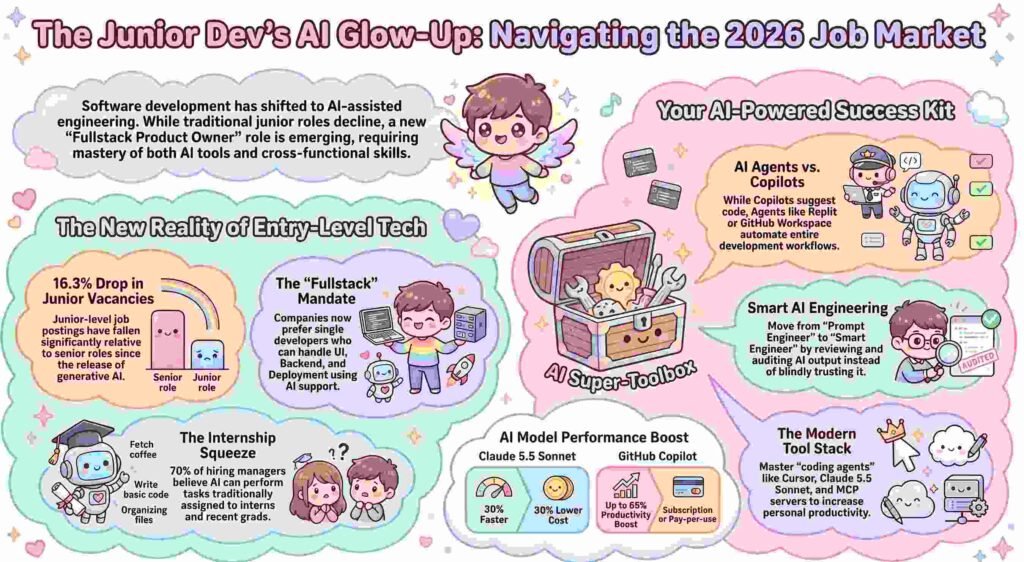
The contraction of entry-level software opportunities is both empirical and severe. A natural experiment analyzing online job postings evaluated the market impact following the public release of ChatGPT in November 2022. Within 12 months of its release, software developer job vacancies requiring fewer than four years of experience experienced a 16.3% relative decline compared to senior-level roles requiring four or more years of experience.
This contraction has altered graduate employment outcomes across the technology sector. Overall unemployment for young adults aged 22–27 reached 7.4%, but computer science and computer engineering graduates faced unemployment rates of 6.1% and 7.5%, respectively. In a striking reversal of historical norms, computer engineering graduates now face unemployment rates equal to fine arts graduates (7.5%) and higher than liberal arts graduates.
Simultaneously, traditional early-career talent pipelines are drying up. Tech-specific internship postings on the recruitment platform Handshake dropped 30%, even as student applications increased by 7%. This drop is driven by a fundamental pivot in manager perception: 70% of hiring managers believe AI tools can perform tasks traditionally assigned to interns, and 57% report trusting AI output more than the work of entry-level human hires or recent graduates.
| Metric / Dimension | Pre-AI Expectations for Junior Coders | Post-AI Realities for Junior Coders |
| Junior Job Postings (<4 Yrs Exp) | High demand baseline; predictable entry roles | 16.3% relative drop within 12 months post-ChatGPT |
| Tech Internship Availability | Abundant campus recruitment pipelines | 30% decline in tech internship postings on Handshake |
| Graduate Unemployment Rates | Lowest among technical STEM majors | 6.1% (CS) to 7.5% (Comp Eng); higher than liberal arts |
| Hiring Manager Perception | Interns needed for routine task execution | 70% believe AI can perform intern-level tasks; 57% trust AI over entry-level work |
“If you don’t hire junior developers, you’ll someday never have senior developers.”
2. The Fall of the Single-Stack Dev and the Rise of the “Full-Stack Product Owner”
The era of the specialized front-end framework developer—someone who works exclusively in React or Angular—is rapidly drawing to a close. AI tools now compress the entire development lifecycle into automated, prompt-driven steps: generating database schemas, rendering UI prototypes, writing backend APIs in Java, Python, or .NET, integrating interfaces, and setting up CI/CD deployment pipelines. Single-framework coders who cannot operate across the broader system are quickly becoming obsolete.
As enterprise engineering teams shrink, hiring demands are consolidating around versatile engineers who understand end-to-end architecture. Industry operations are converging on an emerging role: the “Full-Stack Product Owner.” In this setup, a technical lead or versatile developer uses AI to manage the complete lifecycle—translating client business requirements directly into database models, backend services, user interfaces, and cloud deployments without relying on dedicated, multi-tier scrum teams, specialized UI designers, or dedicated database administrators.
For instance, modern workflows allow developers to use tools like Neon DB to generate complete database table schemas from just two natural language prompts, copy the generated connection string into environment variables, and wire up full-stack functionality in minutes. Success in this environment relies on mastering core computer science principles rather than memorizing framework-specific syntax. Modern engineers must maintain technical fluency across six foundational operational pillars:
- Tech Stack Combination: Navigating multi-tier configurations (e.g., Angular + .NET Core, Java + React, or Python FastAPI + Node.js) rather than remaining isolated within a single framework.
- Deployment Awareness: Maintaining working knowledge of cloud environments (Azure, AWS) and automated CI/CD pipeline structures.
- AI Integration: Ability to embed AI capabilities (such as Retrieval-Augmented Generation or LLM endpoints) directly into production software.
- SQL & Database Concepts: Mastery of data modeling, primary/foreign key relationships, and query logic without relying entirely on abstract object-relational mapping tools.
- Domain & Business Outcomes: Translating high-level client requirements and functional domain knowledge into sound engineering designs.
- System Architecture: Grasping modular system design, architectural design patterns (e.g., Singleton, Factory, Bridge), and inter-system integration logic.
“Previously people say no just focus on one thing now I think that thing is getting changed now you should know everything if even if you know little bit I think that is more than enough with the help of AI…”
3. Autocomplete is Dead: The Shift from Copilots to Autonomous Agents and MCP
First-generation AI coding assistants functioned primarily as inline autocomplete tools, offering passive syntax suggestions at the cursor position. Modern development environments have transitioned to agentic architectures and protocol-driven integrations.
Autonomous AI coding agents (such as Replit Agent, Copilot Workspace, Claude Code, Cursor, Windsurf, and Lovable) do not merely complete lines of code. They interpret natural language prompts, set up development environments, install dependencies, configure databases, run background builds, and manage cloud infrastructure provisioning.
This structural evolution is accelerated by the Model Context Protocol (MCP) and specialized agent skills. For example, Angular version 22 introduced dedicated MCP protocols (dev start and dev stop). Rather than forcing developers to manually copy and paste compile-time errors from a terminal into an external chat window, MCP servers allow the AI agent to interact directly with the local development environment. The agent can control local servers, read compilation errors natively inside the IDE, inspect browser network calls, and apply code fixes automatically.
Tools like GitHub Copilot Workspace fundamentally elevate the developer’s operating level. Engineers no longer spend their days manually editing source files line-by-line; they act as high-level systems thinkers who define technical plans in natural language, review AI-generated execution blueprints, inspect proposed diffs, and validate automated builds.
| Copilot Coding Assistants | AI Coding Agents |
| Primary Interaction: Inline autocomplete & passive inline chat | Primary Interaction: Natural language task planning & full lifecycle execution |
| Code Generation: Syntax completion at cursor position | Code Generation: Full-stack scaffold & multi-file codebase generation |
| Environment Setup: Manual setup required by developer | Environment Setup: Automated environment setup & package management |
| Database Configuration: Passive SQL string generation | Database Configuration: Dynamic database schema configuration & cloud integration |
| Error Resolution: Manual copy-pasting of error logs into chat | Error Resolution: Direct compilation & MCP server error catching (dev start/dev stop) |
| Automated Deployment: Unsupported | Automated Deployment: Integrated cloud infrastructure provisioning & automated deploy |
4. “Vibe Coding” vs. Token Economics: Why Smart Engineers Don’t Dump Full Codebases into AI
The practice of “vibe coding”—entering broad natural language prompts and accepting generated application code without manual review—is widely criticized by senior technical leads. While vibe coding can produce lightweight prototypes or simple side projects, it fails to produce secure, maintainable, or production-ready enterprise systems.
Furthermore, vibe coding ignores the financial and computational realities of Token Economics. Enterprise API access and developer tool subscriptions carry strict usage caps and context window allocations (e.g., enterprise quotas capped at 10,000 monthly tokens per developer). Ingesting entire monolithic codebases into an agentic context window burns through token budgets in minutes, triggering hard API rate limits and halting work.
Understanding the difference between “Ask Mode” and “Agent Mode” is critical for credit preservation. “Ask Mode” processes chat queries using minimal token overhead for localized logic generation. Conversely, “Agent Mode” automatically reads, parses, index-scans, and rewrites multiple file system artifacts, consuming massive context budgets.
Prompt Engineer Flaws:
- Blind Context Dumping: Dropping entire directory structures or monorepos into context windows, wasting thousands of credits per query.
- Abusing Agent Mode for Minor Tasks: Triggering heavy multi-file background rewrite loops (“Agent Mode”) for simple changes easily answered in chat.
- Token Budget Exhaustion: Burning through enterprise token allocations in minutes, causing premature API locks.
- Unreviewed Production Pushes: Accepting generated SQL queries, database migrations, or core business logic and deploying them directly to production without manual validation.
Smart AI Engineer Workflow:
- Targeted Context Scoping: Isolating bugs down to 2–3 specific files before feeding code to an AI agent, preserving token budget and context quality.
- Local Brainstorming & Architecture: Establishing logic patterns and system architecture locally before asking AI to scaffold implementation details.
- Mode Optimization: Preferring lightweight “Ask Mode” chat queries for isolated code logic to save credits, reserving “Agent Mode” strictly for necessary multi-file operations.
- Rigorous Code Review Pipelines: Manually inspecting generated SQL queries, security protocols, and business logic before merging code or executing production migrations.
“There is a difference between a smart AI engineer I would say, but you are just a prompt engineer who did prompted something and you got some output out of it… please try to use AI carefully.”
5. Mid-Tier AI Models (Sonnet 5.5) Are Erasing the Benchmark Gap at 30% Lower Cost
The technological trajectory of AI-assisted engineering is no longer defined strictly by brute-force model scale; it is driven by model efficiency, execution speed, and token optimization. Mid-tier technical models, exemplified by Anthropic’s Claude Sonnet 5.5, are closing performance gaps with top-tier flagship models while operating at lower operational costs.
Sonnet 5.5 generates output over 30% faster and cuts per-task costs by up to 30% compared to previous model generations through optimized token usage. Industry benchmarks highlight these gains across coding and system tasks:
- Terminal-Bench 4.0 (Agentic Coding): Sonnet 5.5 achieves 70.6%, compared to Sonnet 5’s 10.3%.
- CursorBench 4.0 (Real-World IDE Sessions): Sonnet 5.5 scores 55.5%, nearly matching the flagship Claude Opus 5.5 score of 57.8%.
- FrontierCode 1.1: Delivers a 10-point benchmark increase over Sonnet 5 at roughly one-fifteenth the per-task cost.
These cost reductions enable software organizations to run continuous background agents affordably. Companies can deploy automated background agents for continuous bug remediation, UI redesigns, documentation updates, and test suite generation without exceeding engineering budgets. Adjustable model “effort settings” further allow development teams to adjust reasoning depth, speed, and API expenditure based on specific task demands.
6. Pivot Pathways: Alternative Careers for Displaced Computer Science Graduates
For junior software engineers facing structural displacement in traditional entry-level coding roles, technical training remains highly relevant in adjacent fields. Labor market researchers analyzing hiring shifts utilized an Occupational Co-Occurrence Network—evaluating skill comparative advantages across 734 unique occupations—to map lateral career shifts requiring minimal re-skilling.
By leveraging core competencies in data extraction, system structure, algorithmic reasoning, and logical optimization, computer science graduates can transition into four high-demand roles:
- Management Analyst: Leverages high-frequency dataset extraction, data mining, and process optimization methodologies to refine operational workflows for enterprise and public sector organizations.
- Project Manager: Applies technical workflow knowledge, software system design understanding, and requirements translation to bridge communication between business stakeholders and technical execution teams.
- Industrial Engineer: Translates system design, algorithmic planning, and process optimization concepts to improve complex physical, supply chain, and operational workflows.
- Market Research Analyst: Applies data extraction, statistical analysis, and quantitative modeling to forecast market trends, analyze platform metrics, and evaluate user behavior patterns.
The Future Belongs to the AI-Enabled Architect
The historical paradigm of “learn basic syntax, complete a boot camp or CS degree, and step directly into a $100,000 junior developer role” has drawn to a close. However, software engineering as a discipline is not dying. Instead, it is undergoing a structural evolution—transitioning from manual syntax writing toward system orchestration, high-level architecture, and strategic AI management.
The future of technology belongs to engineers who elevate their perspective above line-by-line code writing. To remain resilient in this transformed landscape, developers must confront a fundamental question: Are you actively cultivating deep system architecture mastery and domain comprehension, or are you operating as an easily replaceable prompt operator?
Discover more from TechResider Submit AI Tool
Subscribe to get the latest posts sent to your email.