Many global enterprises share a common frustration: they invest heavily in translating their digital footprint into a dozen languages, yet they see limited traction in international markets. The technical box-checking is complete—the words have been swapped—but the audience remains ghosts in the data.

Digital anthropology tells us that “translation” is a linguistic task, while “localization” is a cultural one. To succeed globally, organizations must abandon regional silos and fragmented tactics. Success requires a Center of Excellence—a centralized, strategic approach that simplifies, structures, and scales SEO across the entire brand. It is time to stop chasing individual algorithms and start building a holistic search experience that respects the nuance of the human behind the query.
——————————————————————————–
1. Forget Engines—Start Optimizing for “Experience” (The URA Framework)
The most successful global brands have made a fundamental mindset shift: they no longer view SEO as Search Engine Optimization. Instead, they practice Search Experience Optimization.
When you focus on the experience, the conversation with internal stakeholders changes. You aren’t merely asking IT to fix a 404 error for a crawler; you are explaining that a 404 error is a customer service failure preventing a high-intent user from reaching a conversion point. This shift makes SEO relevant to every department, from creative writers to the C-suite.
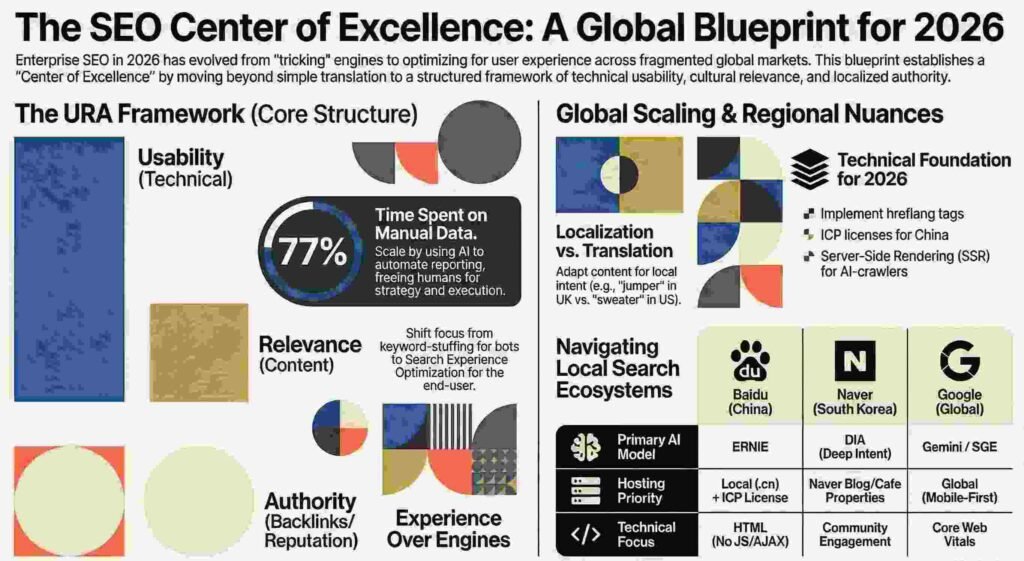
Strategic execution depends on the URA Framework, which must be implemented in this specific order of operations:
- Usability: The foundational layer. Is the site responsive, fast, and indexable? If a user cannot find or use the page, its content is irrelevant.
- Relevance: The intent match. Does the content satisfy the audience’s specific needs and local search behaviors?
- Authority: The trust signal. Does the site earn regional citations, references, and co-citations that prove its reputation?
“Enterprise SEO is hard. It’s hard because of this problem of scale. Organizations need to appreciate all that goes into making SEO work—every team needs to understand and be involved in SEO throughout the entire enterprise.” — Mitul Gandhi, Co-Founder and Chief Product Architect, seoClarity.
——————————————————————————–
2. The “77% Data Trap”: Reclaiming Human Capital
Research into enterprise-level operations reveals a startling inefficiency. Most SEO professionals spend a staggering 77% of their time on data acquisition, reporting, and analysis, leaving a mere 20% for execution.
In a global market, human capital is too valuable to be spent on manual data aggregation. Scaling an international strategy requires leveraging AI and machine learning to consolidate fragmented tech stacks into a “Single Version of the Truth.” By automating the menial tasks of data collection, strategy leaders can reclaim their time for the high-level cultural and strategic execution that machines cannot replicate.
——————————————————————————–
3. The “Pinto” Principle: Why Translation is Your Greatest Liability
Literal translation is a trap that leads to “False Friends”—terms that appear correct but carry unintended, often disastrous, meanings. The classic case is the Ford Pinto; in Brazil, “pinto” is slang for a sexual reference. To salvage the launch, Ford pivoted to the name Ford Corcel, meaning “stallion.”
If you rely on automated tools without native brainstorming, you risk optimized failure. You might sell “pants” in the US (trousers) while your UK audience thinks you are marketing underwear.
Cultural Localization vs. Literal Translation
| US Term | UK / Global Equivalent | The Strategic Context |
| Chips | Crisps | In the UK, “chips” are hot fries. Failure to distinguish leads to mismatched user intent. |
| Pants | Underwear | US “pants” are UK “trousers.” Using the US term in London signals a lack of local trust. |
| Sweater | Jumper | Native brainstorming uncovers high-volume regional phrasing over literal dictionary terms. |
| Cell Phone | Handy (Germany) | Literal translation misses the colloquialisms actually used by real people. |
——————————————————————————–
4. The Algorithm of the East: Navigating Naver and Baidu
A “location-agnostic” approach (the Google style) fails in regions where the search engine acts as a curated portal or requires strict local compliance.
Naver (South Korea): The “Neighborhood” Portal
Naver users treat the search engine more like a community neighborhood than a tool. It prioritizes its own properties, meaning your strategy is incomplete without engaging the Naver ecosystem.
- C-Rank (Creator Rank): Evaluates the creator’s authority and topical expertise across 31 categories.
- DIA (Deep Intent Analysis): Analyzes user behavior, such as time on page and shares, to measure intent satisfaction.
- Strategic Musts: You must utilize Naver Café (community forums) and Naver Blogs to build brand credibility.
Baidu (China): The Technical Fortress
Baidu presents significant technical and regulatory hurdles that translation cannot solve.
- Rendering & Speed: Baidu struggles with JavaScript. Essential content must be available via Server-Side Rendering (SSR). The Lightning Algorithm rewards pages that load in under 2 seconds.
- The Hosting Advantage: Sites hosted in China load 200% faster than those with international hosting. An ICP (Internet Content Provider) license and local SSL certificates are prerequisites for trust.
- The Moneyplant Update: Baidu’s recent updates target link spam aggressively; links from .cn domains carry the highest authority.
- Language Priority: Over 83% of top-ranking pages are in native Simplified Chinese.
——————————————————————————–
5. The “Signal Flag” Code: Solving the Hreflang Nightmare
Think of hreflang tags as signal flags for search engines, indicating which regional version of a page to serve. Technical precision here is the bedrock of global trust; a simple error like using “en-UK” (incorrect) instead of the ISO-compliant “en-GB” (correct) can leave your content invisible in the United Kingdom.
There are three primary methods for implementation, and you must choose only one to avoid conflict:
- HTML Link Elements: Tags in the
<head>of every page. - HTTP Headers: Ideal for non-HTML content like PDFs.
- XML Sitemaps: The most efficient way to manage tags at an enterprise scale.
The Golden Rule of Hreflang: “Add return hreflang links to all original web pages and alternates and have them point to each other.”
——————————————————————————–
Conclusion: The Future of Being “Referenced”
As we are in first quarter of 2026, the landscape is shifting from ranking to Generative Engine Optimization (GEO). In this era, your goal isn’t just to be listed; it is to be cited and recommended by AI models like Google’s Gemini or Baidu’s ERNIE.
This requires a move toward Entity-Based SEO, where your brand is a verified authority rather than just a collection of keywords. Forward-thinking leaders are already implementing llms.txt files—a new communication layer that signals to AI models how to interpret and cite their content responsibly.
In an AI-first world, is your website built for a bot to crawl, or for a human to trust?
Discover more from TechResider Submit AI Tool
Subscribe to get the latest posts sent to your email.