1. 2026: The Year Reality Got an Upgrade
For nearly a decade, augmented reality (AR) has been trapped in a cycle of “clunky novelty.” We tolerated the front-heavy visors, the low-resolution “ghost” images, and the tethered cables because the promise was so seductive. But between late February and early March 2026, the narrative changed. We moved past the prototype phase and into an era of seamless integration.
This shift wasn’t a single event but a cluster of breakthroughs. On February 28, 2026, physicists demonstrated a metasurface spatial light modulator capable of high-fidelity, multicolor holograms, while health-tech innovator OnPoint AI debuted a surgical platform that projects machine-learning guidance directly onto a patient’s anatomy. Days later, the 2026 Mobile World Congress (MWC) showcased hardware that looks less like a computer and more like high fashion. As a seasoned observer of this space, it is clear to me that AR is no longer a niche tool for the laboratory; it is becoming the invisible fabric of our daily lives.

2. The Clinical “Quiet Revolution”: Beyond Experimental Surgery
While consumer gadgets capture the headlines, the most profound maturation of AR has occurred in the sterile environment of the operating room. According to the 2026 systematic review by Nouf Matar Alzahrani, AR has officially crossed the threshold from “experimental curiosity” to “clinically viable intervention.”
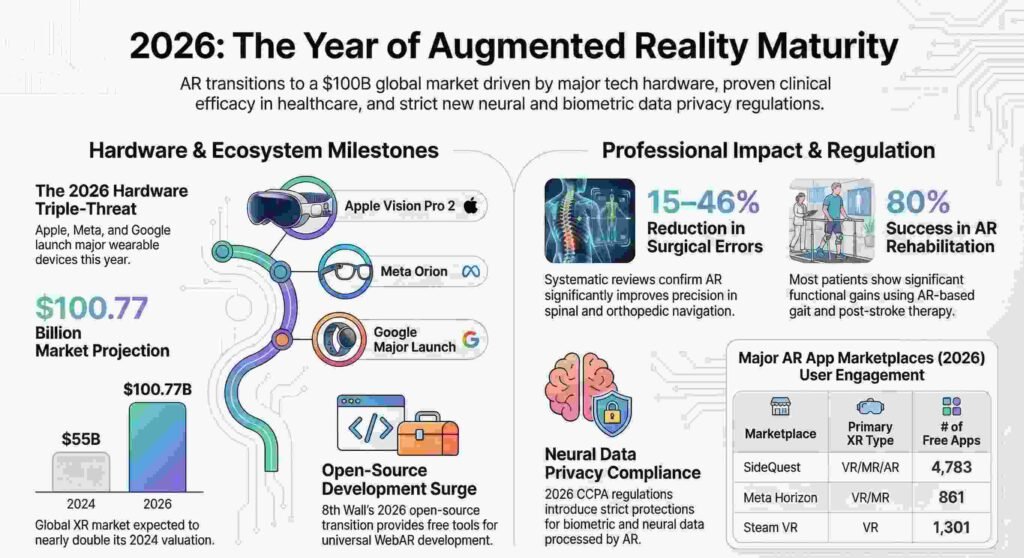
The data is more than just impressive; it represents the death of traditional, opaque medical models. Surgical error rates have plummeted by 15–46% in complex procedures like spinal navigation and orthopedic alignment. In rehabilitation, the shift is even more dramatic. AR-supported therapies—providing real-time kinematic feedback—have delivered functional gains in over 80% of cases, effectively disrupting the traditional physical therapy model by allowing for high-precision, semi-autonomous recovery.
Perhaps the most telling analyst insight is the safety profile: despite rapid deployment, no serious adverse events have been reported. This success is rooted in a shift from Artificial Intelligence (AI) to Intelligence Amplification (IA).
“AR embodies the philosophy that human intelligence amplification (IA) holds greater potential than artificial intelligence (AI), as it combines human intuition and experience with the computational power of computers… [it is] a sociotechnical intervention where clinical efficacy, safety, and workflow performance emerge from the interaction between technology, human cognitive factors, and healthcare workflow integration.” — Augmented reality in healthcare since 2020: A systematic review
3. The Great Democratization: Niantic and the Open Source Shift
On February 28, 2026, the AR ecosystem experienced a seismic shift when 8th Wall—a subsidiary of Niantic Spatial, Inc.—retired its hosted platform to go fully open source. This was not a retreat, but a strategic offensive. By making its XR Engine, Image Targets, and Face Effects free for everyone with no login requirement, Niantic is effectively “breaking the login gate” to challenge the closed ecosystems of Apple and Meta.
This democratization is being fueled by the XRZOO dataset, a massive curated collection of 12,528 free XR applications. For the first time, researchers and developers have a representative map of the fragmented XR landscape, allowing them to benchmark performance across different technology stacks. By lowering the barrier to entry to zero, Niantic is providing the raw fuel necessary for a decentralized AR revolution, ensuring that the next “killer app” isn’t locked behind a proprietary storefront.
4. Goodbye “Headset Zombies”: The Rise of Invisible Computing
We are witnessing the end of the “headset zombie”—that isolated user wearing a bulky visor in public. The 2026 hardware cycle from Google and Snap favors “wear everywhere” monocular and lightweight glasses.
Google’s 2026 monocular AI glasses feature a vibrant right-lens display that prioritizes context over immersion. The killer feature is a “Live View” integration for Google Maps. Imagine walking through a crowded city; by simply tilting your head down, a “pill” of directions and a map reveal themselves in the corner of your vision. It functions exactly like the “GTA corner guide” in a video game—providing essential data without obstructing your view of the real world.
Similarly, the RayNeo Air 4 Pro Batman Edition (launched February 27, 2026) proves that AR is now a fashion statement. These glasses feature a customized Vision 4000 chip and audio fine-tuned by Bang & Olufsen, blending premium sound with “everyday cosplay.” By projecting phone applications directly into the field of view, these devices usurp the traditional headset paradigm. They offer the core functionality of a spatial computer in a frame that weighs just 76 grams.
5. The End of the Wild West: 2026 Privacy Compliance
Regulation is often viewed as a hurdle, but for AR, the new laws effective January 1, 2026, in California and Colorado are a sign of ultimate success. We only regulate what is powerful enough to be dangerous, and AR has reached that tipping point.
The California Consumer Privacy Act (CCPA) has expanded to include neural data—information about how your brain responds to stimuli—in its definition of sensitive data. This is a critical pivot: the industry is moving from “tracking where you look” to “tracking how you think.” Furthermore, any business presenting a “significant risk” must now conduct independent, annual cybersecurity audits. Even insurance companies must now comply with CCPA for non-transactional data like digital tracking cookies. These mandates signal that AR is being taken seriously as a permanent part of the social and legal fabric.
6. The “Magic” in the Optics: Metasurfaces and HDR10
The visual “ghosting” that made early AR feel like a fever dream is finally being solved by breakthroughs in thin optics. On February 28, 2026, physicists detailed a Metasurface Spatial Light Modulator that produces dynamic, multicolor holograms. This lab-to-prototype leap solves the color and brightness limits of previous years, allowing digital objects to appear solid rather than transparent.
We see this already in the consumer market with the RayNeo Air 4 Pro, the world’s first HDR10-enabled AR glasses. Utilizing its specialized Vision 4000 chip, the device delivers over a billion colors and deep shadows. This is the difference between a floating 2D window and a digital object that truly belongs in your room, spatially anchored and visually indistinguishable from physical furniture.
7. Conclusion: A Thought-Provoking Horizon
2026 is the year AR stopped being a destination and started being a layer. It is “context-aware” and “spatially anchored,” following us from the operating room to the street corner.
The horizon remains intensely competitive. Apple is expected to launch the Vision Pro 2 by Spring 2026, featuring a formidable M5 chip. Meanwhile, Meta is expanding access to its Orion developer kits. It is important to distinguish Orion—a $10,000 “time machine” prototype with a 70-degree field of view—from the upcoming consumer target, codenamed Artemis, which aims to be leaner and more affordable.
As AR becomes as stylish as a pair of Ray-Bans and as accurate as a surgeon’s scalpel, we must confront a new reality: the line between the digital and the physical hasn’t just been blurred—it has finally disappeared. Are we ready for a world we can no longer “unplug” from?
Discover more from TechResider Submit AI Tool
Subscribe to get the latest posts sent to your email.