Summary Quick-View
- The Architecture of Ranking Chaos
The search landscape in 2026 is no longer defined by the optimization of prose, but by the verification of entities. For many, the last two years have been a period of systemic “ranking chaos.” SE Ranking’s analysis of 100,000 keywords underscores the severity of this shift: 16.71% of URLs previously occupying the top 10 positions dropped beyond position 100 following recent updates—an 82% increase in volatility compared to previous cycles.

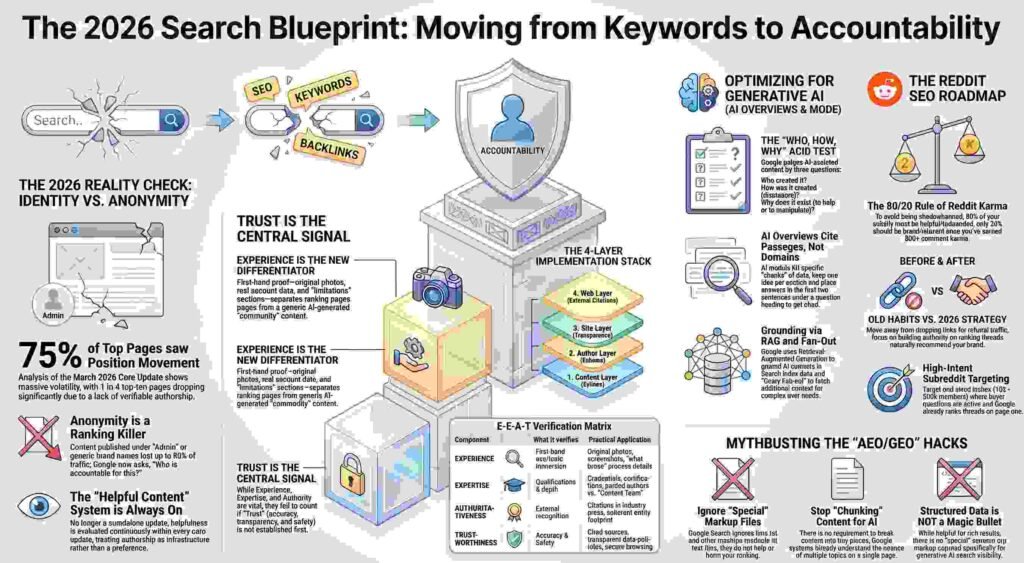
High-quality, well-written sites have seen traffic hemorrhages of 40% to 90%, not because their content quality declined, but because the “writer” effectively disappeared. While disciplined publishing calendars once guaranteed visibility, they have failed in an era where “boring,” technically transparent sites are winning. This is an architectural shift in the web’s infrastructure. To survive, digital strategists must move beyond the vanity of copywriting and toward the rigor of reputation building.
- E-E-A-T is Now a “Bank-Level” Identity Verification System
Experience, Expertise, and Authoritativeness no longer function as stand-alone writing standards; they are signals feeding a central Trust component. Per Google’s Search Quality Rater Guidelines, if the Trust signal fails, the other three components cease to matter entirely. This is particularly acute for YMYL (Your Money or Your Life) topics—finance, health, and safety—where the algorithm now applies a level of scrutiny previously reserved for financial institutions.
Google is no longer asking, “Is this well-written?” It is asking, “Who is accountable?” In this landscape, E-E-A-T has evolved into a rigorous identity verification system.
“In practice, E-E-A-T functions as an identity verification system. The questions being asked about your page are closer to the ones a bank asks before opening an account.”
- The “Admin” Byline is a Structural Death Sentence
The March and August 2026 updates codified a new reality: anonymous publishing is a liability. As site owners deleted author pages or defaulted to “admin” bylines during redesigns, they inadvertently stripped away the human infrastructure Google now requires. Verifiable history and Person Schema are no longer “formatting preferences”; they are essential architectural requirements.
Under the March 2025 Spam Policy regarding “scaled content abuse,” quantity without accountability is the primary offense. Google does not penalize AI content; it penalizes content with no accountable human behind it. Every page must now pass the “Who, How, Why” test:
- Who created the content? (A verifiable human entity?)
- How was it created? (Is there transparency regarding AI assistance?)
- Why does it exist? (To assist a user or to capture a query?)
The acid test for any modern strategist: could a stranger, given ten minutes and a search engine, verify that a specific, qualified human stands behind this page?
- The AI Overview Paradox: Chunks, Citations, and Retrieval-Augmented Generation
Google’s generative search now relies on Retrieval-Augmented Generation (RAG)—a process that uses core ranking systems to “ground” AI responses in search index data. This often involves Query Fan-out, where the model generates concurrent related queries to fetch deeper results.
A technical paradox has emerged: AI Overviews cite “passages” or “chunks” rather than domains. According to the Similarweb 2026 Generative AI Landscape Report, there is a significant disconnect between citation location and referral traffic.
“65% of cited URLs sit two or three folders deep… In contrast, 58.8% of AI referral traffic lands on homepages.” — Lily Ray, VP of SEO & AI Search at Amsive.
To become “citation-friendly” for extraction models, architects must adopt three technical habits:
- Directness: Answer the query in the first two sentences under a question-shaped heading.
- Modularity: Maintain one distinct idea per section to avoid confusing extraction models.
- Precision: Use specific, attributable numbers rather than vague adjectives; data points are more likely to be quoted than prose.
- Reddit: The New Page One Authority and Live Keyword Engine
We have entered a reality where a single Reddit thread can outrank a site with years of earned domain authority. Google now prioritizes “Genuine Debate” and “Multiple Contributors” as superior trust signals compared to polished marketing copy. For Local SEO, threads in communities like r/Austin have become the primary source for “best-of” queries that traditional sites can no longer capture.
Strategists must treat Reddit as a live keyword research engine, capturing conversational, long-tail phrasing that traditional tools miss. However, entry requires a 500+ comment karma threshold and a 60-day account history. Brands must adhere to the 80/20 rule: 80% helpful, unbranded input vs. 20% brand-relevant content. Participation is the only currency Google recognizes in these conversational results.
- Technical Hygiene: The September 1 Merchant API Deadline
For ecommerce, technical visibility now depends on a “complete ecosystem”—Schema, Merchant Center feeds, and real-time inventory status. A critical architectural deadline arrived on September 1, 2026, with the final sunsetting of the old Content API for Shopping.
Organizations that failed to migrate to the Merchant API now face “410 Gone” errors, leading to a total loss of visibility in shopping results. Crucially, the new Merchant API now supports product reviews, integrating social proof directly into the technical feed. Technical hygiene is no longer about page speed alone; it is about the integrity of your API connections and the transparency of your merchant data.
- Verifiability is Built, Not Written
The transition from copywriting to reputation building requires a commitment to the Four Layers of Verifiability:
- The Content Layer: Providing first-hand proof (original assets and account data).
- The Author Layer: Establishing Person Schema and verifiable professional bios.
- The Site Layer: Organization Schema and transparency regarding ownership.
- The Web Layer: External citations and an entity footprint across the broader internet.
Attempting to skip to Layer 4 (Digital PR) without securing Layers 1 through 3 is a systemic waste of budget. Google’s algorithms are now fixated on a singular question that precedes all ranking: “Who is accountable here?”
If a stranger had ten minutes and a search engine, could they prove you are the real expert you claim to be?
Discover more from TechResider Submit AI Tool
Subscribe to get the latest posts sent to your email.